


The Federal Government has raised ₦1.23 trillion so far under a ₦3.3 trillion plan to clear verified legacy debts owed to power generation companies (GenCos), the Minister of Power, Joseph Tegbe, has said.

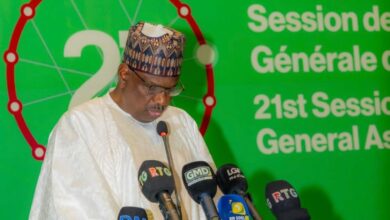
Tegbe made the disclosure on Thursday in Abuja at the 6th annual power conference of the Power Correspondents Association of Nigeria (PCAN).
He was represented by his Special Adviser on Administration and Projects, Martins Olajide.
According to the minister, the funds have eased the pressure on generators and improved their ability to pay for gas and maintain their plants.
He said that over the past three and a half years, President Bola Ahmed Tinubu has confronted long-standing financial and infrastructure constraints in the sector.
Tegbe said more than 2.8 million customers have been metered under the Presidential Metering Initiative to bridge collection losses.
He added that the Rural Electrification Agency has connected universities, hospitals and rural communities to solar power, while construction has begun on a new National Grid Control Centre in Osogbo to replace the old one, which is over 60 years old.
He said more than 15,000MVA of transmission capacity has been added to the national grid between 2023 and October 2026.
In the last two months alone, he commissioned new substation equipment in locations including Kumbotoso, Dankata, Mashi, Dan-Agundi, Apapa, Ijora, Ikeja, Biliri and Walalambe, adding over 1,300MVA and unlocking more power for distribution companies (DisCos).
On vandalism, the minister said the President has approved a coordinated campaign involving relevant security agencies, backed by a stronger legal framework to protect power assets, deter sabotage and hold offenders accountable.
Tegbe said the government has developed a four-pronged roadmap covering grid stabilisation, sector liquidity and sustainability, asset optimisation, and expansion and enhancement of the grid. A technical audit has been commissioned to establish a diagnostic baseline and guide the sequencing of interventions.
Central to the plan is a corridor approach that prioritises major load centres for round-the-clock supply. It aims to align generation, transmission and distribution capacity with demand in three zones: Lagos and Ogun, Benin, Enugu and Port Harcourt, and Abuja, Kaduna and Kano.
The Lagos-Ogun axis and the Abuja franchise area, which together account for over 50 percent of national demand, will serve as pilots for 24-hour energy zones, depending on technical readiness and commercial viability.
The minister urged journalists to play an educative role by giving citizens the facts they need to form their own judgements and take part in public life.
In his keynote address, the Managing Director of FGN Power Company, Kenny Anuwe, said Nigeria can build a trillion-dollar economy by leveraging bankable and scalable investment models in electricity.
He listed infrastructure delivery, coordinated interventions, and financing and commercial sustainability as key requirements.
Anuwe said the government has invested over ₦10 trillion in the sector since privatisation, but the amount remains limited relative to national ambitions.
He noted that the government provides more than 95 percent of new infrastructure investment in the sector, which he said was not the purpose of privatisation.
Under the Presidential Power Initiative, he said, the pilot phase has been completed, and most phase one transmission projects are expected to be finished in Q1 2027. A second batch of 12 Siemens substations is targeted to begin in Q4 2026.
The initiative aims to deliver 5,540MW by 2029, improving grid reliability by at least 60 percent and bringing about 2,000 industries back onto the grid.
He added that FGN Power Company is working on a $2.3 billion project, with $1.3 billion from Europe and $1 billion from China, with the Federal Government providing sovereign backing and 15 percent counterpart funding.
He called for a shift to other models such as viability financing and blended finance to attract institutional and private capital.
In his welcome address, the PCAN Chairman, Obas Esidiesa, said the conference, which began in November 2021, has grown into an important platform for engagement among policymakers, regulators, operators, investors and journalists.
He noted that the theme is significant given the government’s ambition to grow the economy to $1 trillion by 2030.
Esidiesa drew attention to the recurring drop in electricity generation between November and March, when reduced water inflows affect hydropower stations and gas supply constraints hit thermal plants.
He urged government, regulators, GenCos and gas suppliers to work out sustainable arrangements to guarantee gas feedstock during that period.
He also pointed to inadequate transmission and distribution infrastructure, liquidity challenges, investment gaps and regulatory uncertainty as issues to address.
The decentralisation of the electricity market under the Electricity Act 2023, he said, offers opportunities for investment and innovation, but must be matched with effective coordination and clear regulatory frameworks.
The high point of the event was the presentation of awards to deserving dignitaries.