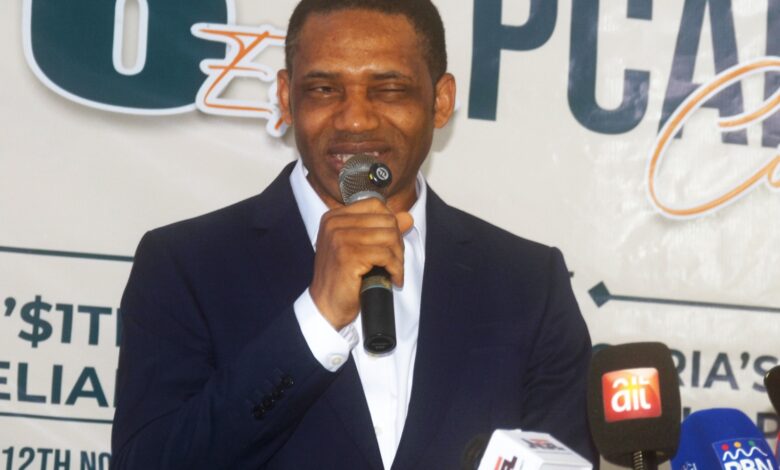


Nigeria cannot reach a trillion-dollar economy if the government continues to provide almost all new investment in the power sector, the Managing Director of FGN Power Company Limited, Kenny Anuwe, has said.

Anuwe spoke on Thursday in Abuja while delivering a keynote address at the 6th annual power conference of the Power Correspondents Association of Nigeria (PCAN).
He said the government has invested over ₦10 trillion in the electricity sector since privatisation, and that the industry would not be standing without it.
However, he described the amount as frustratingly limited compared with the country’s ambitions, noting that the government supplies more than 95 percent of new infrastructure investment in the sector. According to him, that is not the purpose for which the sector was privatised.
“Government cannot do everything,” he said, calling for a change of mindset. He explained that the government should provide the enablers, including infrastructure delivery and market conditions in which public and private capital can perform effectively.
These, he said, include clear responsibility and accountability, predictable regulation, bankable projects, faster decisions and measurable delivery.
Anuwe said Nigeria can build a trillion-dollar economy by leveraging bankable and scalable investment models.
He listed three requirements: infrastructure delivery treated as an economic resource, with clear national targets and integrated resource planning; coordinated interventions, with policy, governance and business strategy fully aligned and technology that is reliable, affordable, resilient and scalable; and financing and commercial sustainability, anchored on financial discipline and strong private sector involvement through guarantees, tariff frameworks and effective market settlement.
He added that infrastructure alone cannot solve the sector’s problems, as the institutional, commercial and regulatory arrangements are too complex for investors.
He pointed to the many players involved, from generation and distribution companies to regulators, financiers, gas suppliers, state governments and development partners, and called for simplification.
Anuwe said the Presidential Power Initiative (PPI) coordinates implementation, structures commercial deals, secures financing and delivers incremental power, with a focus on load centres with growth potential.
The pilot phase has been completed, he said, while phase one of the transmission substations and lines is under way. Despite some delays, most of the projects are expected to be completed in Q1 2027. A second batch of 12 Siemens substations, together with the Omotosho special projects, is expected to start in Q4 2026 and deliver just under 3,400MW.
He said about $237 million has been invested in 16 transmission lines covering roughly 606 kilometres, with capacity improvements of just over 7,000MW. A flagship 480MW transmission substation is also under construction, with commissioning tests expected to begin in December and end in February 2027. He invited PCAN members to join a site visit in two weeks.
By 2029, the PPI targets 5,540MW, improving grid reliability by at least 60 percent and bringing at least 2,000 industries back onto the grid.
Anuwe said the company is working on a $2.3 billion project, with $1.3 billion from Europe and $1 billion from China. The Federal Government provides sovereign backing and 15 percent counterpart funds in each case.
He said FGN Power Company should be capitalised with at least $1 billion, which the Africa Finance Corporation (AFC) has promised to match, while other financiers would need to bring in $18 billion to the sector.
He urged a move toward models such as viability financing and blended finance to attract institutional and private capital.
He added that the private sector, and not only the Federal Government, should be held to account for bringing in the capital needed to achieve the $1 trillion economy ambition.
Also speaking, the Managing Director of the Nigerian Electricity Management Services Agency (NEMSA), Engr. Olusegun Adesayo, has urged journalists to give greater attention to electrical safety, saying improved power supply must go hand in hand with safety, quality and reliability.
According to him, the media has an important responsibility to educate Nigerians on electrical safety, regulatory compliance and the ongoing reforms in the power sector.
He said NEMSA’s commitment remains unwavering: to ensure that electrical installations, equipment and networks across the country comply with prescribed technical standards and regulations, so as to safeguard lives and property.
Referring to Anuwe’s remarks, Adesayo said that beyond infrastructure, safety must be given priority. “You cannot have infrastructure that is not safe,” he said, adding that infrastructure must also comply with regulations.
He noted that the Federal Government, under President Bola Ahmed Tinubu, continues to pursue reforms in the power sector through the Renewed Hope Agenda, and stressed that these reforms must be matched by attention to safety and reliability.
The NEMSA chief therefore urged correspondents to give greater prominence to electrical safety awareness, responsible reporting and public education. He called for a culture in which safety is everyone’s responsibility.
Adesayo congratulated the leadership and members of PCAN on the successful hosting of the conference.