

Minister of State for Petroleum Resources (Oil), Senator Heineken Lokpobiri, has stated that the string of regulatory and fiscal reforms introduced since 2023 has begun reversing years of stagnation in the nation’s oil and gas sector, pointing to rising output, a surge in exploration licences, and tens of billions of dollars in new investment commitments.
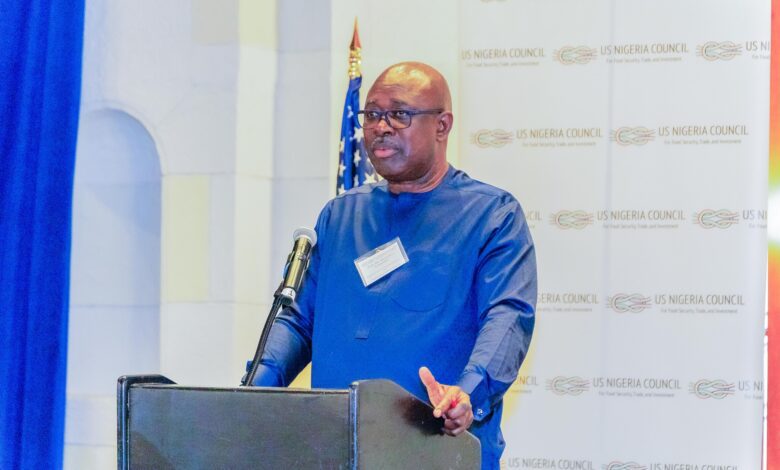
Lokpobiri spoke on Tuesday at the opening of the 2026 edition of the Nigerian Oil and Gas Week (NOG) in Abuja, informing delegates that Nigeria is now producing more than 1.8 million barrels of crude per day, according to the figures by the Nigerian Upstream Petroleum Regulatory Commission (NUPRC).
He said he has pushed the regulator to aim higher, recalling the country’s previous peak of roughly 2.5 million barrels per day, arguing there was no reason it cannot be reached again.
The Minister told the delegates that the number of active rigs has grown from about 40 in 2023 to about 60 today, which he described as evidence that investors are returning to the sector that saw a decade-long drought in new commitments.
He credited President Bola Tinubu’s administration for restoring a stable, predictable, legal and regulatory environment after years in which, he said, international capital bypassed Nigeria in favour of markets such as Guyana and Angola.
Lokpobiri addressed the wave of asset sales by international oil majors, including Shell, ExxonMobile and Eni, to Nigerian independents such as Renaissance and Seplat over the past years.
He rejected the idea that these divestments amounted to the IOCs abandoning Nigeria, saying the companies had instead redeployed toward deepwater acreage while indigenous firms, many staffed by the same personnel who ran assets under the IOCs took over onshore and shallow water production.
The minister commended Renaissance and its partners for the recent onshore drilling campaign, stating that continued exploration was essential for growing Nigeria’s proven reserves beyond the current 37 billion barrels.
He revisited the broader debate over energy transition, arguing that international pressure on African nations to curtail fossil fuel development was inconsistent given that the continent accounts for a small share of global emissions.
He said the conversation among major international energy institutions has shifted in recent years from energy transition toward energy mix.
In her remarks, the Special Adviser to the President on Energy, Olu Verheijin, noted that global capital “is no longer sentimental” and would only flow to projects that are bankable, cost-competitive, and backed by predictable regulation.
She put Nigeria’s financing gap to meet its 2030 production targets at roughly $38 billion, a sum she said cannot be provided by the government alone.
Verheijin said the administration has cut contracting timelines by more than half, clarified fiscal terms under the Petroleum Industry Act (PIA), and streamlined regulatory oversight.
Speaking on the results so far achieved from the regulatory certainty, she said: more than $50 billion in projects currently in the investment pipeline, more than $10 billion in Final Investment Decisions (FIDs) secured in the past three years, crude oil and condensate production up by more than 400,000 barrels per day, onshore production at its strongest levels in nearly two decades, and external reserves of about $50 billion.
She also pointed to the Presidential Power Financial Reform Program, which she said involves roughly N4 trillion in clearing legacy obligations across the power sector value chain, as an effort to rebuild confidence in electricity generation and gas supply.