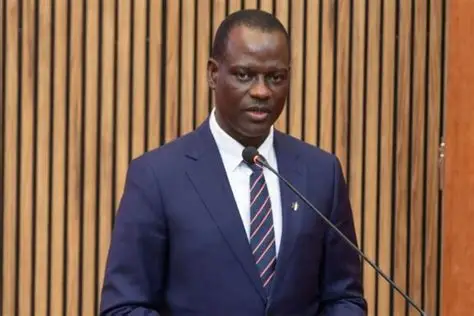


The Minister of Finance and Coordinating Minister of the Economy, Taiwo Oyedele, has proposed the establishment of a specialised Commercial Dispute Resolution Tribunal to fast-track business litigation, arguing that faster justice delivery was essential to attracting long-term investment and deepening Nigeria’s capital market.

He made the proposal on Tuesday while delivering his inaugural lecture as a Fellow of the Capital Market Academics of Nigeria (CMAN) at the association’s Second Biennial Conference in Abuja, themed, “The Nigerian Capital Market as a Catalyst for Equitable and Inclusive Growth.”
Oyedele noted that delays in resolving commercial disputes remain one of the biggest obstacles to investment in Nigeria, noting that cases currently take an average of 15 years to progress through the High Court, Court of Appeal and the Supreme Court.
He warned that such prolonged litigation breeds uncertainty, discourages investors, and raises the cost of doing business. To address this, he proposed a tribunal staffed by judges and arbitrators with specialised commercial and financial expertise, operating with digital case management systems and mandatory timelines.
The minister argued that because virtually every financial instrument, from bonds to syndicated loans, rests on enforceable contracts, speedy dispute resolution is foundational to capital market growth.
Beyond judicial reform, Oyedele urged Nigerians to rethink their attitude toward public borrowing, insisting that debt should be judged by what it finances rather than its size, noting that the real question is never about how much debt exists, but what it is for, what cost, and on what terms it is repayable.
The minister criticised the tendency to condemn all government borrowing without assessing whether the funds are channelled into projects capable of generating returns above the cost of capital, adding that refusing to borrow under such conditions could mean forfeiting valuable development opportunities.
He extended a similar argument to Nigerian entrepreneurs who resist outside investors to retain full ownership, noting that a smaller stake in a larger, well-capitalised company can often be worth more than total control of a small one.
Outlining what he called the “seven laws of capital attraction,” Oyedele said investors are drawn primarily by trust, policy consistency, strong institutions and the rule of law rather than generous tax incentives, stressing that capital seeks predictable returns over the highest returns.
Also speaking at the conference, the Director-General of the Securities and Exchange Commission (SEC), Dr Emomotimi Agama, called for closer collaboration between regulators and academics, saying research-driven policy making is essential to strengthening Nigeria’s capital market.
He described CMAN as a vital bridge between academic research and financial regulation, noting that Commission policies are only as strong as evidence behind them.
Agama pointed to ongoing reforms under the Investments and Securities Act 2025 and a new 10-year Capital Market Master Plan as reasons rigorous research and honest debate are now more necessary than ever, and pledged the Commission’s openness to fresh ideas capable of shaping practical policy outcomes.
CMAN President, Prof. Uche Uwaleke, added his own call for deeper collaboration between academia and the financial industry, arguing that Nigeria has abundant intellectual and practical expertise but lacks a structured framework linking both sides.
He urged the Federal Ministry of Education and the National Universities Commission (NUC) to recognise industry experience in appointing and promoting lecturers in finance-related disciplines, and proposed a Financial Market Research Partnership, led by the Finance and National Planning ministries, to commission research on priorities such as capital market development, pension reform and financial inclusion.