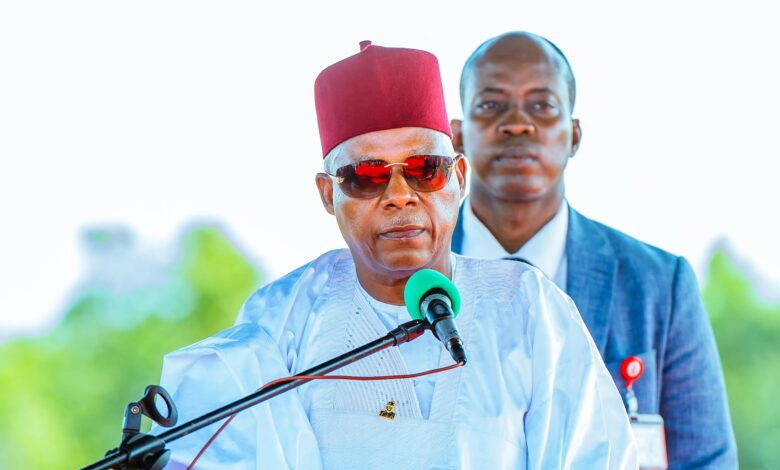


President Bola Tinubu on Friday performed the groundbreaking ceremony for the $3.5 billion Bakassi Deep Seaport in Cross River State, describing the project as a fiscal game changer that could make Cross River and Nigeria a leading hub of the blue economy.
The flag off in Bakassi revived hopes for a deep seaport in the state after decades of false starts.
The President was represented by Vice President Kashim Shettima, who said they had not come to Calabar to cut a ribbon and dance Ekpe masquerade, but to break ground and end a centuries old jinx.
“Many people believed this port would never happen,” the President’s message said. Critics called it a pipe dream and said Bakassi would only be remembered for what Nigeria lost. The message answered them “with a shovel, with concrete, with steel, and with hope.”
President Tinubu dismissed rumours that Abuja, Lagos or the South West had deliberately blocked the growth of seaports elsewhere in the country. He said his presence at the site, shovel in hand, was proof of his administration’s commitment to a decentralised and resilient maritime economy.
“If that were true, would I be standing here today with a shovel in my hand? Lagos is not our enemy,” he said.
The President, in a statement by the Senior Special Assistant to the Vice President on Media and Communications, Stanley Nkwocha, described Lagos as the country’s elder brother in trade and a partner whose success should be replicated across the nation.
He warned that no country can carry its entire load on one shoulder. With over 80 percent of foreign trade passing through Lagos alone, he said, congestion builds, ships queue, goods are delayed and prices rise in markets as far as Calabar, Onitsha and Maiduguri.
“This project is not against Lagos. It is for Nigeria. When Lagos is free, Nigeria breathes. When Calabar works, Nigeria walks on two legs,” he said.
The President said the project was first envisioned in the colonial era and re-engineered in 2014, with its Environmental and Social Impact Assessment completed by March 2015. It centres on a deep seaport with a 20-metre draft, designed to be among the largest in Africa and to receive the giant vessels that now bypass Nigerian waters.
It will be paired with a 260-kilometre superhighway as an evacuation corridor, so cargo landing in Bakassi can move to the North, East and West.
He said the idea drifted for years until Governor Bassey Otu gave it new life. Securing $3.5 billion from Afreximbank provided the funding, and in February 2025 the state formalised a public private partnership.
The Federal Government now stands fully behind the project, he said, describing it as a Nigerian project and not only a Cross River dream.
The President presented the blue economy as a multitrillion naira opportunity. He said maritime activity could generate $44 billion annually once Nigeria captures the regional cargo traffic now going to neighbouring countries.
Recalling the loss of the Bakassi Peninsula, its oil wells and revenue after the International Court of Justice ruling, he praised the people for keeping their character, hospitality and faith.
“The same water that took something from you will now bring something back,” he said, urging them to protect the project from politics and rumour.
He also asked the people to remember who stood with them, “not just with words, but with a shovel, funding, and federal might,” and to vote for continuity and Renewed Hope.
Governor Otu told the people of Bakassi that their cries of yesterday had been answered. He urged investors in primary and ancillary maritime services to commit to the port.
He said the project, conceived by the previous state administration, had been held back by political, administrative, legal and environmental bottlenecks until President Tinubu took over the leadership of the nation.
He thanked the President for guiding the state through the process to the Certificate of Compliance and final federal approval.
The Minister of Marine and Blue Economy, Dr Adegboyega Oyetola, said the project opens a new chapter in Nigeria’s maritime development, economic diversification and regional competitiveness.
He said the Renewed Hope Agenda rests on productive investment, modern infrastructure, private sector participation and efficient use of the nation’s natural advantages.
The Managing Director of the Nigerian Ports Authority, Dr Abubakar Dantsoho, said the port would open up trade with landlocked neighbours such as Chad, Niger, Mali and Burkina Faso. He noted that Africa has 16 of the world’s 44 landlocked countries, four of them in West Africa.
The President and Chairman of the Board of Directors of Afreximbank, Dr George Elombi, called the project an important step for Nigeria, Africa, regional trade and the African Continental Free Trade Area.
Represented by Executive Vice President Mrs Kanayo Awani, he said it could strengthen Nigeria’s maritime corridor, expand port capacity and ease trade with neighbours in West and Central Africa.
Separately, Senator Shettima called on subnational governments to unlock their unique competitive advantages to drive economic transformation.
He spoke on Friday in Calabar at the 6th African Sub Sovereign Governments Network (AfSNET) Investment Conference 2026.
Citing the conference theme, “The Role of Sub Sovereigns in Catalysing Development through Trade and Investment,” he said regional prosperity depends on local leaders turning untapped potential into bankable opportunities, because development is ultimately felt locally.
He said it is at the state, provincial, county and municipal levels that roads connect producers to markets, electricity powers industries, farm produce is turned into valuable products and jobs are created. National policies and continental frameworks give direction, he said, but their success depends largely on what happens at the subnational level.
States and regions, he added, are economic actors, investment destinations, production centres and gateways to regional and continental markets.
He called for stronger state capacity to identify competitive advantages, develop investment ready projects, attract private capital and build partnerships that deliver sustainable results.