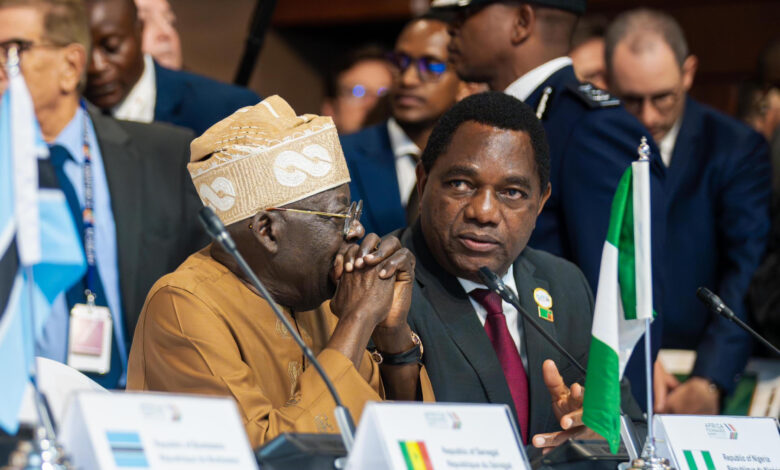


President Bola Tinubu has urged African countries to treat maritime governance and ocean security as critical pillars for economic growth.
He made the call at the High-Level roundtable on Maritime Sovereignty and Ocean Governance at the Africa Forward Summit 2026 in Nairobi, according to a statement made available on Wednesday by the Special Adviser to the Minister of Marine and Blue Economy, Dr Bolaji Akinola.
The President said Nigeria has moved beyond viewing its waters mainly through the lens of insecurity to seeing them as strategic economic assets.
Tinubu said Africa must overcome what he described as “sea blindness” and embrace “ocean sovereignty” to unlock the continent’s blue economy potential.
The President said maritime governance had become central to Nigeria’s economic planning, citing the establishment of the Ministry of Marine and Blue Economy as part of broader reforms aimed at positioning the maritime sector as a major contributor to national development.
“For too long, ‘sea blindness’ has meant that we have looked upon the vast waters under our jurisdiction as voids, or simply as sources of threat,” Tinubu said.
“Nigeria is here to tell a different story: our maritime domain is a sovereign territory, and its governance must be asserted, resourced, and institutionalised.”
In a significant security claim, the President said piracy had been eliminated within Nigerian waters following sustained investments under Nigeria’s Deep Blue Project, a maritime security initiative designed to strengthen surveillance, intelligence gathering and rapid response capabilities across the country’s territorial waters.
According to him, the project deployed command-and-control centres, special mission vessels, fast intervention boats and aerial surveillance platforms to tackle maritime crime and improve security in the Gulf of Guinea.
Tinubu noted that improved maritime security was already reshaping international perceptions of the region and creating conditions for investment in shipping, fisheries, offshore energy and other blue economy sectors.
He stressed that maritime sovereignty should not only be viewed as a security issue but also as an economic necessity, arguing that investors require secure sea routes and stable regulatory systems before committing capital to maritime industries.
The President also called for stronger regional cooperation among Gulf of Guinea countries, warning that piracy, illegal fishing and transnational maritime crimes could not be effectively addressed by individual countries working alone.
“As we endorse the Nairobi Declaration, Nigeria affirms that maritime sovereignty and ocean governance are the non-negotiable foundations of Africa’s Blue Economy transformation,” he said.
Tinubu further urged African leaders to see ocean governance as a long-term responsibility tied to future generations, declaring that “the oceans have no duplicate as a common heritage of mankind.”