
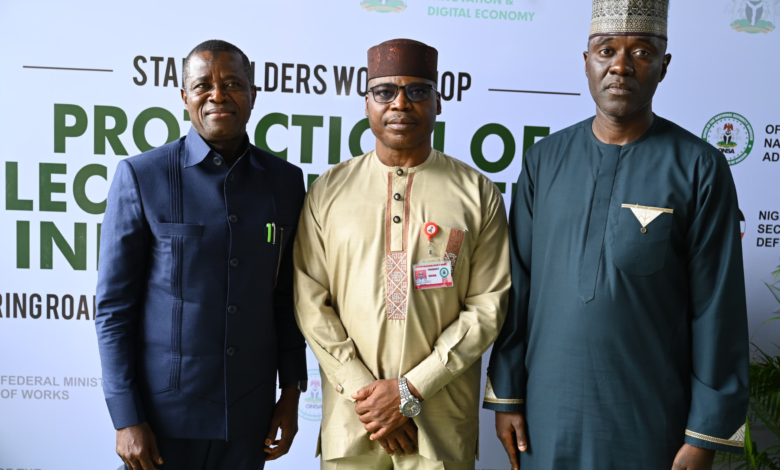


The Nigerian Communications Commission (NCC) has raised the alarm over the rising incidents of damage to fibre-optic cables during road construction and excavation works, revealing that more than 5,000 fibre cuts were recorded across the country in the first half of 2026.

The Executive Vice Chairman of NCC, Dr. Aminu Maida, disclosed this at a stakeholders’ workshop on the protection of fibre-optic cables, according to a statement made available on Wednesday by the commission’s Director, Public Affairs Department, Mrs. Nnenna Ukoha in Abuja.
Maida urged road contractors, construction companies, engineers, government agencies and telecommunications operators to improve coordination and take preventive measures before embarking on projects that could affect underground telecommunications infrastructure.
He said the increasing dependence of the country on digital connectivity made the protection of fibre infrastructure a matter of national importance.
“Communications infrastructure has become a critical national lifeline, underpinning banking, government services, education, healthcare, commerce, security and emergency communications,” he said.
The NCC boss warned that damage to fibre cables could cause widespread disruption to essential services while imposing significant economic costs on citizens, businesses and government institutions.
“To a machine operator on a construction site, it may appear to be one buried cable. To the nation, it can mean failed calls, stalled payments, interrupted services and missed opportunities,” Maida said.
He recalled that fibre cuts in February 2024, including those linked to road construction, caused an almost network-wide disruption for one telecommunications operator, affecting millions of subscribers for several hours.
According to him, the recurring incidents should not be viewed as a conflict between road construction and telecommunications development, but as a coordination challenge requiring all parties to work together.
“No road contractor deliberately seeks to disconnect a community, just as telecommunications operators do not intend to obstruct road construction,” he said.
Maida disclosed that the Permanent Secretaries of the Federal Ministry of Works and the Federal Ministry of Communications, Innovation and Digital Economy had inaugurated a Standing Committee on the Protection of Fibre Optic Cables to develop mechanisms for better coordination during road projects.
He added that representatives of the Office of the National Security Adviser had also been included in the committee because of the security implications of protecting telecommunications infrastructure.
The EVC noted that telecommunications infrastructure had been designated as Critical National Information Infrastructure, stressing that such infrastructure must be accorded appropriate protection.
He urged stakeholders to ensure that the location of fibre infrastructure was properly established before excavation and construction activities commenced.
“Our central message is simple: Nigeria must build the roads that connect our communities while protecting the fibre networks that connect our economy. We need both forms of infrastructure, and we need them to work together,” Maida said.
He called for stronger collaboration among contractors, telecommunications operators, regulators, government agencies and security organisations to reduce service disruptions caused by fibre cuts.
Maida said the workshop was part of broader efforts by the NCC and its partners to institutionalise preventive measures and make coordination a standard requirement for road construction and other excavation activities.
He expressed optimism that the stakeholders’ engagement would produce a practical framework capable of safeguarding the country’s telecommunications infrastructure while allowing critical road and other physical infrastructure projects to proceed.