

The Federal Government of Nigeria and UNICEF have deepened collaboration to advance sustainable, climate-resilient, and inclusive WASH services across Nigeria.
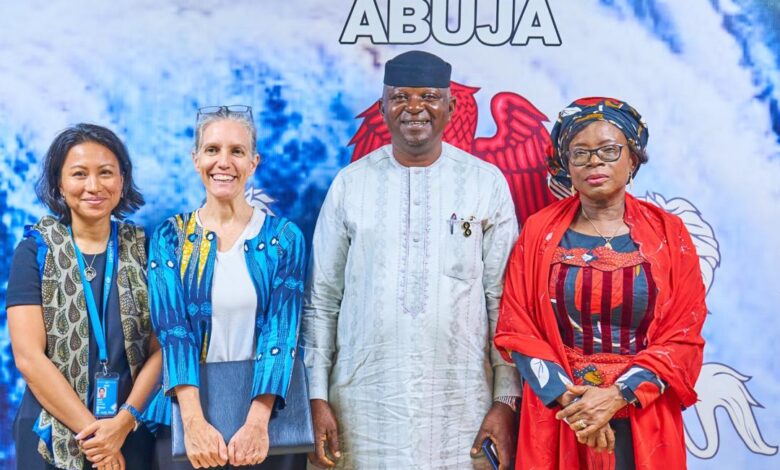
This commitment was reinforced on Friday when the Minister of Water Resources and Sanitation, Prof. Joseph Utsev, and the Permanent Secretary, Dr. Emanso Okop Umobong, received the newly appointed Chief of Water, Sanitation and Hygiene (WASH), UNICEF Nigeria, Engr. Ms. Emily Rand, alongside UNICEF WASH Manager, Ms. Jolly Ann Maulit, during a courtesy visit in Abuja.
The partnership aligns with national development priorities and the Sustainable Development Goals (SDGs), particularly in improving public health, sanitation, and sustainable water resource management.
According to a statement by the Assistant Director, Information & Public Relations of the Ministry, Agbajor, Matthew, the Minister warmly expressed deep appreciation for the organization’s longstanding contributions to Nigeria’s WASH sector.
He commended UNICEF for its impactful interventions and applauded the dedication of Directors and technical teams within the Ministry who continue to drive progress in the sector.
Utsev identified sustainability as a critical challenge, stressing the need for deliberate and coordinated efforts to ensure the long-term success of WASH programmes.
He noted that the Permanent Secretary would collaborate closely with the Ministry’s technical Directors to harmonize ongoing initiatives, identify gaps, and clearly define priority areas requiring UNICEF’s support.
Emphasizing a shift toward a more proactive engagement model, Prof. Utsev stated that the Ministry would intensify direct collaboration with UNICEF through regular interactions aimed at improving programme design, implementation, and sustainability.
He reaffirmed the Ministry’s commitment to building a dynamic, results-driven partnership with UNICEF that will deliver measurable and lasting improvements in water supply, sanitation, and hygiene services nationwide.
The Minister expressed appreciation to UNICEF, the Permanent Secretary, Directors, and staff of the Ministry for their dedication and contributions, reiterating the Federal Government’s resolve to position Nigeria as a model for effective and sustainable WASH service delivery.
In her welcome address, the Permanent Secretary, Dr. Emanso Okop Umobong, warmly received the delegation to the Ministry and Nigeria at large. She noted UNICEF’s longstanding presence and consistent support in Nigeria, particularly in the areas of water supply, sanitation, and hygiene, describing the organization as a reliable and impactful partner.
Dr. Umobong reaffirmed the Ministry’s commitment to strengthening collaboration with UNICEF and expressed optimism about building a productive working relationship with the newly appointed Chief, aligning on new strategies that will enhance ongoing programmes and projects.
In her response, Engr. Ms. Emily Rand, the newly appointed UNICEF Nigeria WASH Chief, reaffirmed UNICEF’s commitment to supporting Nigeria through a results-driven approach, emphasizing that programmes demonstrating impact will continue to receive funding and support. She highlighted opportunities to mobilize resources, particularly through climate financing, to improve WASH access for children.
Similarly, the UNICEF WASH Manager, Ms. Jolly Ann Maulit, noted that many of the Ministry’s priorities are already integrated into UNICEF’s plans. These include support for water quality analysis, WASH information systems, technical assistance, public-private partnership (PPP) frameworks, and sustainability initiatives. She also emphasized ongoing efforts in impact assessment and Open Defecation Free (ODF) sustainability programmes.
She further stressed the importance of scaling climate-resilient WASH approaches, strengthening sector-wide sustainability actions, and enhancing data use for planning.
Both officials reaffirmed UNICEF’s commitment to continued collaboration, technical support, and resource mobilization to advance sustainable WASH services in Nigeria.
During the meeting, Directors of departments relevant to the WASH framework, alongside agencies and units within the Ministry, presented concise briefs outlining ongoing programmes, key achievements, and priority areas requiring collaboration and technical support from UNICEF.