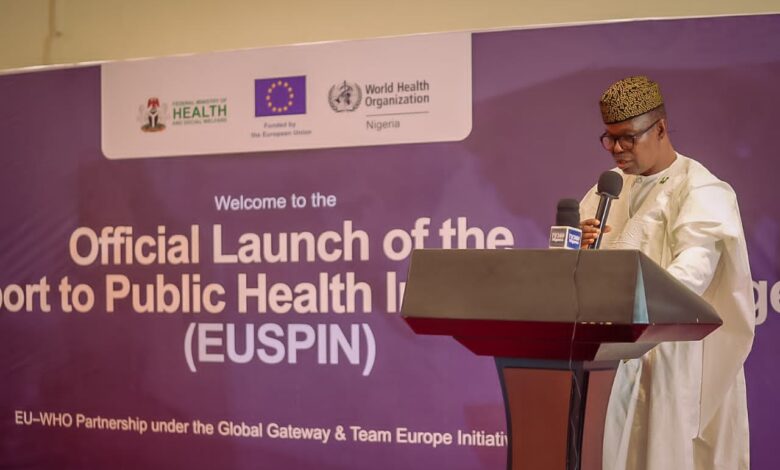


The European Union (EU) has donated the sum of €4.2 million (N6, 791 billion) to strengthen Nigeria’s healthcare delivery system to deal with disease outbreaks.

According to a statement issued by WHO on Monday, the EU Support to Public Health Institutes in Nigeria (EU SPIN) will be implemented by the World Health Organization (WHO), in partnership with the Federal Ministry of Health and Social Welfare, over a four-year period.
The €4.2 million (N6, 791 billion) programme funded by the European Union, aims to help 6 core functions of selected public health institutes to detect outbreaks earlier, share information faster, and reduce the negative impact of poor health outcomes nationwide.
Nigeria continues to face a double burden of repeated disease outbreaks alongside a growing number of people living with long term conditions such as hypertension and diabetes. As the pressures rise, so do the expectations on health institutions to respond faster across multiple levels.
Noncommunicable diseases are rising and now account for 27% of deaths in Nigeria, whilst Malaria contributes 30% of global malaria deaths and recurrent outbreaks, like cholera, diphtheria, Lassa fever, meningitis, Mpox, remain a major cause of illness and death (WHO).
To effectively fix gaps that slow outbreak response, EU SPIN contribution will improve how public health institutes work together and share responsibilities. It will train leaders and frontline staff involved in prevention and response, it will support systems that share data in real time, so decisions are based on timely information. It will link public health work to primary health care and communities, and it will build digital skills for the public health workforce, with a target of 75% trained staff.
Dr. Iziaq Salako, Nigeria’s Minister of State for Health and Social Welfare, said: “This initiative is designed to strengthen our health institutions, and it is truly a welcome development. It will improve the well‑being of Nigerians, especially our vulnerable populations. We appreciate the European Union and the World Health Organization for their support, which aligns with the Renewed Hope Agenda. Our commitment to equitable healthcare and prosperity for all remains unwavering.”
Gautier Mignon, European Union Ambassador to Nigeria said: “Through EU SPIN, the European Union is investing in strong, digitally enabled public health institutions in Nigeria. This partnership reflects our shared commitment to health security and sustainable systems strengthening”.
Following the launch, public health workers at all levels will benefit from clearer coordination, better tools, and improved skills. Over time, this will support better health outcomes for Nigerians, particularly women, children, the elderly, persons with disabilities, internally displaced persons and vulnerable populations.
Dr Pavel Ursu, WHO Representative in Nigeria, said: “By improving coordination, skills, and digital tools, the project will help protect lives and keep communities healthier.”
By 2028, the programme aims to have contributed to Nigeria having more efficient inter-institutional coordination, clearer roles, and more reliable public health data across federal, state, and local levels. Progress will be tracked through agreed national monitoring systems, with regular review points involving government and partners.
Media resources
The World Health Organization works with the Government of Nigeria to improve health through technical assistance, emergency response, and stronger health systems. WHO supports Nigeria’s efforts to achieve universal health coverage and better protection from outbreaks and emergencies.