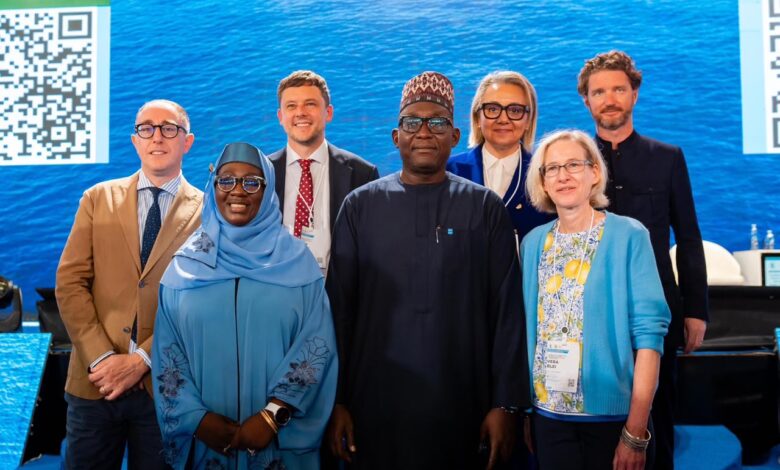


Regional regulators, government officials and energy investors wrapped up two days of talks in the Nigerian Capital, Abuja, last week, closing out the second West Africa Refined Fuel Market Conference with a shared call for more investment, tighter rules, and closer cooperation if it wants to build a credible fuel-pricing of its own.
The Conference, held from August 11-12, 2026, at the Transcorp Hilton, was organised by the Nigerian Midstream and Downstream Petroleum Regulatory Authority (NMDPRA) alongside S&P Global Commodity Insights and the West African Regulators Forum (WARF).
Unlike the 2025 inaugural edition which focused on the roadmap, this year’s, with the theme, “Funding West Africa Infrastructure & Distribution to Create a Transparent Market for Regional Regulatory Benchmarks,” placed emphasis on execution.
Nigeria’s Minister of State for Petroleum Resources (Oil), Senator Heineken Lokpobiri, opened the conference with a blunt assessment that the region simply isn’t refining enough fuel to meet its own demand.
He pointed to the Dangote Refinery -Africa’s largest, with a nameplate capacity of 650,000 barrels of crude oil per day -as proof of progress but insisted it isn’t enough.
The Minister’s concern was backed by data from the NMDPRA of decline in total petrol supply to Nigeria’s domestic market, which fell from 41.5 million litres a day in May to 32.45 million litres a day in June.
Dangote Refinery supplied 32.5 million litres per day to the domestic market in June, out of a total production run of 39.1 million litres per day. Meanwhile, demand moved in the opposite direction: petrol consumption climbed to 47.4 million litres per day in June, up from 46.3 million per day in May.
He therefore called for further investment to expand refining capacity, arguing that oil and gas would remain the region’s dominant energy source for years to come, to industrialise.
On the upstream side, the picture was more positive. The Commission Chief Executive of the Nigerian Upstream Petroleum Regulatory Commission (NUPRC), Oritsemeyiwa Eyesan, told the delegates that national oil production had climbed to 1.6 million barrels per day, exceeding OPEC’s quota.
She stated that the countries in the region “could no longer operate in silos” and pressed for infrastructure development across the value chain to make the market more profitable.
In his remarks, the Authority Chief Executive of the NMDPRA, Rabiu Umar, noted that the conference had moved from setting a roadmap in 2025 to a focus on execution in 2026.
He said progress since the inaugural conference included the institutionalisation of regional regulatory cooperation through the West African Regulators Forum, advances toward a West African reference pricing system, and deeper collaboration with S&P Global Commodity Insights on market reporting and benchmark expertise.
Umar outlined five imperatives for the region going forward: deepening physical market liquidity, financing strategic infrastructure, accelerating regulatory and product-standard harmonisation, institutionalising market transparency, and building a complete trading ecosystem involving refiners, traders, terminal operators, banks, and regulators.
He said Africa’s infrastructure deficit represented an investment opportunity spanning pipelines, storage, marine terminals, refinery expansion, digital commodity exchanges, regional logistics corridors, but stressed that capital would only flow where projects are bankable and regulation predictable.
He added that the continent’s ambition should be to move from being a price-taker in global petroleum markets to becoming a credible centre of price discovery, trading, investment, and value creation, an outcome he said would require infrastructure, capital, operational excellence, regulatory cooperation, and execution.
THE NEED FOR STRATEGIC INVESTMENT
Much of the conference’s second day was devoted to financing strategic infrastructure and strengthening regulatory alignment- a direct response to what officials described as Africa’s core paradox: it holds the resources, the refining capacity and the demand, but not yet the connective infrastructure to turn them into a functioning regional market.
Umar pointed investors toward a broader menu of opportunities: pipelines and product-transport systems, strategic and commercial storage, marine terminals, refinery expansion, road and rail logistics, gas processing, LNG and LPG infrastructure, digital commodity exchanges and integrated regional logistics corridors.
Olu Verheijen, Special Adviser to the President on Energy, framed the challenge in similar terms, telling the delegates that the real test for the continent is whether it can build the infrastructure, market systems and regulatory framework needed to support the transformation -and urging governments to remove barriers to cross-border trade.
Security also came up as an investment precondition. Hon. Ikenga Ugochineye, Chairman of the House of Representatives Committee on Petroleum Resources and Downstream, said the National Assembly would work with the NMDPRA and other stakeholders to secure infrastructure against pipeline vandalism and crude oil theft -both longstanding deterrents to investor confidence in Nigeria’s downstream sector.
REGULATORS TOLD TO LOOK BEYOND THEIR BORDERS
A recurring theme was the need for regulators themselves to change how they operate. Prof. Zainab Gobir, NMDPRA’s Executive Director for Economic Regulations and Strategic Planning, told delegates that the real measure of WARF’’s success would be visible only at the end of the conference, in stronger collaboration, clearer communication and follow-through on shared commitments.
She pressed member institutions to assign clear responsibilities and identify what support they need to convert recommendations into coordinated action.
Umar echoed that call in his closing remarks, saying regulators need to move “beyond localised oversight towards active facilitation of cross-border energy cooperation” -through shared information, aligned standards, interoperable market rules and smoother cross-border trade procedures.
THE BIGGER AMBITION
Panelists at the conference canvassed for a regional shift from a price-take to a price-maker in global petroleum markets.
As Umar noted, the ambition is for Africa to move from being principally a price-taker in global petroleum markets to becoming an increasingly credible centre for price discovery, trading, investment, and value creation.
He acknowledged that the goal remains distant -dependent on infrastructure financing, operational efficiency, regulatory cooperation and, above all, follow-through.
Closing the conference, Umar reaffirmed NMDPRA’s commitment to working with regional partners on what he described as the ultimate objective: not simply a reference price, but “the transparent, liquid and resilient African markets that gives that reference price credibility.”
Whether that materialises will likely be the first item on the agenda when the conference reconvenes for its third edition.