

The Minister of Water Resources and Sanitation, Engr. Prof. Joseph Utsev, has called on Nigeria to fold water security into its national security architecture, arguing that access to safe water and sanitation underpins public health, food security, economic stability and overall national resilience.

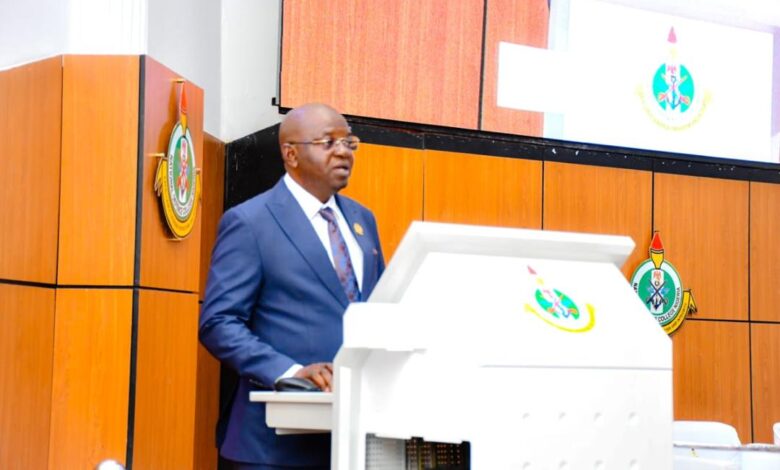
Prof. Utsev made the call on Monday while delivering a lecture titled “Water Resources Management and Sanitation as Catalysts for Sustainable National Development and Security in Nigeria” at the National Defence College, Abuja.
The Minister said Nigeria must move beyond viewing water as merely a development issue and recognise it as a strategic national security priority.
He noted that water insecurity, unsafe water, inadequate sanitation, flooding, drought and climate variability could trigger public health emergencies, displacement and resource-based crises, intensify competition among water users, undermine livelihoods and increase vulnerability to climate-related shocks.
Prof. Utsev, in a statement by the Director Information and Public Relations, Mrs. Funmi Imuetinyan, also highlighted the important roles of the River Basin Development Authorities (RBDAs) in irrigation, agriculture, fisheries, rural water supply, flood control, job creation, agro-processing and rural economic development.
On food security, the Minister said irrigation development was critical to reducing Nigeria’s dependence on increasingly unpredictable rainfall patterns.
He disclosed that approximately 154,000 hectares of irrigable land are currently benefiting more than 1.6 million farmers, noting that efforts are ongoing to expand irrigation coverage.
He also raised concerns over the security implications of climate-induced flooding and drought, noting that the 2026 Annual Flood Outlook identified 1,249 communities in 176 Local Government Areas across 30 States and the Federal Capital Territory as high flood-risk areas.
Prof. Utsev advocated stronger coordination among government institutions, particularly in the water, agriculture, health, environment and security sectors, alongside increased investment, effective regulation, reliable water intelligence, climate-resilient infrastructure and stronger community participation.
On policy coordination, the Minister disclosed that the Ministry is developing a National Water Compact for 2026–2030 as a roadmap to harmonise Nigeria’s water and sanitation policies and interventions.
He said the Compact is built around three strategic pillars: Water for People, Water for Food and Water for the Planet, focusing respectively on safe water and sanitation, irrigation and food security, and climate resilience and sustainable water resources management.
He emphasised that the Compact is being developed through a whole-of-government and multi-stakeholder approach involving the Federal and sub-national governments, security agencies, River Basin Development Authorities, traditional and religious institutions, the private sector, development partners, civil society organisations and communities.
The Minister further stressed the importance of water diplomacy and transboundary cooperation, noting that Nigeria shares major water resources with neighbouring countries and must strengthen regional collaboration to promote stability, economic growth and sustainable development.
To strengthen Nigeria’s water security, Prof. Utsev identified five strategic priorities: integrating water security into national security planning; strengthening whole-of-government coordination; increasing strategic investment and sustainable financing; building climate resilience and national water intelligence; and developing the capacity of women and youths.
The Minister stressed that the resilience of the systems that sustain the people is fundamental to national security, adding that protecting water resources, expanding access to safe water and sanitation, strengthening irrigation, and improving preparedness for floods and droughts were essential to securing Nigeria’s future.
In his response, the Commandant of the National Defence College, Abuja, Rear Admiral Abdullahi Ahmed, commended the Minister for the presentation, noting that it clearly demonstrated that water security remains key to national security.
The Commandant identified flooding, drought and resource-based conflicts as major security concerns and called for greater utilisation of Nigeria’s abundant freshwater resources, as well as stronger international cooperation in managing shared water systems.
The Minister was accompanied by the Director overseeing the Office of the Permanent Secretary, Engr. Dallah Ali Ibrahim, FNSE; Director, Water Supply and Support Services, Mr. Babarinde Segun Mukaila; and Director, Water Quality Control and Sanitation, Mr. Habu Jemilu.
The lecture was attended by the full complement of the faculty of the National Defence College.