
CBN’s Rate Reset: What The Numbers Reveal About Nigeria’s Economic Turnaround
By Sunday Etuka


For much of the past two years, Nigeria’s monetary policymakers have been engaged in a delicate balancing act: taming stubborn inflation without choking off the fragile recovery of Africa’s largest economy.
This week, the Central Bank of Nigeria’s (CBN) Monetary Policy Committee (MPC) signalled that the balancing act may finally be paying off, even as it made one of its more technical, and potentially consequential, moves in recent times.
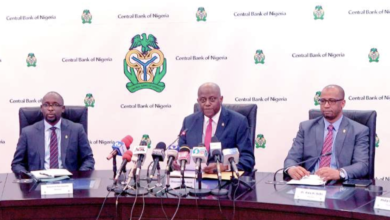
Meeting for two days on September 21 and 22, 2026, the eleven member Committee reset the Monetary Policy Rate (MPR) at 23 per cent and recalibrated the Standing Facilities Corridor to +50/-300 basis points around it.
On the surface, the numbers might suggest a shift in direction. But CBN Governor, Olayemi Cardoso and his colleagues were emphatic that this was not a change in policy stance at all, but a technical repositioning meant to make the existing stance work better.
The distinction matters. According to the communique issued after the meeting, the Committee had observed a widening gap between the official policy rate and the rates actually prevailing in the market, a divergence that was quietly undermining how effectively monetary policy decisions filtered through to banks, businesses and ultimately households.
By recalibrating the corridor and leaning on the newly adopted Nigerian Overnight Funds Rate (NOFR) as a more transparent, transaction based benchmark, the Bank hopes to restore the MPR’s authority as the true signal of where monetary policy stands, a step it says is also laying groundwork for Nigeria’s eventual transition to a full inflation targeting framework.
External Buffers At Record Highs
Behind the technical language lies a broader story of economic resilience. The Committee’s confidence in making this adjustment now was underpinned by a string of encouraging data points.
External reserves have climbed to $55.25 billion as of September 18, the highest level in 18 years, enough to cover roughly 11.3 months of imports.
The balance of payments swung to a surplus of $3.51 billion in the second quarter of 2026, up sharply from $2.38 billion in the first quarter, while the current account surplus jumped 67.92 per cent to $7.54 billion over the same period.
Inflation’s Long Retreat
Inflation, the stubborn villain of Nigeria’s recent economic narrative, has also been retreating. Headline inflation eased to 15.39 per cent in August, marking a third straight month of decline even as geopolitical tensions in the Middle East pushed global energy prices higher.
Food inflation, which has weighed heavily on household budgets, slowed to 19.57 per cent from 20.31 per cent the previous month, while core inflation dropped to 13.29 per cent.
The 12 month moving average has now moderated for twenty consecutive months, a streak the Bank points to as evidence that its earlier tightening measures are finally working their way through the system.
Growth Picks Up Across Sectors
Growth, too, has picked up pace. The economy expanded by 4.43 per cent in the second quarter, up from 3.89 per cent in the first, with both the oil and non-oil sectors contributing.
Non-oil growth was driven by technology, crop production, real estate and financial services, while the oil sector staged a stronger rebound on higher production and investment.
A rising Purchasing Managers’ Index, up to 52.7 points in August, adds further weight to the sense of a broadening recovery.
Structural Reforms Reinforcing The Gains
The Committee also pointed to structural developments it believes will reinforce these gains: a newly signed Memorandum of Understanding (MoU) between the Federal Ministry of Finance and the CBN aimed at tighter fiscal monetary coordination, a Presidential initiative promoting affordable CNG transit that could ease transport costs and inflation pressures, and the completion of the banking sector’s recapitalisation programme, which has left lenders with stronger capital buffers to finance long term projects.
Risks On The Horizon
Still, the Committee was careful not to declare victory. It flagged prolonged tensions in the Middle East and election related government spending as risks that could yet push prices back up, and it reaffirmed that future decisions would remain strictly data dependent.
For now, though, the mood among policymakers appears to be one of cautious optimism, an economy showing genuine signs of healing, with a central bank recalibrating its tools rather than reversing its course.
The MPC’s next meeting is scheduled for November 23 and 24, 2026, when the Committee will assess whether this week’s technical reset is delivering the sharper policy transmission it was designed to achieve.