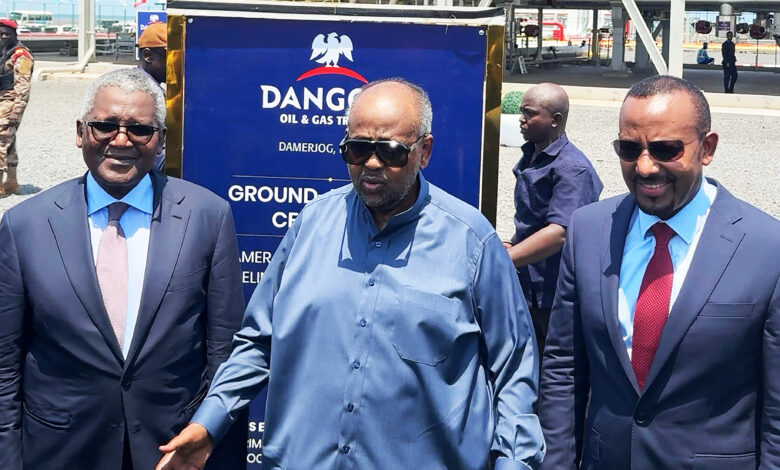
Ethiopia, Djibouti Break Ground On $660m Dangote Pipeline To Boost Regional Energy Security
By Sunday Etuka


Construction has officially begun on a $660 million oil pipeline linking Djibouti and Ethiopia, with leaders from both countries describing the Dangote Group project as a major boost to regional trade, energy security and job creation across the Horn of Africa.

Ethiopian Prime Minister Abiy Ahmed and Djiboutian President Ismaïl Omar Guelleh attended the groundbreaking ceremony for the Damarjog-Dewele Oil Terminal and Pipeline Project at the Damerjog Industrial Development Free Trade Zone in Djibouti, where both leaders praised Dangote Industries Limited President and Chief Executive Aliko Dangote for championing what they called one of the region’s most significant privately funded energy infrastructure investments.
The project centres on a 120-kilometre multiproduct pipeline connecting marine and coastal storage facilities at Damarjog in Djibouti to inland storage and distribution facilities at Dewele in Ethiopia. Once complete, it is expected to improve the transportation of refined petroleum products and strengthen supply reliability for Ethiopia and the wider region.
President Guelleh described the pipeline as central to Djibouti’s ambition to become a leading logistics, industrial and energy hub for Africa.
“The Damarjog-Dewele Pipeline Project is not merely infrastructure; it is an investment in the future prosperity of our region,” he said, adding that the project would expand port operations, attract new investment and generate “significant value for Djibouti through increased trade volumes, stronger commercial activity, and enhanced investor confidence.”
He said the initiative reflected the strength of African-led investment in solving the continent’s own infrastructure challenges.
For his part, Prime Minister Abiy said the pipeline would strengthen Ethiopia’s energy security and support its industrialisation drive by providing “a modern, dependable, and cost-effective system for transporting refined petroleum products into the country.”
He said the project would ease transportation bottlenecks and stabilise fuel supply for sectors including aviation, agriculture, manufacturing and construction, while improving product quality control and reducing losses from long-distance transport.
Abiy also framed the project as another example of the longstanding economic partnership between the two countries, saying it demonstrated “how African nations can work together to unlock opportunities, improve connectivity, and deliver sustainable development.”
According to a statement on Thursday by the Dangote Group, Aliko Dangote, while speaking at the ceremony, said the pipeline reflects the Group’s broader push to build infrastructure that supports Africa’s economic self-sufficiency.
“This project is designed to enhance energy security, improve supply-chain efficiency, and create sustainable economic value for both Djibouti and Ethiopia,” he said, describing the arrangement as “a win-win outcome for both countries.”
He noted that the Djibouti corridor is currently Ethiopia’s primary trade route, including for petroleum imports, making the pipeline one of the most strategically important economic corridors in Africa.
He added that the project would improve the safety of fuel transportation by cutting reliance on long-distance tanker movements, easing congestion and reducing the risk of product losses and environmental incidents.
The project is expected to create thousands of construction and operational jobs, support skills transfer, and benefit local contractors, suppliers and host communities.
It forms part of Dangote Group’s Vision 2030 strategy, under which the company plans to invest $50 billion across Africa in industrial and energy infrastructure.
“This is Africa building the infrastructure it needs to accelerate development and deepen intra-African trade,” Dangote said.