

The Federal Government has called on state governments to make full use of the Electricity Act 2023 by setting up functional electricity markets, drawing in private investors and ceasing to rely on Abuja to solve their local power problems.
Vice President Kashim Shettima said Nigeria’s goal of building a competitive industrial economy will stay out of reach unless power sector reforms deliver dependable electricity to businesses, homes and public institutions nationwide.
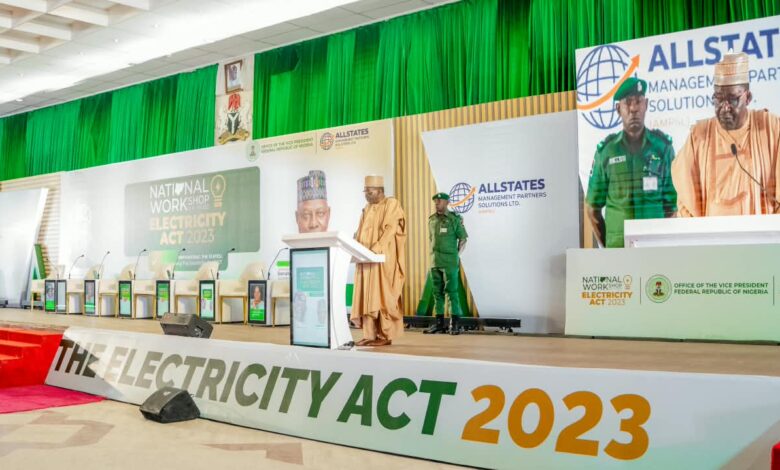
He spoke on Wednesday at the opening of the National Stakeholders’ Workshop on the Electricity Act 2023, held at the State House Banquet Hall in the Presidential Villa, Abuja.
The event, themed “Unlocking the Opportunities of the Electricity Act 2023 for Sustainable Energy Development and Economic Growth in Nigeria,” gathered federal and state institutions, regulators and other stakeholders to assess how the law is being implemented.
Represented by the Deputy Chief of Staff to the President, Senator Ibrahim Hassan Hadejia, the Vice President said the Act offers a chance to spread electricity governance across the federation and let states build markets that match their economies and natural resources.
He noted that the law lets states develop and regulate their own intrastate markets within the constitutional and statutory framework and said the country’s size and diversity make this approach necessary.
According to him, power supply must become a shared responsibility across all tiers of government, and states should stop waiting for the centre to hand them every solution.
In a statement issued by his Senior Special Assistant on Media and Communications, Stanley Nkwocha, the Vice President pointed to the country’s varied energy endowments as a major opening for wider access.
He cited solar potential in Sokoto, Borno and Katsina, gas reserves in Delta, Rivers and Bayelsa, and hydropower prospects in Niger and Kebbi.
He urged states to convert these assets into investments that can power agriculture, manufacturing, healthcare and education.
Senator Shettima cautioned, however, that a law cannot improve supply on its own. He asked states that have not yet created their electricity regulators to start the legislative and institutional work immediately and stressed that these bodies need real technical competence and capacity.
To support implementation, he proposed a National Electricity Reform Peer Review and Implementation Framework. It would bring together the Nigerian Electricity Regulatory Commission (NERC), the Federal Ministry of Power, the Nigeria Governors’ Forum (NGF) and state electricity regulators.
The voluntary arrangement would let states share experiences, strengthen their regulators and measure progress on market development, investment readiness, consumer protection and electricity access.
He said no state should have to learn through failure what another state has already figured out.
The Vice President said annual voluntary reviews would help identify obstacles, arrange technical assistance and encourage practical fixes, all without weakening the constitutional powers of the states.
He also stressed the role of private capital, saying government funds alone cannot cover the country’s electricity infrastructure needs.
In his view, investors will gain confidence through transparent licensing, predictable regulation, commercially viable markets, protection for their investments and credible ways to resolve disputes.
Senator Shettima reaffirmed President Bola Ahmed Tinubu’s commitment to widening electricity access through policies that attract investment, build institutions and improve service.
He said the Federal Government will maintain the policies and partnerships needed to make power accessible, reliable, efficient and increasingly affordable for households and businesses.
He further called for stronger protection for consumers against arbitrary billing, poor service and unfair commercial practices, insisting that operators must answer for the quality of their service.
He added that the real test of the law will come whenever a Nigerian flips a switch, since entrepreneurs need dependable power, young people need jobs and investors need clear rules.
Earlier, the Permanent Secretary of the Federal Ministry of Power, Mahmuda Mamman, who represented the Minister of Power, said the Act will succeed only if states build credible institutions and commercially viable markets.
He added that planning at the state level would help governments respond better to local demand and infrastructure needs.
The Director General of the NGF, Dr. Abdulateef O. T. Shittu said the forum is working to improve coordination between federal and state institutions on the law’s implementation.
He revealed that a standard tariff framework is being developed for states, aimed at protecting consumers while encouraging investment and commercial sustainability.
He also urged stakeholders to ensure that any amendments to the current legal framework build on the gains already made in electricity regulation.
Speaking for NERC, the Deputy General Manager (Compliance) and Head of Compliance, Hauwa Yakubu, said the commission has handed over regulatory responsibility to 17 states, the latest being Akwa Ibom.
She added that NERC continues to support new state regulators through training exchanges between peers and technical engagement.
According to her, the Act has ushered in a new era of regulation at multiple levels of government, bringing oversight closer to consumers and letting states tackle their own particular power challenges.