Nigerian Boardrooms Must Evolve To Drive Inclusive, Sustainable National Prosperity – Udoma
By Sunday Etuka


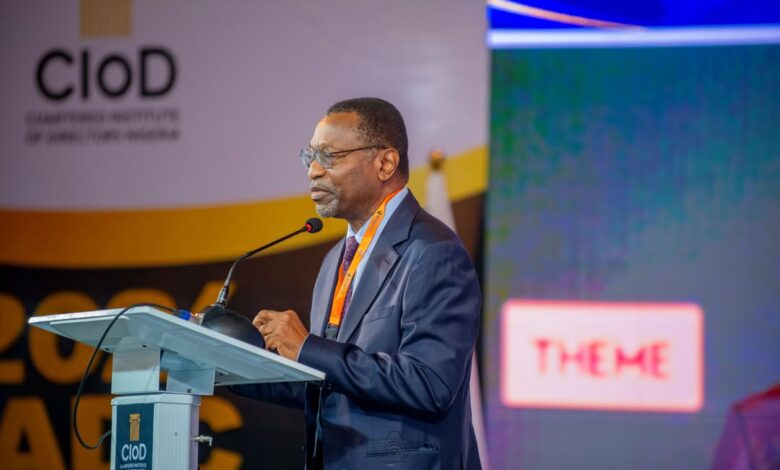
The Chairman of Seplat Energy Plc, Senator Udoma Udo Udoma, has underscored the need for the corporate boards across Nigeria to reposition themselves for the rapidly evolving global economy, stressing that the quality of decisions taken in boardrooms will have far-reaching implications for economic growth, job creation, innovation and national prosperity.

Udoma, who spoke at the 2026 Annual Conference of the Chartered Institute of Directors (CIoD) in Lagos, while delivering a keynote address titled “Reimagining the Boardroom for Inclusive and Sustainable National Prosperity in the New Economy.”
He said companies, although private institutions, play a critical role in shaping the wider economy through their investment, employment, innovation and governance decisions.
According to him, Nigeria’s future will be shaped not only by decisions taken in government ministries, legislative chambers and policy forums, but also by decisions made in boardrooms across the country.
“Every time a board approves a major investment, it contributes to economic growth. Every time a board invests in people, it influences future leadership. Every time a board supports innovation, it strengthens competitiveness. Every time a board insists on integrity and accountability, it strengthens trust in the wider economy,” Udoma said.
He stressed that while technological change, artificial intelligence (AI), the energy transition, climate change, geopolitical developments and changing stakeholder expectations are transforming the business environment, the fundamental responsibilities of directors remain unchanged.
Udoma therefore urged directors to maintain a firm grasp of their fiduciary responsibilities and continually refresh their knowledge of corporate governance requirements, particularly as investors and regulators increasingly demand accountability from boards and individual directors.
Udoma, in a statement on Thursday by the Manager, Corporate Communications & Media Relations, Stanley Opara, also underscored the continuing relevance of Environmental, Social and Governance (ESG) principles, arguing that despite changing international sentiment around ESG, sustainability considerations remain important to corporate resilience, competitiveness and long-term value creation.
“At Seplat, we are committed to ESG principles. We believe that we must integrate Environmental, Social and Governance considerations into strategic decision-making,” he said, adding that ESG continues to influence access to capital, investor confidence and operational resilience.
He also highlighted diversity and inclusion as essential components of an effective modern boardroom, noting that diversity in gender, expertise, experience, generation and perspective strengthens decision-making and enables boards to identify risks and opportunities more effectively.
At Seplat Energy, women currently account for approximately 38.4 per cent of Board membership and 45.5 per cent of the senior leadership team, reflecting the company’s commitment to ensuring that diversity translates into stronger debate, decision-making and business outcomes.
Udoma further emphasised that the responsibility of businesses extends to creating meaningful and sustainable value for communities.
Citing Seplat Energy’s Corporate Social Investment programmes, he highlighted the Eye Can See initiative, which has expanded access to eye healthcare across the company’s operational areas. In Akwa Ibom State, more than 5,000 eye screenings have been conducted, 4,987 reading glasses issued and approximately 221 surgeries carried out following the programme launched in September 2026.
He also referenced Seplat Energy’s Youth Entrepreneurship Programme, investments in STEM laboratories, the provision of power to 27 schools and hospitals across its operational areas, and its Tree for Life initiative as examples of interventions designed to support socioeconomic development and environmental sustainability.
Udoma, however, stressed that responsible corporate citizenship must go hand-in-hand with delivering competitive returns to shareholders.
“A successful company must deliver good returns to shareholders,” he said. “But the two are not mutually exclusive. A company can do both.”
He cited Seplat Energy’s recent performance as evidence of its focus on balancing commercial performance with responsible business practices. The company recorded US$2.764 billion in revenue and US$1.530 billion in adjusted EBITDA in the first nine months of 2026, while its share price on the Nigerian Exchange appreciated by more than 700 per cent over the past three years.
Looking ahead, Udoma identified artificial intelligence, cybersecurity and the rapid expansion of social media as increasingly important issues that boards must address.
He warned that social media has fundamentally changed the speed and scale at which corporate reputational issues can develop, with minority shareholders and other stakeholders now able to mobilise rapidly and influence corporate discourse. This, he said, makes digital and social media literacy increasingly important at board level.
On artificial intelligence, Udoma said companies whose boards develop sufficient AI, data and digital transformation capabilities would be better positioned to capture emerging opportunities and manage new risks.
He noted that AI could strengthen directors’ ability to interrogate management information, analyse board materials, stress-test proposals and undertake scenario planning. However, boards must simultaneously confront cyber threats, data breaches, AI-related risks and the danger of overdependence on similar AI-generated information.
“The potential impact of AI is real. These are still relatively early days, and I do not know the exact manner board operations will be changed by AI. But one thing I do know is that the changes will be major. We should prepare for them,” he said.
Udoma concluded that boards capable of combining strong governance, ESG principles, diversity, responsible corporate citizenship and shareholder value creation with greater technological agility would be best positioned to succeed in the new economy.
He added that organisations that respond quickly and responsibly to AI, social media and other emerging disruptions would also be better equipped to contribute to the achievement of inclusive and sustainable prosperity for Nigeria.