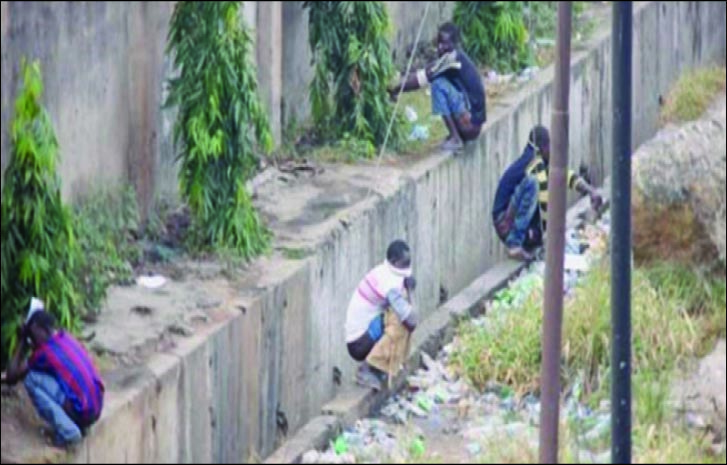


In many parts of Nigeria, a toilet is still a luxury rather than a given. Tens of millions of people relieve themselves in bushes, farmland, drainage channels, riverbanks and roadsides every day, and the consequences ripple through classrooms, clinics, markets and household budgets.
Last week, government officials, development partners, Civil Society Organisations (CSOs), and the media, gathered in Abuja for two high profile events, where the Federal Government again put the issue at the centre of national attention, restating its commitment to make Nigeria fully Open Defecation Free (ODF) by 2030.
The numbers explain the urgency. Speaking at the 2026 National Retreat on the Clean Nigeria Campaign, held on November 17, 2026, at the Rockview Royale Hotel, Minister of Water Resources and Sanitation, Prof. Joseph Utsev, said more than 40 million Nigerians still practise open defecation.
The Water, Sanitation and Hygiene Manager at UNICEF Nigeria, Jolly Ann Maulit, put the figure at roughly 23 per cent of the population.
The World Health Organisation estimates that ending the practice will cost about N4 trillion. Set against a population of well over 200 million, those figures show both how far Nigeria has come and how far it still has to go.
To understand why the problem is so stubborn, it helps to look at what open defecation does. Human waste left in the open contaminates water sources, soil and food.
It spreads diarrhoea, cholera, typhoid and intestinal worm infections, which hit young children hardest. Repeated bouts of diarrhoea in early childhood are linked to stunting, poor school attendance and weakened learning.
Women and girls face an additional burden, because the lack of a private, safe toilet can force them to wait until nightfall, exposing them to harassment and attack. This is why officials keep describing sanitation as a matter of dignity and personal safety as much as public health.
Nigeria’s modern campaign against the practice took formal shape in the late 2010s. Faced with some of the highest numbers of open defecation in the world, the government declared a state of emergency in the water, sanitation and hygiene sector in 2018.
The following year, the then President signed an executive order that set a national target of ending open defecation by 2025.
In November 2019, the Clean Nigeria: Use the Toilet Campaign was launched to rally governments, development partners, traditional rulers, civil society and communities behind that goal. The campaign has since marked its anniversary alongside World Toilet Day each November, which is why this year’s celebration doubled as its seventh anniversary.
The early target of 2025 proved too ambitious. Building toilets is only part of the task. Households must be persuaded to use them, communities must verify that no one is defecating in the open, and local governments must find money to maintain what has been built.
Progress was also slowed by the economic shocks of recent years, competing budget demands and the sheer scale of the country. The deadline has therefore been moved to 2030, aligning Nigeria’s ambition with the global Sustainable Development Goal on sanitation for all.
That shift is reflected in the policy architecture now in place. President Bola Ahmed Tinubu has signed a revised Executive Order on Open Defecation Free Nigeria by 2030 and Other Related Matters, 2025.
According to the minister, the order strengthens the policy and institutional framework, and provides a basis for improved coordination, clear responsibilities and accountability at all levels of government.
On Thursday, 19 November 2026, it was formally unveiled in Abuja at the World Toilet Day celebration. Vice President Kashim Shettima, represented by Engr. Akubo Adegbe, Senior Special Assistant to the President on Projects Delivery and Coordination, led the unveiling.
Alongside the order sits the Revised Clean Nigeria Strategy 2025 to 2030, which the minister identified as a key guide for implementation. The campaign’s strategy rests on six pillars, according to its National Coordinator, Mrs. Chizoma Opara. It is led by the Office of the President, with States championing it locally.
A third element is the Clean Nigeria Real Time Monitoring and Information System, known as CNC RTMIS, which is meant to give planners reliable and timely data on where progress is being made and where it is stalling.
What has been achieved so far is real, even if incomplete. Since the campaign began, 185 Local Government Areas have attained ODF status, meaning communities in those areas have been assessed and found to be free of open defecation. Two states, Jigawa and Katsina, have gone further and achieved statewide ODF status.
Both are in the north of the country, a region often associated with deep development challenges, which makes their achievement a useful counterweight to assumptions about what is possible. The Federal Capital Territory is also in the race, with a target of reaching ODF status by 2027 and an appeal for collaboration to get there.
Utsev argued that these results prove the model works. “These achievements demonstrate what political commitment, effective coordination, adequate support and community participation can deliver,” he said in his keynote address, before adding a warning: “We must accelerate progress in the LGAs yet to attain ODF status and ensure that communities which have achieved it do not slide back.”
That second concern, known in the sector as relapse, is one of the most serious risks. A community can be certified ODF and still drift back to old habits if latrines collapse, fill up or are never repaired, or if the energy of the original campaign fades.
For this reason, the government’s message now stresses sustainability as much as speed. Utsev said progress would rest on three priorities: financing, data and institutional strengthening. On financing, he called on Federal, State and Local Governments to make deliberate budgetary provisions for sanitation, use resources effectively, explore innovative financing and encourage private sector participation.
His blunt assessment was that sanitation must not depend solely on occasional interventions or development partner support. For a sector that has long relied heavily on donors and one off projects, that is a significant statement of intent.
On data, the minister asked States to ensure that information submitted through national monitoring platforms is accurate, complete and timely. The point is practical. Without credible figures, planners cannot tell which Local Government Areas need urgent attention, donors cannot target funding, and citizens cannot hold officials to account. Anyone who has followed development statistics in Nigeria knows that disputed or outdated numbers have often hampered action, so the emphasis on a real time system is a notable shift.
On institutions, Utsev said the campaign must be built into the regular structures and programmes of State Governments and Local Government Areas, with clear responsibilities, effective coordination and regular monitoring.
Engr. Ali Ibrahim Dallah, the Director overseeing the Office of the Permanent Secretary, echoed the theme, saying responsibility for an ODF Nigeria cannot rest with the Federal Government alone, or with any single administration.
He urged that interventions be written into policies, development plans and annual budgets, so that they survive changes in political leadership. Because sanitation is largely delivered at the local level, the commitment of States and Local Governments is arguably the decisive factor.
Opara made the same point from the campaign’s perspective. She noted that the President has reaffirmed national leadership by signing the 2030 order, and said the same level of commitment is needed from State governors.
“Everyone must have access to sanitation and hygiene. Everyone must have access to the toilet,” she said.
She urged States to examine honestly what is working and what is not, and said the next stage for Jigawa and Katsina is to sustain their achievements and help other States follow their example.
The retreat was designed to turn such statements into obligations. Utsev said he expects every State to assess its performance, identify the Local Government Areas that need urgent attention and develop realistic acceleration roadmaps. States that have attained ODF status are expected to share their experiences and set out how they will hold on to their gains.
The aim, officials said, is for the retreat to produce practical solutions and clear commitments rather than another round of speeches.
The World Toilet Day celebration added a note of public recognition. Certificates and awards were presented to deserving states and sanitation champions, and Mrs. Didi Walson-Jack, the immediate past Head of the Civil Service of the Federation, was officially decorated as WASH Ambassador.
In her goodwill message, she called for improved access to safe and inclusive sanitation facilities, particularly for women and girls, and urged Nigerians to take collective responsibility for ending open defecation. The Vice President, through his representative, appealed to development partners, traditional rulers, civil society organisations, the private sector and communities to intensify collaboration.
Whether Nigeria reaches 2030 will depend on arithmetic and political will. About 40 million people must gain access to a toilet and, just as importantly, the habit of using it.
The missed 2025 target is a reminder that deadlines alone change nothing. Yet the foundations are firmer than they were in 2019: a revised executive order, a fresh strategy, a monitoring system, two fully ODF States and 185 certified Local Government Areas.
The remaining test is whether governors, council chairmen, donors and private investors will turn promises into budgets, and budgets into toilets that people actually use, long after the ribbon cutting and the certificates are forgotten.