

The All Progressives Congress (APC) Presidential Campaign Council has urged Nigerians to ignore what it described as fictitious mock election figures published by an organisation that claimed to be working with the Independent National Electoral Commission (INEC).

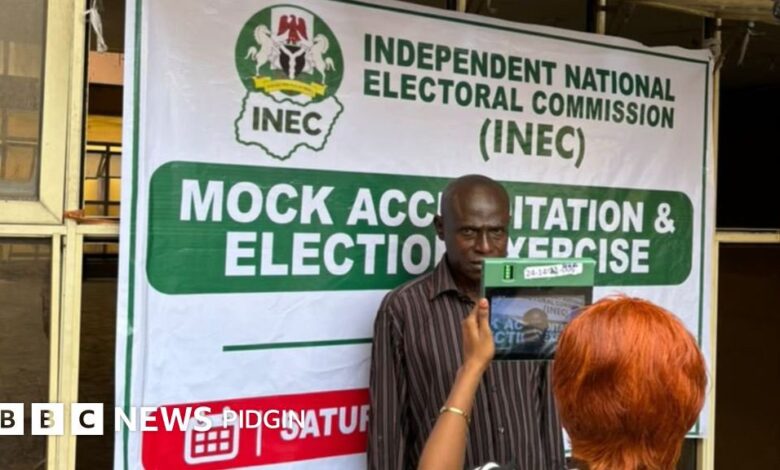
On Saturday, INEC conducted a mock election in two polling units in each ward nationwide in preparation for the 2027 general elections. With 8,809 wards and 176,846 polling units nationwide, the exercise covered just 17,618 polling units, or approximately 10 per cent of the total.
The exercise also tested the efficacy of INEC’s Bimodal Voter Accreditation System (BVAS). The ballot papers did not feature the names or logos of political parties. Instead, options such as “AQUA”, “BLUE”, “COAL”, “CYAN” and “GOLD” were used. INEC declared no winner or loser.
The Council said the Nigeria Election Intelligence System (NEIS), which it described as a pro National Democratic Congress (NDC) and pro Peter Obi organisation, published figures purportedly from INEC claiming that Obi led the mock poll with more than five million votes. It called the figures a product of NEIS’s imagination, fraudulent and meant to mislead the public.
In a statement on Sunday by its Spokesperson, Dele Alake, the Council raised a number of questions.
It asked on what basis and under whose authority NEIS was presenting figures as election results, noting that INEC has never announced results through a third party and that, under Nigeria’s electoral law, the commission is responsible for announcing official results.
It also asked how NEIS arrived at figures for the APC, NDC, ADC and other political parties when none of them featured on the ballot papers.
The Council further noted that INEC did not collate or announce any results at the polling unit, ward, local government, state or national levels, and asked where NEIS got the figures it claims to have recorded.
The Council questioned how NEIS arrived at more than 17 million votes from an exercise that covered only about 10 per cent of the country’s polling units.
It added that NEIS itself describes the process on its website as a “simulation” yet appears to have presented the figures as though they were actual election results. If the exercise was merely a simulation, it argued, the figures should not be mistaken for a genuine representation of voters’ preferences.
According to the Council, NEIS’s claim appears to be an online political game designed to attract attention, engagement and traffic, rather than a reliable attempt to gauge the country’s political mood.
It advised citizens to avoid interpreting the figures as an indication of the likely outcome of the 2027 general elections.
The Council said the Obidient movement may choose to celebrate NEIS and its figures, but such celebrations should not be confused with an actual electoral victory or evidence of nationwide support.
It also asked Nigerians to take note of its previous warnings and alerts about what it called the devious plots of opposition elements to manipulate public opinion through fake news and AI-generated images, discredit the electoral process, and delegitimise INEC in order to force a predetermined electoral outcome.