

Officials of the Nigeria Customs Service (NCS) and the World Customs Organization (WCO) have asked the Economic and Financial Crimes Commission (EFCC) to work more closely with them to fix weak spots in the country’s systems for stopping money laundering and terrorism financing.
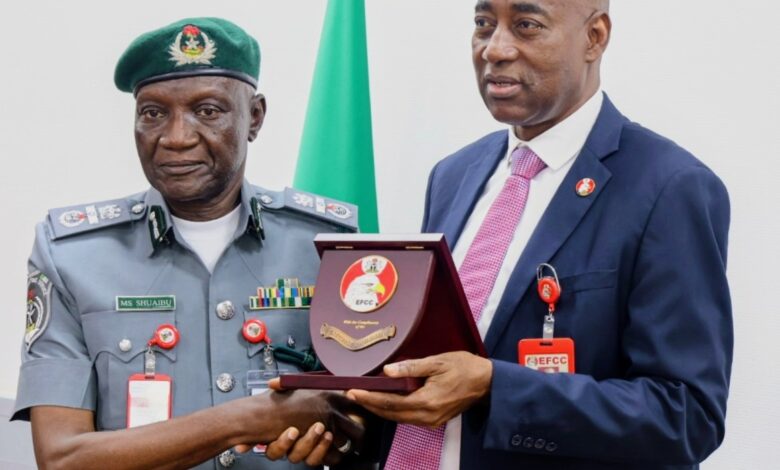
The request was made on Tuesday when a delegation led by the Assistant Controller General of Customs, Headquarters, M.S. Shuaibu, paid a courtesy visit to the EFCC Headquarters in Jabi, Abuja.
In a statement issued Wednesday, the EFCC’s Head of Media and Publicity, Dele Oyewale, said the visit aimed to build on current cooperation and address areas of deficiency in the Anti Money Laundering and Countering Financing of Terrorism (AML/CFT) framework.
Shuaibu praised the EFCC for maintaining its long working relationship with the NCS and called on both agencies to deepen their cooperation.
“The EFCC’s mandate as the lead agency in combating economic and financial crimes has been remarkable. We are here to engage in existing collaboration to identify what is working and what needs improvement. We will engage you on case management, intelligence sharing and operational synergy to better understand Nigeria’s AML/CFT framework, the WCO perspective and the recommended world best practices,” he said.
Speaking for the Executive Chairman, Ola Olukoyede, the Secretary to the Commission, Mohammad Hammajoda, thanked Customs for the enduring partnership, particularly in the fight against money laundering, and assured the delegation that the EFCC would sustain it.
He recalled that Nigeria was once named among countries with non-compliant anti money laundering frameworks, but exited the grey list through its own efforts and cooperation with other agencies.
“That one has enabled us to travel and use our debit card. That is why the EFCC and also the Customs are working as authorities to ensure that money laundering is tackled, with no room for financing of terrorism,” he said.
Hammajoda added that the Commission was prepared to expand collaboration with the WCO in capacity building, information sharing and operational synergy.