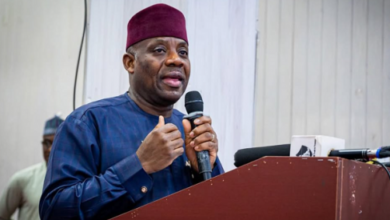


The Federal Government has commissioned an upgraded digital e-library at Federal Government College (FGC), Kano, accelerating the expansion of bilingual schools to tackle the challenge of out-of-school children.

Special Adviser to the Minister of Education on Media and Communications, Ikharo Attah announced this in a statement on Monday.
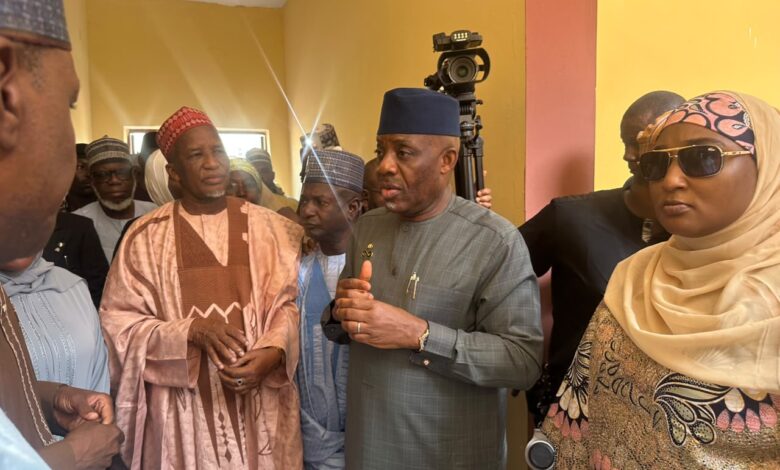
Attah said the Minister of Education, Dr. Tunji Alausa embarked on a strategic inspection of major Federal Government education projects and institutions across Kano State.
He was accompanied by the Minister of State for Education, Professor Suwaiba Ahmad, the Executive Secretary of the Universal Basic Education Commission (UBEC), the Executive Secretary of the Nigerian Educational Research and Development Council (NERDC), senior officials of the Federal Ministry of Education and the Kano State for Commissioner for Education, the Minister inspected the Bilingual School in Ungogo, the JICA-supported Junior Secondary School in Lenge, Tofa Local Government Area, Federal Government College, Kano, the National Commission for Mass Education (NMEC) Kano Office and Tarda Smart School.
The inspection commenced at the Bilingual School in Ungogo, where the Minister expressed satisfaction with the pace of work, noting that the project has reached about 90 percent completion and is on course for delivery on or before 31 August 2026. He directed that preparations for teacher recruitment and other operational requirements begin immediately to ensure that the school receives its first set of learners when it opens in September.
Dr. Alausa disclosed that preparations were equally underway to commence academic activities in a third bilingual school at the beginning of the 2026 academic session, while a fourth is expected to become operational by June 2027.
He described the bilingual school initiative as one of the Federal Government’s most impactful responses to the out-of-school children challenge, explaining that the schools are designed to integrate Almajiri and other vulnerable children into formal education while equipping them with the knowledge, skills and values required to thrive.
According to the Minister, the Nigeria Education Sector Renewal Initiative has continued to deliver encouraging results, with more than one million out-of-school children returned to classrooms within the last 24 months. Beyond bringing children back to school, he said, the administration is focused on ensuring they remain in school through improved teaching, better learning environments and sustained support that will translate into stronger learning outcomes.
At the JICA-supported Junior Secondary School in Lenge, Tofa Local Government Area, the Minister inspected ongoing construction of classrooms, perimeter fencing and Water, Sanitation and Hygiene facilities. He announced that upon completion, the junior secondary school would relocate to the new structures, while the existing buildings would be converted into a primary school.
At Federal Government College, Kano, Dr. Alausa commissioned the newly renovated digital e-library, describing it as another significant milestone in the Federal Government’s drive to prepare Nigerian students for a digital future. The modern facility, equipped with solar power, air conditioning, quality lighting and nearly 80 digital computer workstations, provides students with a world-class environment to develop essential digital literacy skills.
He disclosed that the present administration inherited 36 abandoned and poorly executed e-library projects across Unity Colleges. Through the intervention of UBEC, 16 of the facilities have now been fully rehabilitated, reflecting the Federal Government’s determination to modernise public schools and provide Nigerian children with education that meets global standards.
Addressing the proposed Public Private Partnership Land Swap initiative at the college, Dr. Alausa reaffirmed the Federal Government’s commitment to the policy, explaining that responsibly leveraging underutilised land will generate resources needed to provide better classrooms, hostels and other critical infrastructure for students. He stressed that every decision of the Ministry was guided by one overriding consideration: what best serves the interests of Nigerian children.
“Our responsibility is to ensure that every policy translates into better opportunities for our students. We have no interest other than providing quality education and improved infrastructure for Nigerian children,” the Minister said.