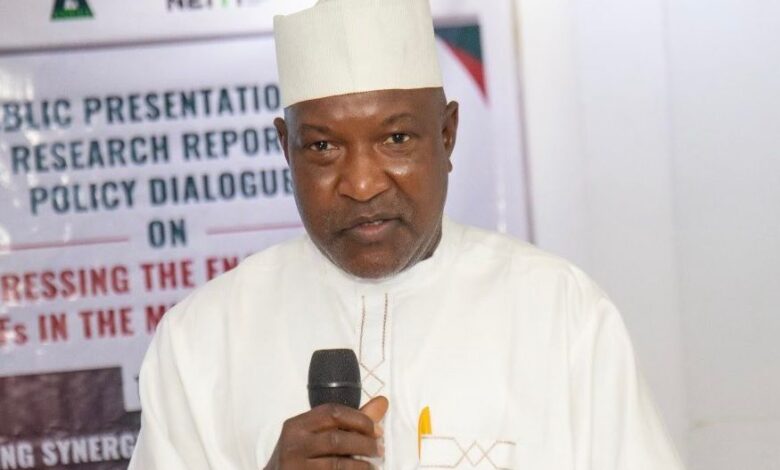


The Nigeria Extractive Industries Transparency Initiative (NEITI) has promised to work with other stakeholders in the solid minerals sector to check illicit financial flows into the sector.
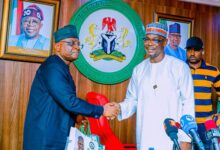
NEITI Executive Secretary, Hon. Musa Sarkin Adar, made this pledge on Wednesday at the Public Presentation of Research Report and Policy Dialogue on addressing Illicit Financial Flows (IFFs) in Nigeria’s Solid Minerals Sector, held at the NEITI House, Abuja.
According to the African Union estimates, Nigeria accounts for thirty-five percent of all illicit flows from Africa. Revealing that ninety-three percent of these illicit flows occur through the extractive industry.
To address this problem, Hon. Adar said the agency and partners must continue to generate reliable data for policymakers, noting that the research directly addresses one of the most pressing governance challenges facing not only Nigeria’s extractive sector but the entire economy.
He commended the Africa Network for Environment and Economic Justice for undertaking the timely and evidence-based study, in collaboration with NEITI and the Ministry of Solid Minerals Development.
“This is why I commend your effort and commitment in this project. I want to reassure you of NEITI’s institutional support and partnership to ensure that transparency, accountability, and data-driven reforms remain at the heart of Nigeria’s solid minerals development agenda.
“The research aims to present key findings and policy recommendations on illicit financial flows in Nigeria’s solid minerals sector, provide a national platform for multi-stakeholder dialogue, identify critical policy, legal, and institutional reforms to strengthen transparency and accountability, and promote synergy for coordinated anti-Illicit Financial Flows actions. These objectives align closely with NEITI’s mandate to promote transparency and accountability in the management of Nigeria’s extractive resources,” the NEITI boss said.
According to him, the report also underscores the limited integration of solid minerals data across government institutions, including mining regulators, revenue authorities, and border agencies.
“This weakness reduces the effectiveness of monitoring and enforcement and weakens the state’s ability to detect and prevent illicit financial practices,” he added.
He said the relevance of the research was further reinforced by Nigeria’s commitment to implementing the 2023 EITI Standard, which places stronger emphasis on addressing corruption risks and illicit financial flows in extractive industries.
Adar said the Standard calls for enhanced transparency across the entire extractive value chain, including license allocation, beneficial ownership disclosure, production and export data, revenue collection, and inter-agency data sharing.
“In particular, the 2023 EITI Standard recognises that transparency is a critical tool for exposing the structural weaknesses and opacity that enable illicit financial flows. It encourages countries to use EITI disclosures to identify risks, inform reforms, and strengthen collaboration among oversight institutions.
“NEITI has continued to align its reporting and policy engagement with these requirements, especially in the solid minerals sector, where governance gaps remain pronounced,” he concluded.
Earlier, the Chief Executive Officer (CEO), Nigerian Financial Intelligence Unit (NFIU), Hafsat Bakari, commended the NEITI, the Federal Ministry of Solid Minerals Development, ANEEJ, and the UK Foreign, Commonwealth and Development Office for convening this timely engagement and for the rigorous work that underpins the research.
Bakari, who was represented by the Chief Operating Officer, Law Enforcement, Support and Coordination Sector, Dr (Mrs) Biola Shotunde, said Illicit financial flows continue to undermine revenue mobilisation, governance, and development outcomes, particularly in resource-rich economies such as Nigeria.
In the solid minerals sector, she said these risks are amplified by structural and operational vulnerabilities that expose the sector to abuse by criminal actors and facilitate the laundering of illicit proceeds.
She maintained that as the central and coordinating agency for AML/CFT/CPF in Nigeria, the NFIU emphasises the importance of embedding Anti-Money Laundering, Counter-Terrorist Financing, and Counter-Proliferation Financing measures across the entire solid minerals value chain.
“From licensing and production to trading, exports, and payments, AML/CFT/CPF controls must be fully integrated to enable the early identification, tracking, and disruption of illicit financial flows,” she added.
Achieving this, according to her, requires more than intent. “It calls for targeted policy reforms, strengthened inter-agency collaboration, capacity building, timely intelligence sharing, improved data systems, and the systematic deployment of parallel financial investigations alongside traditional enforcement actions.
“There is also a clear need to deepen understanding of predicate offences linked to the sector, including corruption, tax evasion, terrorist financing, environmental crimes such as illegal mining, and arms trafficking,” she said.