Nigeria To Accelerate National Food, Nutrition Bill As Child Nutrition Fund Hits $52m
By Sunday Etuka


Vice President Kashim Shettima has said Nigeria will speed up work on a National Food and Nutrition Bill to protect nutrition financing, strengthen accountability and keep interventions going across successive administrations.

He said the proposed law would reinforce the Federal Government’s Nutrition 774 Initiative and deepen a compact among federal, state and local governments to deliver a unified response to malnutrition, starting at the community level.
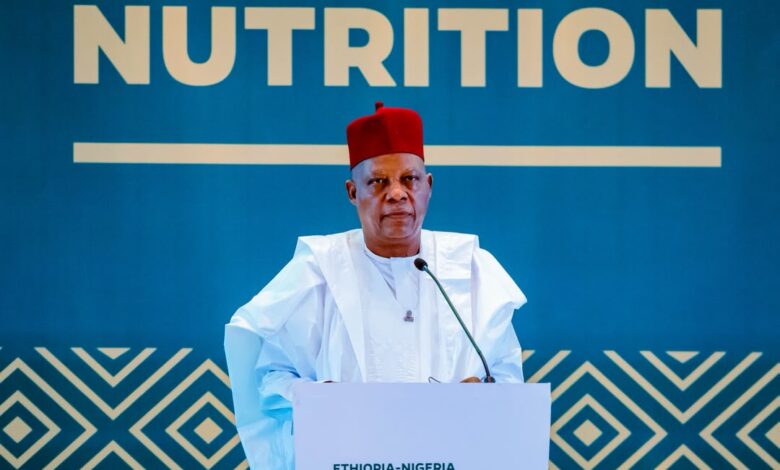
Shettima spoke on Wednesday at the Nigeria-Ethiopia Nutrition Leadership Exchange Forum in Addis Ababa, Ethiopia, according to a statement by his Senior Special Assistant on Media Ns Communications, Stanley Nkwocha.
He said Nigeria’s National Policy on Food and Nutrition 2026 to 2035 sets targets to cut the country’s stunting rate to 32 per cent by 2029, 28 per cent by 2032 and 25 per cent by 2035.
The Nigerian delegation included the Governors of Jigawa, Malam Umar Namadi; Zamfara, Dr. Dauda Lawal; Osun, Senator Ademola Jackson Nurudeen Adeleke; and Abia, Dr. Alex Chioma Otti.
Also present were the Coordinating Minister of Health and Social Welfare, Prof. Muhammad Ali Pate; the Minister of Agriculture and Food Security, Senator Abubakar Kyari; the Minister of Budget and Economic Planning, Senator Abubakar Atiku Bagudu; the Minister of Water Resources and Sanitation, Prof. Joseph Terlumun Utsev; and the Minister of Education, Dr. Maruf Tunji Alausa.
Other members were the Director-General of the National Emergency Management Agency, Zubaida Abubakar Umar; the Executive Director of the National Primary Health Care Development Agency, Dr. Muyi Aina; the Senior Special Assistant to the President on Public Health and Focal Person on Nutrition, Uju Vanstasia Rochas-Anwukah; and the National President of the Association of Local Governments of Nigeria (ALGON), Hon. Bello Lawal.
The Vice President said nutrition committees now exist in 32 State Houses of Assembly, making this the right time to give the national response firmer legislative support.
“We are convinced that, with nutrition committees in 32 state assemblies, there is no better time for us to accelerate the development of a National Food and Nutrition Bill,” he said, adding that it should come with a federal, state and local compact to protect financing and enforce accountability beyond any one administration.
He added that committees have also been set up in more than 450 local governments, while the Federal Government is strengthening state councils and delivery capacity at every level.
According to Shettima, the Nutrition 774 Initiative offers a single framework that brings all tiers of government together, with governors and local government chairpersons leading implementation in their areas.
He described each council as the basic unit of planning, financing and accountability, and said the government is working with states on cost plans for priority councils that bring health, agriculture, social protection, water, sanitation, hygiene and education to the same mother and child.
The Vice President disclosed that Nigeria’s $26 million commitment to the Child Nutrition Fund drew matching support, unlocking $52 million. He said 21 states have also contributed $6.3 million since 2023 for supplies to prevent and treat malnutrition.
He said the proposed Presidential Nutrition Investment Fund would provide catalytic financing, while the Nutrition Financing Subcommittee is working to raise more domestic resources.
The government is also linking public spending to measurable nutrition outcomes through scorecards and stronger domestic financing. “We can only claim that our budget fulfils its purpose when it nourishes a child,” he said.
He said the urgency is clear, as 40 per cent of Nigerian children under five are stunted and undernutrition costs the economy an estimated $56 billion every year. “We act to protect learning. We act to preserve earnings. We act to project productivity,” he said.
Shettima added that the government is engaging food vendors, small and medium enterprises, manufacturers, financiers and regulators through its Private Sector Engagement Framework to make nutritious food more available and affordable. It is also working with industry and regulators to improve compliance with fortification requirements for salt, flour, edible oil and sugar.
He said Nigeria and Ethiopia will work towards a joint statement setting out continued cooperation on nutrition. “Nigeria and Ethiopia owe Africa an example worthy of its children,” he said.
Ethiopia’s Deputy Prime Minister, Mr. Temesgen Tiruneh, who opened the forum, said the long relationship between the two countries could help shape Africa’s development path.
He welcomed Nigeria’s interest in Ethiopia’s nutrition experience, noting that his country has placed food and nutrition at the centre of its development agenda.
Better nutrition, he said, requires sustained political leadership, financing and accountability at every level of government, supported by systems that track results.
He said more than 100,000 children in Ethiopia have been protected from malnutrition through community mobilisation and improvements in the nutritional value of their food and added that Ethiopia also has lessons to learn from Nigeria.
Ethiopia’s Minister of Health, Dr. Mekdes Daba, said the exchange focused on one of Africa’s most urgent development challenges, with particular attention to the Seqota Declaration, Ethiopia’s national commitment to end child stunting by 2030.
She said poor nutrition can limit brain development, weaken school performance, reduce future earnings and slow economic progress.
“Investing in the first 1,000 days of a child’s life is among the most important investments a country can make,” she said.
She added that malnutrition cannot be defeated by one ministry or sector acting alone.
Governors and ministers from the Nigerian delegation who spoke at the forum pledged to strengthen the nutrition value chain through more investment in technology, financing, education and food systems.
On the sidelines of the forum, Shettima and Tiruneh held a bilateral meeting where they reviewed relations and explored deeper cooperation in trade, investment, food security, aviation and security.
Tiruneh, who conveyed Ethiopia’s condolences over the recent Ondo air crash, said his country places a high premium on ties with Nigeria, as both are among Africa’s most populous nations.
He said Ethiopia’s decision to treat nutrition as an economic and development issue led to the launch of the 15-year Seqota Declaration in 2015, starting with the communities worst hit by malnutrition before spreading to about half the country.
He also welcomed progress on the Transfer of Sentenced Persons Agreement signed by both countries, called for the Nigeria-Ethiopia Joint Commission to be convened, and praised growing private-sector cooperation, including the Dangote Group’s investment in Ethiopia.
Shettima reaffirmed Nigeria’s commitment to deeper bilateral relations, saying both countries should use their population, resources and strategic positions for Africa’s development.
He commended Ethiopia’s progress in agriculture and domestic value addition and stressed the need for stronger intra-African investment under the African Continental Free Trade Area.
He assured the Ethiopian side of Nigeria’s commitment to the Joint Commission and said both countries should expand cooperation in investment, agriculture, economic development and security.
With global growth shifting increasingly towards Africa, and the continent blessed with a young population, he said Nigeria and Ethiopia must provide the leadership needed to unlock its potential.