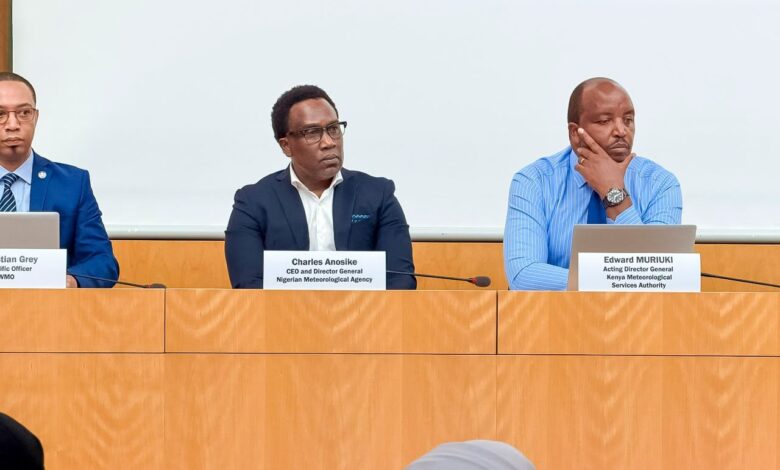


The Director-General Nigerian Meteorological Agency (NiMet), Prof. Charles Anosike, has called for increased investment in weather observation systems across Africa, saying quality data remains the foundation for effective Artificial Intelligence (AI)-powered weather forecasting and climate services.

Anosike made the call on Friday while participating in the World Meteorological Organization (WMO) Executive Council Side Event on “Scaling AI-Powered Weather Services for Farmers” in Switzerland.
Speaking during the session, the NiMet boss stressed that bridging observation and data gaps across Africa is critical to unlocking the full benefits of AI in meteorology and improving weather information for farmers.
He said Nigeria, through NiMet, has taken deliberate steps to integrate AI into its operations, noting that the agency inaugurated an AI Research Team in January 2026 to identify, evaluate and deploy AI and machine learning technologies in its operational activities.
According to him, the agency has since developed AI Terms of Reference (TOR), Standard Operating Procedures (SOP), an AI Operational Framework with phased implementation milestones, and documented AI use cases to guide the technology’s adoption.
Anosike disclosed that NiMet is currently evaluating leading AI weather prediction models while developing the MeteoAI platform to improve weather forecasting, climate prediction, forecast verification and early warning services.
He added that the agency is also assessing the most cost-effective computing infrastructure required for operational deployment of AI technologies.
The Director-General reaffirmed the agency’s commitment to leveraging AI and modern geospatial technologies to strengthen operational meteorology and advance the Early Warnings for All initiative across Africa.
He said the initiative is aimed at ensuring farmers and vulnerable communities receive more timely, accurate and actionable weather and climate information to support food production, disaster preparedness and climate resilience.