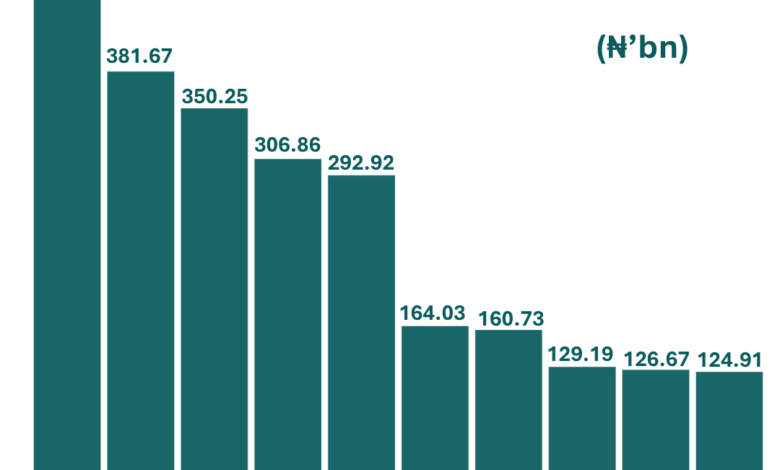


Lagos and Oyo states recorded the largest year-on-year growth in gross allocations from the Federation Account Allocation Committee (FAAC) in the first half of 2026, according to the latest report by an Abuja-based policy think-tank, Agora Policy.

The report shows Lagos’s gross FAAC allocation grew by 41.5% compared to the same period last year, while Oyo’s rose by 36.4%. At the other end of the scale, Edo and Delta recorded the lowest increases, at 16.4% and 16.8% respectively.
Lagos remained the largest recipient of Gross FAAC allocations in the first half of 2026, receiving ₦477.05 billion, while Nasarawa received the least at ₦72.78 billion. The composition of the top and bottom recipients changed slightly compared to H1 2025.
Ondo entered the top 10 states by Gross FAAC allocation, replacing Edo, which dropped out of the top 10. At the lower end of the ranking, Ogun joined the bottom 10 states, while Zamfara moved out of the group.
Across the 36 states, 20 received gross allocations of between ₦100billion to ₦300billion, Nine received less than ₦100billion, and four states -Lagos, Delta, Rivers and Akwa Ibom each received over ₦300billion.
The report also highlighted a notable pattern at the local government level. Despite having the highest number of Local Government Areas (LGAs) of any state at 44, Kano’s combined gross FAAC allocation of ₦163.5 billion to its LGAs was only the second highest and was nearly half of the ₦310.85 billion received by the 20 LGAs of Lagos.
Similarly, Rivers, with 23 LGAs, received a higher gross FAAC allocation to its LGAs than Oyo and Katsina, despite having 33 and 34 LGAs, respectively. This pattern appears recent and is likely on account of the growing prominence of Value Added Tax (VAT) as a source of FAAC revenue.
LGAs receive 35% of VAT revenue, and states with urban and commercial LGAs with a high level of consumption, like Lagos and Rivers, stand at an advantage, even with fewer numbers of LGAs.
Overall, the report found that FAAC performance in the first half of 2026 was marginally better than the corresponding period of 2025, with higher gross FAAC revenue, a larger distributable pool, and lower deductions.
Total gross FAAC revenue for the period stood at ₦18.72 trillion, with statutory revenue contributing ₦13.95 trillion, which is equivalent to 75% of the total gross revenue, while VAT accounted for ₦4.77 trillion (25%).
The mid-July disbursements, covering revenue generated in June 2026, marked the close of the first half of the fiscal year and gave analysts an opportunity to review allocation trends from January through June.
However, the report cautioned that improved allocations alone will not necessarily translate into better development outcomes unless accompanied by more efficient public spending across the three tiers of government.
It called for stronger transparency and accountability mechanisms to ensure that rising revenues deliver measurable value for citizens, arguing that as allocation grows, attention should shift from the size of receipts to how effectively the funds are used to improve infrastructure, public services and general welfare.