

President Bola Tinubu has disclosed that his administration is working with all the relevant stakeholders in the disaster risk sector to ensure that the country does not experience the repeat of the Maiduguri flood.

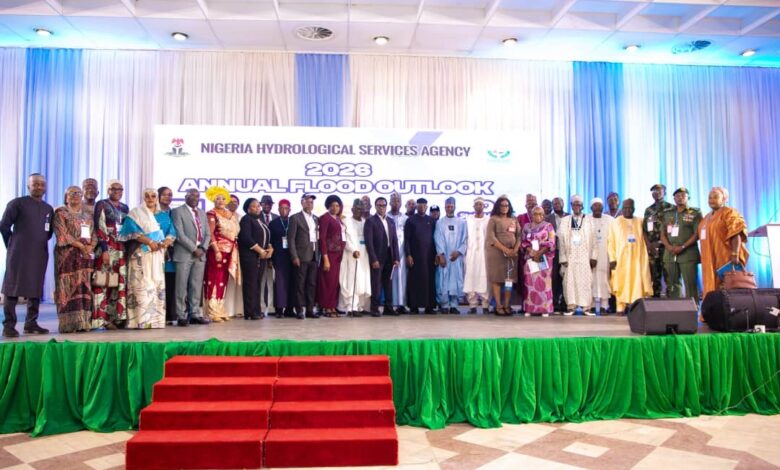
The President stated this on Wednesday at the Presentation of the 2026 Annual Flood Outlook (AFO) by the Nigeria Hydrological Services Agency (NiHSA) at the State House, Abuja.
He said the 2024 flood in Maiduguri, Borno State has enabled the country to transform from the traditional flood management to proactive management of not only flood, but also the nation’s natural resources.
“The Office of the Vice-President has championed the Anticipatory Action for flood and other related disasters management with the support of the Office of the National Security Adviser, Development Partners, MDAs and Stakeholders in the disaster risk sector.
“I am happy to inform you that the Anticipatory Action Committee have been working tirelessly to ensure that our country does not experience the repeat of the Maiduguri flood,” President Tinubu said.
The Nigerian leader said the key to the anticipatory action is the Annual Flood Outlook (AFO) by the Nigeria Hydrological Services Agency. Noting that the AFO has been the foundational document upon which the early actions, preparedness and mitigation strategies are planned.
“It is, therefore, commendable that this year’s Annual Flood Forecast is being presented today, and early enough before the rains and other climate variabilities set in,” he said.
Acknowledging that the nation has been facing devastating flood disasters since 2012, President Tinubu said he faced challenges head on by initiating policy framework and programmes to tackle the recurrent annual floods in different parts of the country.
He explained that part of these programmes were to execute several flood control projects across all the States. Saying that in addition, the States that were known to be predominantly flood hotspots, notably: Adamawa, Taraba, Benue, Borno, Yobe, Kebbi, Niger, Nasarawa, Kogi, Edo, Anambra, Delta, Bayelsa, Rivers and Cross-River were given deserved attention.
He called on the Ministries of Water Resources and Sanitation, and the Marine and Blue Economy to come up with blue print of utilizing the nation’s vast water resources potentials to drive the economy.
“I dare say that, Nigeria can gradually transform from an oil dependent economy to accessing the derived benefits accrued from effective utilization and management of our abundant water resources and waterways,” he said.
He expressed belief that the 2026 Annual Flood Outlook (AFO) has provided required forecasts and information that are impact-based in all the 36 States of the Federation and the Federal Capital Territory, the 774 Local Government Areas, and all the Communities enough to activate preparedness, response and evacuation against any probable flooding event.
He urged all the relevant stakeholders in the water sector “to join hands to make Nigeria a flood-safe nation, our environment and natural resources protected, cultivate the country’s vast agricultural lands to enhance food security and build the resilience of the vulnerable populations and riparian communities from the effects of climate change and flood disasters.”