


The Federal Government and the Lagos State Government have reaffirmed their commitment to strengthening collaboration in the areas of flood resilience, sustainable water resources management, urban water sector reforms and sanitation to improve the well-being of Nigerians.
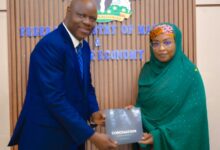
Minister of Water Resources and Sanitation, Prof. Joseph Utsev, made this known during a courtesy visit to the Governor of Lagos State, Mr. Babajide Sanwo-Olu, at the Lagos House, Marina, on Thursday.
Speaking during the visit, the Minister expressed appreciation to the Governor for the warm reception accorded to him and his delegation. He also conveyed the Federal Government’s sympathies to the Government and people of Lagos State over the recent flooding incidents experienced across the State.
Prof. Utsev noted that as one of Africa’s fastest-growing megacities, Lagos occupies a strategic position in the nation’s development, making collaboration between the Federal Ministry of Water Resources and Sanitation and the Lagos State Government essential to addressing emerging water resources and sanitation challenges.
He identified three key areas for enhanced collaboration: strengthening flood resilience, accelerating the attainment of Open Defecation Free (ODF) status, and advancing sustainable urban water sector reforms to improve service delivery and attract greater investment.
According to a statement by the Director Information and Public Relations of the Ministry, Mrs. Funmi Imuetinyan, the Minister observed that flooding has become an increasingly serious challenge in Lagos, particularly during the rainy season, with devastating impacts on homes, businesses, transportation and critical infrastructure.
He attributed the recurring floods to several factors, including the State’s coastal geography, rapid urbanisation, climate change, rising sea levels and increasingly intense rainfall.
He disclosed that the Annual Flood Outlook (AFO) 2026, issued by the Nigeria Hydrological Services Agency (NiHSA), identified Lagos State as one of the 33 states at high risk of flooding, underscoring the need for proactive planning, early warning systems and stronger intergovernmental collaboration.
Prof. Utsev commended the Lagos State Government for the various measures already being implemented to mitigate flooding and reaffirmed the Federal Government’s readiness to work closely with the State to strengthen flood resilience through integrated water resources management, improved drainage infrastructure, nature-based solutions, effective urban planning and enhanced institutional coordination.
The Minister also acknowledged Lagos State’s interest in participating in the Sustainable Urban and Rural Water Supply, Sanitation and Hygiene (SURWASH) Programme, describing it as a strategic platform for improving water supply and sanitation services through institutional reforms, strengthened governance, enhanced service delivery and performance-based financing.
On sanitation, Prof. Utsev commended the State Government’s efforts to improve sanitation and hygiene while calling for accelerated action towards achieving Open Defecation Free status, particularly in underserved communities.
The Minister also informed the Governor that the Ministry had developed the first draft of the National Water Compact, a strategic framework designed to drive transformative reforms across Nigeria’s water sector through improved policy coherence, institutional coordination, investment mobilisation and sustainable water resources management in line with the Renewed Hope Agenda of President Bola Ahmed Tinubu, GCFR.
He highlighted additional Federal Government initiatives aimed at reducing flood risks, including the launch of the National Flood Intelligence Monitoring System and the Multi-Hazard Flood Early Warning System by the Nigeria Hydrological Services Agency (NiHSA).
According to him, the systems will strengthen flood forecasting, support early action and improve coordination among governments, communities and other stakeholders to minimise the impact of flooding.
Prof. Utsev reaffirmed the commitment of the Federal Ministry of Water Resources and Sanitation to working closely with Lagos State and development partners to improve water supply, sanitation services and resilient water infrastructure capable of meeting the demands of the State’s rapidly growing population.
Responding, the Governor of Lagos State, Mr. Babajide Olusola Sanwo-Olu, welcomed the Honourable Minister and his delegation and appreciated the Federal Government’s commitment to supporting the State in addressing flood-related challenges.
Governor Sanwo-Olu underscored the strategic economic importance of Lagos State and acknowledged the increasing effects of climate change on the State, particularly flooding and other environmental challenges. He stressed the need for sustained collaboration between the Federal and State Governments in implementing practical and sustainable measures to mitigate the adverse effects of climate change.
The Governor further disclosed that Lagos State had already developed a comprehensive strategy for attaining Open Defecation Free status and expressed the State Government’s readiness to work closely with the Federal Ministry of Water Resources and Sanitation to strengthen sanitation, improve hygiene services, enhance flood management and promote sustainable water resources development.
The meeting reaffirmed the shared commitment of both governments to building a cleaner, healthier, safer and more climate-resilient Lagos State while advancing national efforts towards sustainable water resources management and improved sanitation services for all Nigerians.
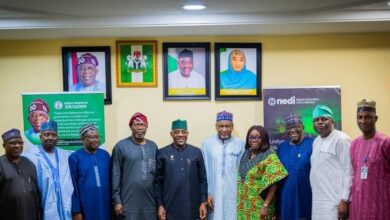
Present at the meeting were the Director-General of the Nigeria Hydrological Services Agency (NISHA), Arc. Umar Ibrahim Mohammed; the Managing Director/Chief Executive Officer of the Ogun-Osun River Basin Development Authority, Engr. Adedeji Ashiru; and other senior officials of the Federal Ministry of Water Resources and Sanitation and the Lagos State Government.