Tinubu’s Reforms Laying Groundwork For $1 Trillion Economy Target -Yilwatda
By Sunday Etuka


The All Progressives Congress (APC) says President Bola Ahmed Tinubu’s administration is steadily building the foundation for a $1 trillion Nigerian economy by 2030, pointing to reforms in fuel subsidy removal, foreign exchange, infrastructure and human capital development as evidence of progress.
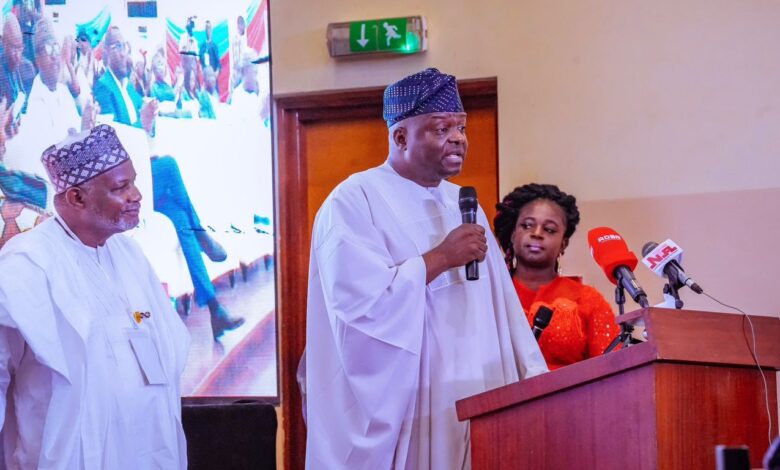
National Chairman of the party, Prof. Nentawe Goshwe Yilwatda, made the assertion while representing President Tinubu as Special Guest of Honour at the Second Edition of the Asiwaju Scorecard Series/Asiwaju Policy Roundtable, organised by the APC Professional Forum.
He thanked organisers and participants for providing a platform to discuss the administration’s policies and achievements.
Prof. Yilwatda said President Tinubu inherited a troubled economy in 2023, marked by fuel subsidy distortions, multiple foreign exchange windows, weak revenue generation, forex shortages, rising debt servicing costs and years of underinvestment in infrastructure.
He said the President made difficult but necessary decisions, notably removing the fuel subsidy and reforming the forex market, to reverse the trend.
Citing recent economic indicators, he noted that Nigeria’s external reserves had risen to about $52.7 billion by August 2026, while consolidated non-oil revenue grew from roughly N13.63 trillion in 2023 to N16.4 trillion in the first two quarters of 2026.
He also referenced improvements in the country’s merchandise trade position, real GDP growth of 4.43 percent in the second quarter of 2026, and a decline in inflation to about 15.4 percent from its earlier peak.
“These figures do not mean that our economic challenges have disappeared, but they demonstrate that the direction of travel has changed,” he said.
He stressed, however, that macroeconomic stability is not the ultimate goal of the Renewed Hope Agenda but a foundation for tangible improvements in the lives of Nigerians.
“The ultimate test is when stability translates into cheaper food, more jobs, affordable credit, reliable electricity and greater purchasing power for Nigerians,” he said.
Prof. Yilwatda described the $1 trillion economy target as a national development mission rather than a mere numerical goal, aimed at increasing production, exports, investment, job creation and opportunities for the country’s young population.
He said achieving it would require Nigeria to rethink its economic geography by leveraging its location, maritime resources, population and natural resources.
He proposed an integrated five port maritime and logistics corridor linking major deep sea ports in Lagos, Ondo, Ibom, Port Harcourt and Calabar through modern rail and road networks.
He said the Lagos Calabar Coastal Super Highway could serve as the coastal spine, with a Western Corridor connecting the Lagos Abuja Kaduna Kano rail line and the Sokoto Badagry Super Highway, and an Eastern Corridor linking the Port Harcourt Abuja Kaduna Kano rail line with the proposed Calabar Maiduguri Trans Sahara Super Highway.
He said the network could eventually connect Nigeria’s ports to landlocked markets in Niger, Chad, Burkina Faso, Sudan and the Central African Republic.
“This is how Nigeria can move beyond being simply a coastal trading nation to becoming the maritime gateway and logistics hub of West and Central Africa, capturing a much larger share of the continent’s trade, logistics, manufacturing and distribution value chain,” he said, describing the plan as “a trade architecture” that would generate employment and economic activity in logistics, warehousing, banking, manufacturing and agro processing.
He also underscored the importance of expanding rail connectivity toward Maradi and the Sahel, saying improved links would allow Nigerian businesses easier access to neighbouring markets while keeping trade related economic activity domiciled in Nigeria.
“If you are a businessman in Nigeria, the rail to Maradi will ensure that you can trade with all the neighbouring countries,” he said, urging northern governors to treat the corridors as platforms for economic transformation.
On energy, Prof. Yilwatda said no industrial transformation could succeed without reliable power, citing the Ajaokuta Kaduna Kano (AKK) gas pipeline as key to powering electricity generation, fertiliser production, manufacturing and industrialisation in Northern Nigeria.
He further highlighted government investment in education and skills development, particularly the Nigerian Education Loan Fund (NELFUND), which he said ensures financial hardship no longer prevents qualified youths from accessing higher education.
Drawing on his background as a former university lecturer, he said he had seen bright students drop out over unpaid fees.
“Even if you don’t like President Tinubu, your children can access the fund and access higher education,” he said.
He also cited government backed credit programmes for small and medium enterprises, as well as investments in healthcare, including new cancer treatment centres and improved maternal health facilities, and in the solid minerals sector, which he said offers Nigeria an opportunity to process resources locally rather than export them raw.
Earlier, the Chairman of the APC Professional Forum, Alhaji Isa Yuguda, described the forum as an important platform for APC members and public officials to account for their contributions to the Renewed Hope Agenda.
He singled out the removal of fuel subsidy as one of the administration’s most consequential decisions, acknowledging its controversy but arguing that its long-term benefits outweigh the immediate hardships.
Yuguda said the subsidy regime had long been marked by leakages and abuse, and commended President Tinubu for ending it, saying the resulting savings had expanded fiscal space for infrastructure and development spending.
He warned against any attempt to reinstate the old subsidy system ahead of the 2027 general elections, urging that political parties be judged on the credibility of their economic proposals rather than promises that could reverse the reforms.