

For a country where about 98 per cent of the population depends on roads for movement, Nigeria’s road crisis is difficult to describe as merely an infrastructure problem. It is a national economic emergency.

This ugly reality exposes the extraordinary burden placed on a road network that is already struggling with poor maintenance, heavy traffic, overloading, insecurity and years of underinvestment.
Permanent Secretary, Ministry of Transportation, Engr. Olufunso Adebiyi, said the overwhelming dependence on roads had created enormous pressure on existing infrastructure, resulting in congestion, deterioration and avoidable accidents.
But the more uncomfortable question is this:Why does a country that has spent billions of naira on road construction and rehabilitation continue to have roads that deteriorate so quickly? Where does the money go?
The Federal Government has repeatedly announced major road projects, rehabilitation programmes and emergency interventions.
The Ministry of Works has also acknowledged the enormous funding requirements of ongoing projects and continues to list hundreds of federal highway projects across the country.
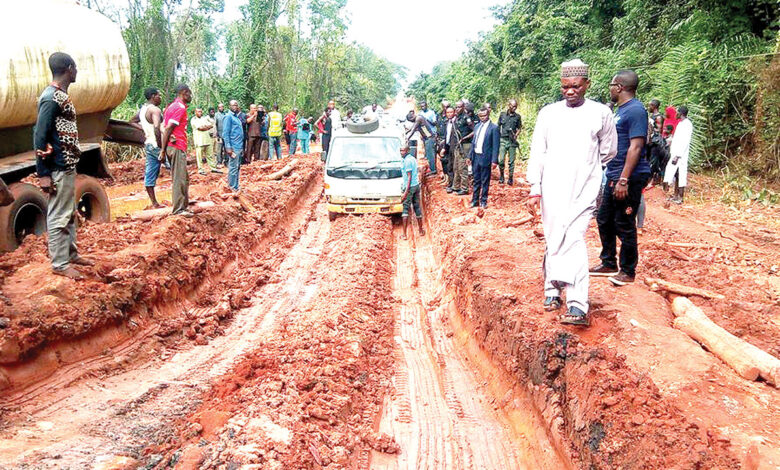
Yet, motorists travelling on many of these corridors still encounter potholes, failed sections, collapsed drainage, erosion and unfinished projects.
This creates an accountability gap. The issue should no longer be simply how much the government has budgeted or awarded in road contracts, but how durable the roads are.
Nigerians need to know how much was released, how much was spent, what kilometres were completed, whether the roads met specifications and how long the completed roads lasted.
Without such information, the cycle continues: a road deteriorates, the government awards another contract, repairs are carried out and, after a few years, the same problem returns. That is not sustainable infrastructure management.
The hidden tax of bad roads
Every pothole eventually produces a bill. A transport operator pays more for tyres, suspension components, fuel and repairs. The passenger pays more in fares. The trader pays more to move goods. The farmer pays more to transport produce to the market.
A survey cited in a 2025 report found that 86 per cent of transporters said poor road conditions contributed to higher transport fares, while others reported increased vehicle maintenance costs and longer journey times.
In other words, Nigerians are paying for bad roads even when they are not paying a direct road charge.They pay through higher fares.They pay through food prices.They pay through vehicle repairs. They pay through lost working hours. And, in worst cases, they pay with their lives.
For travellers on vulnerable highways, reaching a destination is no longer only a question of whether the vehicle will break down or encounter a pothole. It can also be a question of whether the passengers will arrive safely.
Kidnapping and other criminal attacks have made some road corridors particularly dangerous, while poor infrastructure can increase journey times and leave motorists stranded or vulnerable.
This means that improving roads without improving security will produce only half a solution.Nigeria needs highways that are not only motorable but secure. Are Nigerians also part of the problem? The government cannot be blamed for every failed road.
Road users contribute to the deterioration of infrastructure through overloading, reckless driving, illegal parking and poor vehicle maintenance.
Heavy trucks carrying loads beyond prescribed limits place enormous pressure on pavements. Drivers who ignore speed limits and traffic regulations increase the risk of crashes.
Communities also contribute when drainage channels are blocked with refuse or road reserves are occupied by traders and illegal structures.
The problem, therefore, is not simply government versus citizens.
It is a system in which the government must provide infrastructure and enforcement, while citizens must use and protect it responsibly.But responsibility cannot be equally distributed.
The government controls the design, construction, regulation and maintenance of the national road network. It therefore carries the greater responsibility for ensuring that public money produces durable infrastructure.
The accident statistics are a warning. The human cost makes the issue even more urgent.Road crashes remain one of Nigeria’s most persistent public safety problems, with thousands of crashes and deaths recorded annually.
The 2025 crash figures reported by the Federal Road Safety Corps showed more than 10,000 crashes and over 5,000 deaths, demonstrating that road safety cannot be treated as a secondary issue.
Bad roads are not responsible for every crash. Speeding, dangerous overtaking, fatigue, vehicle defects and driver indiscipline are major contributors.
But the condition of the road can turn a driver’s mistake into a fatal accident. A missing road sign, a failed shoulder, poor drainage, an unmarked construction zone or a deep pothole can all increase the consequences of human error.
The question should therefore be: How many crashes could be prevented if Nigeria’s roads were designed, maintained and monitored properly?
The government is doing something but is it enough?
There is evidence of substantial government intervention.
New roads are being awarded. Existing highways are being reconstructed. Some projects are adopting concrete pavement and other approaches intended to improve durability.
The Ministry of Works has also continued to push major highway projects and emergency repairs. But the scale of the problem means that simply awarding more contracts cannot be the answer.
Nigeria needs to move from a construction culture to a maintenance culture.A road should not be allowed to deteriorate to the point where reconstruction becomes the only option.
The government should know the condition of every major federal road, identify defects early and intervene before minor failures become major reconstruction projects.
Nigeria puts almost everything on the road.The 98 per cent dependence figure points to an even deeper problem.
Nigeria is asking roads to do too much.
Roads are carrying passengers, containers, agricultural produce, fuel, construction materials and virtually every category of freight.
The result is predictable: congestion, pavement damage and higher maintenance costs.This is why the country’s transport solution cannot be limited to road construction.
Rail must carry more freight.
Waterways must become commercially viable.Dry ports must be properly connected to rail.Major cities need functional mass transit systems.
If 30 trucks can be replaced by one train carrying equivalent cargo, the pressure on the highway is reduced.
The Permanent Secretary’s argument for integrated transportation therefore deserves attention: Nigeria must reduce its dependence on one mode rather than endlessly expanding the burden placed on roads.
What must change?
First, the government must publish clearer figures on road spending and project delivery.Second, road maintenance should become a permanent programme rather than an emergency response.
Third, axle-load regulations must be enforced without political or commercial interference.
Fourth, contractors should be held accountable for the quality and lifespan of their work.
Fifth, drainage must become a central part of road design because flooding and water damage are major contributors to road failure.
Sixth, security agencies must protect major highways and establish rapid-response systems for motorists.Seventh, Nigeria must strengthen vehicle inspection and enforce roadworthiness standards.
Finally, the government must accelerate rail and water transport so that highways are no longer expected to carry virtually the entire economy.
Nigeria’s road crisis is no longer about whether the government is constructing roads.It is about whether the country is getting value for money.
If billions are spent repairing roads that fail repeatedly, Nigerians deserve answers.If contractors are paid but projects remain incomplete, somebody must be held accountable.
If roads are completed without adequate drainage, signs or safety features, the system has failed before the first pothole appears. And if citizens overload trucks, destroy drainage systems and disregard traffic rules, they too must answer for their contribution.
With 98 per cent of Nigerians depending on roads, the country cannot afford a system where bad roads are treated as normal.Nigeria does not simply need more roads.
It needs roads that last, roads that are safe, roads that are secure and a transport system that does not force virtually every Nigerian and every tonne of cargo onto them.