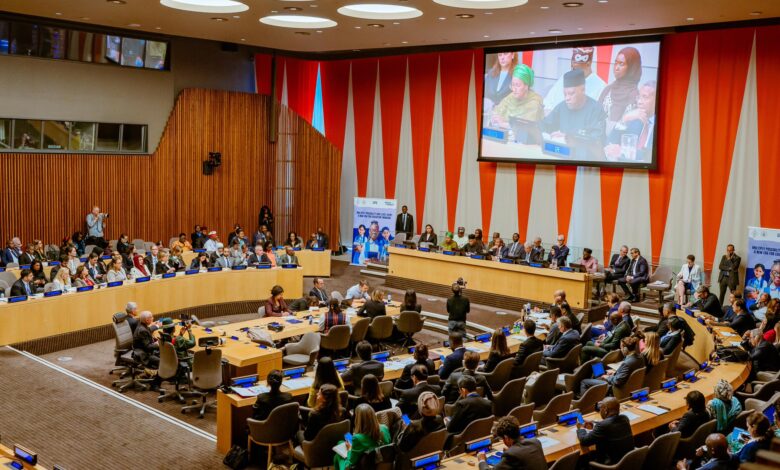


When Vice President Kashim Shettima stepped to the podium at the UN General Assembly on behalf of President Bola Tinubu, one demand anchored Nigeria’s entire address: a permanent seat, with full veto power, for Africa on the UN Security Council.
The call is not new, Nigeria and its African partners have pressed it for two decades, but the statement laid out, in compact form, the argument for why the continent believes its exclusion has gone on too long.
The Security Council’s five permanent members: the United States, United Kingdom, France, Russia and China were fixed in place at the UN’s founding in 1945, reflecting the victors of the Second World War.
Eighty-one (81) years later, Nigeria’s statement argues, that arrangement no longer matches global reality, insisting the “world of 2026 cannot remain captive to the distribution of power in 1945.”
The imbalance is stark: Africa contains 54 of the UN’s 193 member states, more than a quarter of the entire General Assembly, yet has never held a permanent seat on the body that makes the world’s most consequential decisions on war, peace and sanctions.
Nigeria’s statement captured the contradiction directly: “Africa cannot continue to fill the Council’s agenda while remaining absent from its permanent membership.”
That last point is central to the case. A large share of the Security Council’s active agenda, conflicts in Sudan, the Sahel, the Democratic Republic of Congo, Somalia and elsewhere, concerns African nations. Yet decisions on peacekeeping mandates, sanctions and interventions affecting those countries are made without a single African permanent voice in the room.
What Nigeria Is Actually Asking For
Nigeria’s demand is not freelanced; it rests on two established African Union positions: The Ezulwini Consensus (2005), Africa’s common negotiating framework for UN reform, calling for full African representation in global decision-making, especially the Security Council.
The Sirte Declaration, a companion African Union document reinforcing the same continental position.
Built on these, Nigeria’s statement calls for a minimum of two permanent seats for Africa, carrying full permanent-member privileges “including the veto for as long as it exists,” plus five non-permanent seats for the continent overall, a total of seven African seats on an expanded Council.
Beyond the continental argument, Nigeria makes an individual case for its own qualification, built on decades of peacekeeping contributions.
The statement points to Nigerian troop and resource commitments across some of Africa’s most difficult conflicts: Liberia and Sierra Leone in the 1990s and early 2000s, and more recent deployments to Darfur, Mali and The Gambia.
It also cites Nigeria’s ongoing institutional role — through ECOWAS, the African Union, and Gulf of Guinea maritime security partnerships, in mediation, counter-terrorism and democratic governance support across West Africa.
As Africa’s most populous nation and one of its largest economies, Nigeria has long presented itself as best-positioned among several regional contenders, including South Africa and Egypt, though the statement stopped short of pressing Nigeria’s individual claim over the AU’s collective position.
Why It Matters Beyond Prestige
The push for Security Council seats is not simply about status. Permanent membership carries the veto; the power to block any substantive Council resolution, which has repeatedly shaped outcomes on conflicts, sanctions regimes and humanitarian interventions worldwide.
Without it, African nations can raise concerns in the General Assembly or as non-permanent Council members, but cannot ultimately stop or shape binding decisions on crises unfolding on their own continent.
Nigeria’s statement linked this democratic deficit to a broader argument about global trust: institutions retain legitimacy, it argued, only when “institutions that adapt preserve their relevance; those that resist change imperil it.” The implicit warning is that a UN seen as structurally unrepresentative risks eroding the very trust the 81st General Assembly’s theme sought to restore.
A Familiar Deadlock
Despite periodic voiced support from some permanent members for the principle of African representation, the reform process has been gridlocked for years. Any change requires amending the UN Charter, a two-thirds vote in the General Assembly plus ratification by all five existing permanent members, each holding an effective veto over reform itself.
Complicating matters further, African nations have not always agreed on which countries would fill new seats, with Nigeria, South Africa and Egypt often viewed as rival claimants, a division that has, at times, blunted the collective leverage the Ezulwini Consensus was designed to provide.
The Bottom Line
Nigeria’s statement frames the Security Council demand as both a matter of fairness, correcting an 80-year-old exclusion and of function, arguing a Council that repeatedly deliberates on African crises cannot claim full legitimacy without African permanent voices deciding them.
Whether this fresh appeal moves the needle on a reform process long stalled by competing interests remains, as in past years, an open question.