
FG Warns Vice-Chancellors Against Poor Governance, Regulatory Breaches
By Alice Etuka, Abuja


The Federal Government has charged vice-chancellors of Nigerian universities to uphold transparency, accountability and strict regulatory compliance.

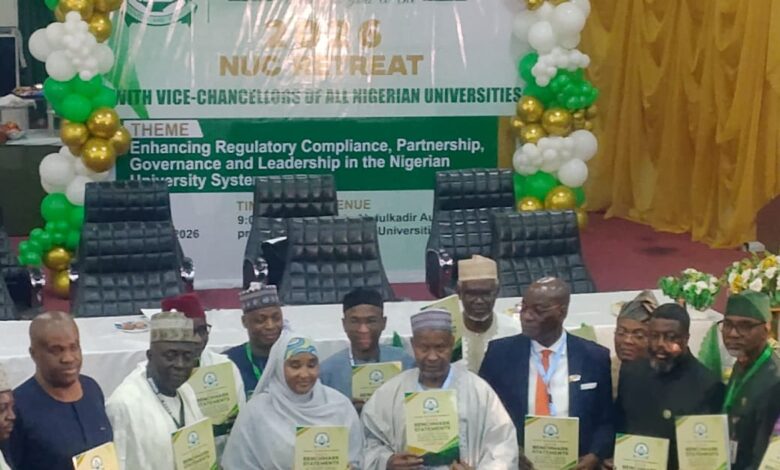
The Minister of State for Education, Professor Suwaiba Said Ahmad, gave the charge on Tuesday at the opening of the 2026 retreat of the National Universities Commission (NUC) with vice-chancellors of all Nigerian universities in Abuja.
Ahmad warned that weak governance and disregard for due process could undermine the quality and credibility of the country’s higher education system.
She said university leaders must ensure that financial management, procurement, recruitment, promotions, admissions and examinations were conducted transparently and in accordance with established institutional procedures.
Additionally, she stressed that sustainable excellence in the university system depended on effective leadership, sound governance and responsible management of institutional resources, urging vice-chancellors to provide clear strategic direction and create an environment conducive to academic excellence.
The two-day retreat, holding from October 13 to 14, is themed, “Enhancing Regulatory Compliance, Governance, Leadership, and Partnership in the Nigerian University System.”
The minister warned that the challenges confronting Nigerian universities could not be addressed through isolated institutional efforts or regulatory directives alone, calling for stronger collaboration between the NUC, university governing councils, senates, staff, students, proprietors and development partners.
She also called for responsible adoption of artificial intelligence and other emerging technologies in higher education, stressing the need to protect academic integrity, ensure data security and establish appropriate ethical guidelines.
Ahmad commended the NUC Executive Secretary, Professor Abdullahi Yusuf Ribadu, and his management team for reviving the retreat after several years, describing it as an important platform for resolving longstanding challenges and coordinating policy implementation across federal, state and private universities.
In his address, Ribadu disclosed that the Commission was strengthening its quality assurance framework through new guidelines for the award and use of honorary doctorate degrees, with sanctions for defaulting universities, as well as post-matriculation monitoring and carrying-capacity visits to improve admission processes.
He said the NUC was also preparing to introduce post-accreditation monitoring visits to ensure that universities sustained the standards required for accredited academic programmes, while Blueprint 2.0 for the rapid revitalisation of Nigerian university education had been produced.
Ribadu further revealed that the Commission was developing a national Artificial Intelligence roadmap and policy framework to guide the integration of AI into the Nigerian university system, alongside accreditation software designed to improve transparency, data management and regulatory oversight.
On research, the NUC chief urged universities to move beyond producing academic papers to developing practical innovations that could address challenges in healthcare, agriculture, manufacturing, education and other sectors of the economy.
He said the Commission was working to strengthen research commercialisation through a dedicated division and was exploring international learning opportunities for selected vice-chancellors to study commercialisation models in Europe and Asia.
Ribadu also identified inadequate funding as a major constraint on university development, urging institutions to diversify their funding sources through partnerships with the private sector, alumni associations and development agencies, while maintaining accountability in the use of available resources.
The minister said the retreat should produce more than resolutions, expressing support for a communiqué containing specific policy actions and institutional commitments, backed by post-retreat monitoring and feedback to measure progress across the Nigerian university system.