

President Bola Tinubu has directed the comprehensive redesign and full reconstruction of the 136-kilometre Benin-Asaba Highway as a dual carriageway.
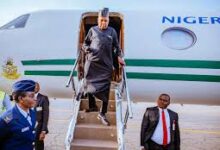
Senior Special Assistant to the Minister of Works on Media, Francis Nwaze disclosed this in a statement on Friday.
The Minister of Works, Engr. David Umahi who announced the return of the Benin-Asaba Road to the Federal Ministry of Works, assured motorists that permanent reinforced concrete pavement works would commence on the road.
The Minister described the development as a major step towards resolving the longstanding challenges faced by motorists travelling between the South-South and South-East, noting that the return of the road to the Ministry of Works would enable the Federal Government to take direct responsibility for its reconstruction.
He disclosed that President Tinubu had directed the total and comprehensive redesign of the 136-kilometre Benin-Asaba Road as a dual carriageway, adding that the design process was ongoing and construction would commence upon its completion.
The announcement came as the Minister outlined the Federal Government’s intervention to protect and rehabilitate the First Niger Bridge, a strategic transport link connecting communities and businesses across the South-East and South-South.
Umahi explained that the Ministry of Works responded after a content creator alerted the government to activities threatening the structural integrity of the bridge. An inspection subsequently revealed that some individuals were removing bolts and cutting iron components from the steel structure, activities he described as dangerous and capable of causing a bridge collapse.
He noted that the bridge was originally built and commissioned in 1966 by Nigeria’s then Prime Minister, Sir Abubakar Tafawa Balewa, but had suffered from inadequate maintenance over the years.
According to the Minister, the government has undertaken rehabilitation works similar to those carried out on Lagos’ Third Mainland Bridge, including asphalt resurfacing and median demarcation. He explained that the demarcation was necessary because bridges were not designed to withstand static loads indefinitely.
The ongoing safety improvements include the installation of CCTV cameras, solar-powered lighting and observation centres at both ends of the bridge. Security personnel will use the facilities to monitor activities on and beneath the structure, while three turnaround passages have been created to help motorists manoeuvre safely in the event of a vehicle breakdown.
He commended the contractor, SKCC, for its work but clarified that the rehabilitation was not yet 100 per cent complete. Outstanding works include repainting the entire steel structure, completing the maintenance of rust-affected areas beneath the bridge deck, installing CCTV cameras above and below the bridge, and providing canopies at both ends.
The Minister also issued a strong warning against illegal sand dredging around bridges, reminding the directors of the Federal Ministry of Works in Delta and Anambra States that federal regulations prohibit sand dredging within a 10-kilometre radius of bridges.
He warned that disciplinary action would follow if the illegal activity continued, directing the state directors to report any failure by security agencies to enforce the regulations.
Beyond the First Niger Bridge and the Benin-Asaba Road, Umahi highlighted other major infrastructure projects across the South-East and South-South, describing them as part of President Tinubu’s wider commitment to national infrastructure development.
He disclosed that the President had directed the reconstruction of approximately 400 kilometres of the East-West Road, which traverses the Niger Delta, from the Benin axis through the South-South to Cross River State.
According to Umahi, the project would serve as a spur of the 750-kilometre Lagos-Calabar Coastal Highway, another major infrastructure project under the Tinubu administration.
The Minister dismissed suggestions that construction on the Lagos-Calabar Coastal Highway had stopped, explaining that work remained ongoing and that the remaining sections in Bayelsa and Cross River would be taken up in the coming weeks.
He maintained that the coastal highway was a legitimate infrastructure investment for the Niger Delta and that the region was entitled to its share of national development projects.
“The coastal road is the right of the Niger Delta people. And the President will complete that 750-kilometre road. And they will also complete the SPP, which is the full reconstruction of 400 kilometres of East-West Road,” he said.