
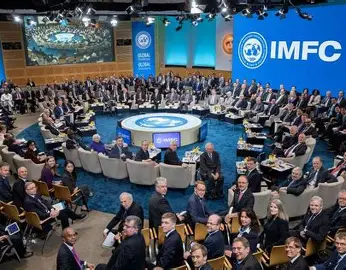


The International Monetary Fund (IMF) has projected Nigeria’s economy to grow at 4.1 per cent in 2026, from the 4.4 per cent growth rate projected in January this year.

In the April World Economic Outlook released by the Fund at the ongoing IMF/World Bank Spring Meetings in Washington DC, IMF however projected a stronger growth rate of 4.3 per cent for the nation’s economy in 2027.
The cut in the growth projection was largely influenced by the global shock, especially, the energy market disruptions occasioned by the ongoing Middle East conflict.
The US–Israel–Iran conflict has triggered a major external shock, disrupting energy markets, tightening global financial conditions, and introducing renewed inflationary pressures across advanced and emerging economies.
This shock comes on the back of recent economic reforms in Nigeria, aimed at building the right economic foundations for lifting millions out of poverty.
In the last few weeks, the Federal government of Nigeria has strengthened the country’s economic position and in response to the external shocks by: a. Continuously looking for ways to improve oil production, now 1.86 mbpd, according to recent data. This is to maximise Nigeria’s crude oil revenues, foreign exchange earnings, and fiscal revenues.
The government has also strengthened the Naira for Crude policy to safeguard domestic fuel production and supply to ensure no further strain to households and businesses due to fuel and diesel shortages.
The government continues to maintain a liberalised foreign exchange market to ensure continuous smooth capital flows. The policy has been validated by Nigeria’s reclassification as a Frontier Market by FTSE Russell, effective from September 2026.
There is also an improved and continuous close coordination across fiscal, monetary, and trade policies resulting in the recent tariff changes that reduces tariffs on critical industrial inputs to support production and expand international trade. These actions reflect a government focused on stabilisation, resilience, and growth continuity.