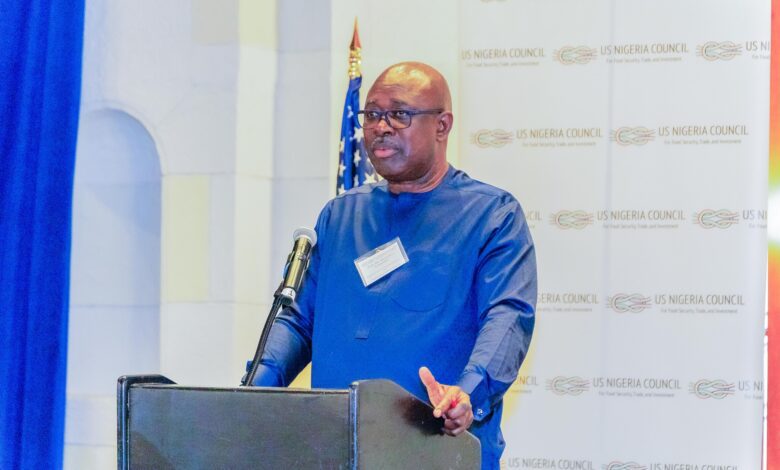


The Minister of State for Petroleum Resources (Oil), Senator Heineken Lokpobiri, has called for increased investment in Nigeria’s oil and gas industry, particularly in the midstream and downstream subsector, warning that current refining capacity remains insufficient to meet market demand.

Lokpobiri spoke on Tuesday at the opening of the Two-Day West Africa Refined Fuel Market Conference 2026, organised by the Nigerian Midstream and Downstream Petroleum Regulatory Authority (NMDPRA), in collaboration with the West African Regulators Forum and the S&P Global Energy in Abuja.
TheFact Daily reports that the conference with the theme: “Funding West Africa Infrastructure & Distribution to Create a Transparent Market for Regional Price Benchmarks,” brought together industry leaders, regulators and key stakeholders to explore opportunities, strengthen collaboration and shape the future of the region’s refined fuel market.
The Minister said the Dangote Refinery’s current capacity of 650,000 barrels per day of crude oil is not enough and called for further investment to expand refining capacity nationwide.
NMDPRA’s latest Factsheet shows that the total petrol supply to the domestic market declined from 41.5million l/d in May to 32.45million l/d in June. Of this volume, the Dangote Refinery supplied 32.5million l/d to the domestic market out of its total production of 39.1 million l/d.
Despite the lower supply to the domestic market, overall, petrol consumption in the country increased to 47.4million l/d in June from the 46.3million l/d 2026 in May.
On energy transition, Lokpobiri maintained that oil and gas would continue to be the dominant energy resource for a long time to come and stressed that Nigeria needs this resource to industrialize.
He described the conference as one of the most significant of its kind in Africa and urged the country to lead the continent’s oil and gas revolution.
Also speaking, the Commission Chief Executive of the Nigerian Upstream Petroleum Regulatory Commission (NUPRC), Mrs. Oritsemeyiwa Eyesan, said the nation’s oil and gas industry is undergoing major transformation, pointing to an increase in oil production to 1.6 million barrels per day, and meeting OPEC Quota.
She stressed the need to integrate the West African oil market, noting that countries could no longer operate in silos, and called for infrastructure development across the value chain to reposition the market for profitability.
The Special Adviser to the President on Energy, Olu Verheijen, said the pressing question for the continent is whether it can build the infrastructure, market systems, and regulatory framework required to advance the oil and gas transformation.
She called for greater infrastructure financing and urged governments to remove barriers to encourage cross-border trade across the continent.
On his part, the chairman of the House of Representatives Committee on Petroleum Resources and Downstream, Hon. Ikenga Ugochinyere said the National Assembly would work with all the relevant stakeholders, including the NMDPRA, to secure infrastructure against pipeline vandalism and crude oil theft in order to attract investors.
In his welcome remarks, the Authority Chief Executive of the NMDPRA, Rabiu Umar, described the gathering as the second edition of the conference, noting that the event had moved from setting a roadmap in 2025 to a focus on execution in 2026.

He said progress since the inaugural conference included the institutionalisation of regional regulatory cooperation through the West African Regulators Forum, advances toward a West African reference pricing system, and deeper collaboration with S&P Global Commodity Insights on market reporting and benchmark expertise.
Umar outlined five imperatives for the region going forward: deepening physical market liquidity, financing strategic infrastructure, accelerating regulatory and product-standard harmonisation, institutionalising market transparency, and building a complete trading ecosystem involving refiners, traders, terminal operators, banks, and regulators.
He said Africa’s infrastructure deficit represented an investment opportunity spanning pipelines, storage, marine terminals, refinery expansion, digital commodity exchanges, regional logistics corridors, but stressed that capital would only flow where projects are bankable and regulation predictable.
He added that the continent’s ambition should be to move from being a price-taker in global petroleum markets to becoming a credible centre of price discovery, trading, investment, and value creation, an outcome he said would require infrastructure, capital, operational excellence, regulatory cooperation, and execution.