
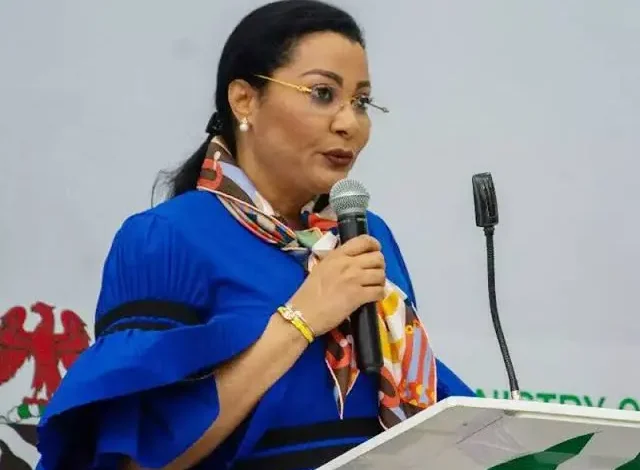
Minister Calls For Measurable Reform Gains To Achieve Investment-Grade Rating By 2030
By Sunday Etuka


Nigeria’s ambition to achieve investment-grade sovereign credit status by 2030 must be the product of stronger economic fundamentals rather than a goal pursued for its own sake, the Minister of State for Budget and Economic Planning, Dr. Doris Uzoka-Anite, said on Thursday.

Delivering the keynote address at the 2026 International Credit Rating Webinar organised by DataPro Limited, the minister said sovereign ratings reflect more than a country’s capacity to meet its financial obligations.
According to her, they also signal investor confidence in a nation’s institutions, policy environment and ability to attract long-term capital.
“Investment grade should be the outcome of stronger economic fundamentals, sustainable public finances, improved debt dynamics, rising productivity, stronger external buffers and credible institutions, not an end in itself,” Uzoka-Anite said.
The webinar, themed “Achieving Investment-Grade Rating By 2030: The Roadmap for Nigeria,” was the sixth edition of DataPro’s annual flagship event.
The minister said the road to stronger creditworthiness rests on four connected pillars: fiscal health and domestic revenue mobilisation, debt sustainability, economic diversification and productivity, and institutional credibility.
On revenue, she said projections under the National Development Plan (NDP) 2026 to 2030 show government revenue rising from 11.15 per cent of GDP in 2025 to 18.70 per cent by 2030.
She cautioned that “these are Plan projections whose achievement will depend on effective reforms and improved collection efficiency.”
The plan also projects capital expenditure rising to 57.43 per cent of total government spending by 2030, from 36.03 per cent in 2025.
On debt, the minister said public debt is projected to fall from 36.07 per cent of GDP in 2025 to 18.83 per cent by 2030.
The Federal Government’s debt service to revenue ratio is expected to drop from 62.93 per cent to 21.01 per cent over the same period.
She stressed that these also remain projections, dependent on growth, prudent borrowing and sound fiscal management.
“The guiding principle must be that borrowing should expand productive capacity rather than perpetuate fiscal pressures,” she said.
Under the NDP 2026 to 2030, real GDP growth is projected to rise from 4.68 per cent in 2026 to 10.34 per cent in 2030, averaging 7.79 per cent across the plan period.
Gross capital formation is expected to reach 40 per cent of GDP by 2030, with the private sector accounting for about 72 per cent of cumulative investment.
Uzoka-Anite acknowledged that the targets are demanding. “These are ambitious targets requiring improvements in infrastructure, energy supply, access to finance, regulatory efficiency and policy predictability,” she said, adding that the government cannot finance the country’s development needs alone.
The plan’s preferred scenario envisages a nominal economy approaching US$1 trillion by 2030.
Reflecting on the previous plan, the minister noted that real GDP growth averaged 3.11 per cent between 2021 and 2025, below the 4.65 per cent target.
She cited constraints in fiscal space, inflation, infrastructure, industrial productivity and exposure to external shocks.
She said the World Bank reported growth of 3.87 per cent in 2025, while the International Monetary Fund’s June 2026 assessment projected 4.1 per cent growth for 2026 and noted improvements in external reserves.
The IMF, she added, estimated the 2025 consolidated fiscal deficit at 4.4 per cent of GDP and stressed the need for fiscal adjustment and stronger revenue mobilisation.
She pointed to reforms since 2023, including petrol subsidy removal, foreign exchange market changes, public financial management improvements and the enactment of four major tax laws in 2025.
“Although these reforms have involved difficult adjustments for households and businesses, their ultimate success must be measured by their capacity to promote economic stability, reduce production costs, create jobs and improve living standards,” she said.
The minister said the ministry is institutionalising a National Macroeconomic Dashboard to track growth, inflation, revenue, fiscal balances, debt, investment and other indicators.
The government has also set up a Macroeconomic Assumptions Standing Committee to report to the Economic Management Team on the performance of key indicators.
She added that the rebasing of GDP and the Consumer Price Index offers a chance to improve how economic activity and inflation are measured.
“Stronger credit ratings and macroeconomic indicators must ultimately translate into improved living standards,” she said, linking the agenda to the Renewed Hope Ward-Based Development Programme, which targets Nigeria’s 8,809 wards.
On the role of rating agencies, she said they provide “independent assessments” and help identify areas where further reforms may strengthen resilience.
Concluding, Uzoka-Anite said the country is “moving in the right direction” toward becoming a diversified, resilient and globally competitive economy, while laying the foundation for stronger sovereign creditworthiness.
In his opening remarks, the Founder of DataPro Limited, Mr. Abimbola Adeseyoju, said credit rating is no longer a passive measure of risk. “It is now a catalyst for economic transformation,” he said.
He identified three priorities for African nations seeking and sustaining investment-grade status: structural reforms and fiscal sustainability, deeper and more transparent capital markets, and what he called domesticating the African narrative in global ratings through context-aware methodologies that balance risk awareness with growth potential.
“Africa’s journey towards investment-grade status is achievable through deliberate policy execution, sound market infrastructure and robust cross-border collaboration,” Adeseyoju said.
The event was attended by the Director-General of the Securities and Exchange Commission, Dr. Emomotimi Agama, and the Statistician-General of the Federation and CEO of the National Bureau of Statistics, Prince Adeyemi Adeniran, among other dignitaries.