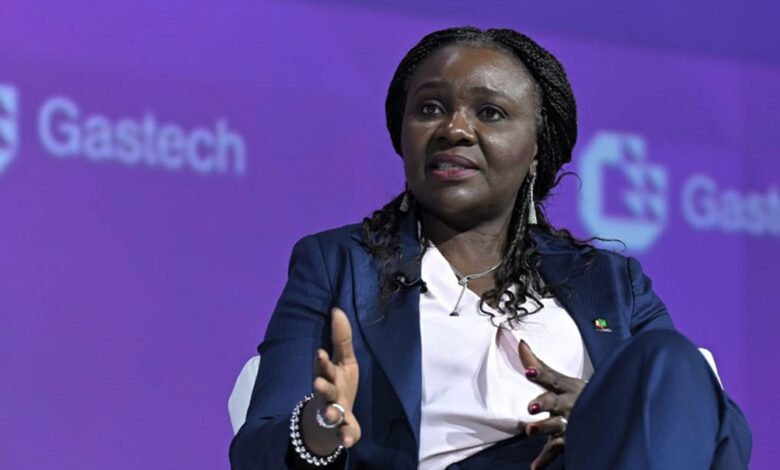


Nigeria plans to hold oil licensing rounds at least once a year, and possibly twice annually, as part of a broader effort to reverse a decade long decline in crude production, according to Oritsemeyiwa Eyesan, Chief Executive of the Nigerian Upstream Petroleum Regulatory Commission (NUPRC).
In an interview with S&P Global, Eyesan said the regulator aims to bring new entrants into the sector and enforce “drill or drop” rules designed to push companies to develop the licenses they hold rather than sit on them.
She was appointed last year in a surprise reshuffle of Nigeria’s two oil regulators and is now tasked with raising the country’s output to 3 million barrels per day by 2030.
That target has proven elusive for previous administrations. Nigeria has pumped roughly 1.5 million barrels a day of crude and condensate recently, and output has not exceeded 2 million b/d for the past 12 years, according to Platts OPEC+ survey data from S&P Global Commodity Insights. Maturing fields, pipeline vandalism and years of underinvestment have all weighed on production.
Eyesan took over midway through Nigeria’s 2025 bid round, the country’s second in two years, and wants to lock in a faster, more predictable schedule going forward.
“These will be annual, if possible, even twice-annual events. At a minimum, we’ll be going to the market on an annual basis,” she said, adding that she expects future rounds to be completed within six to seven months.
The pace of licensing has already accelerated sharply since Nigeria passed its Petroleum Industry Act (PIA) in 2021. Before that law, the country sometimes went five to ten years between bid rounds. Since then, the rounds have grown steadily larger, from seven blocks offered in 2022 and 2023 combined, to 19 in 2024 and 50 in 2025.
Nigeria’s most recent round covered the Niger Delta along with the Benin, Anambra and Chad basins, and resulted in 37 of the 50 available licenses being awarded in July.
Eyesan said those concessions should add 300,000 barrels a day of production within their first three years, with future rounds targeted to deliver 300,000 to 600,000 additional barrels a day each.
The next round is expected to launch by early October, drawing on new acreage that will include 13 blocks left unlicensed from the previous auction. It will span deepwater, shallow water and possibly frontier onshore basins, though Eyesan did not provide further details.
It will also be the first round she manages from beginning to end, and she said the commission intends to be more selective this time, limiting the offering to “viable assets.” She acknowledged that some blocks included in the last round were not ready.
“I knew we were going to have a problem with some of the blocks,” she said, noting the regulator “took a gamble” by adding them prematurely.
With international majors such as Shell, ExxonMobil, TotalEnergies and Eni retreating from Nigeria’s onshore fields, the commission has focused on attracting smaller, newer operators to fill the gap and revive inland production.
Eyesan pointed to companies including Renaissance and First E&P as examples of that strategy working. New rules also limit how long companies can hold licenses without drilling: shallow water licenses awarded in the 2025 round run for three years with a possible extension, while deepwater and frontier awards run for five years.
Even as it courts smaller onshore players, Nigeria continues to market its deepwater fields to major international companies. The sole deepwater block in the latest round, PPL 2010, went to Chevron.
The commission hopes to attract $30 billion to $50 billion in new deepwater investment across 22 projects by 2030, helped by tax incentives and what Eyesan described as shifting investor sentiment toward West Africa following the US-Iran war.
Nigeria’s growing refining capacity is also reshaping the outlook for its crude. Since Dangote’s refinery began operating in 2024, the country has gained a major domestic outlet for its oil.
The refinery, currently running at 700,000 barrels a day, has sourced 77% of its feedstock from Nigerian crude, according to data from S&P Global Commodities at Sea.
Dangote has previously complained about crude availability and terminal reliability, issues Eyesan expects to intensify once the refinery’s planned expansion doubles its capacity.
Eyesan said she supports a goal set by Nigeria’s downstream regulator to direct all domestic crude to local refiners by 2030, and that officials have used the growth of refining capacity to argue for a larger OPEC production quota, currently fixed at 1.5 million barrels a day since 2024.
Nigeria’s Domestic Crude Supply Obligation sets required volumes for local delivery, but producers can still sell to foreign buyers offering better terms.
To address that, the commission plans to launch a compliance trading platform that would let producers who exceed their domestic obligations trade certificates with those focused on exports.
Still, Eyesan said Dangote should not be forced to buy Nigerian crude if cheaper alternatives are available elsewhere.
“I would not begrudge Dangote if [it’s] not picking up domestic crude,” she said. “It might not be prudent to procure those grades as opposed to cheaper alternatives.”
Once its expansion is complete, the refinery will be able to process nearly all of Nigeria’s current crude output, not counting new government refining projects.
Despite that, Eyesan said she remains confident Nigeria can eventually rebuild a crude surplus, saying the country could reach 4 million barrels a day of production within eight to ten years.