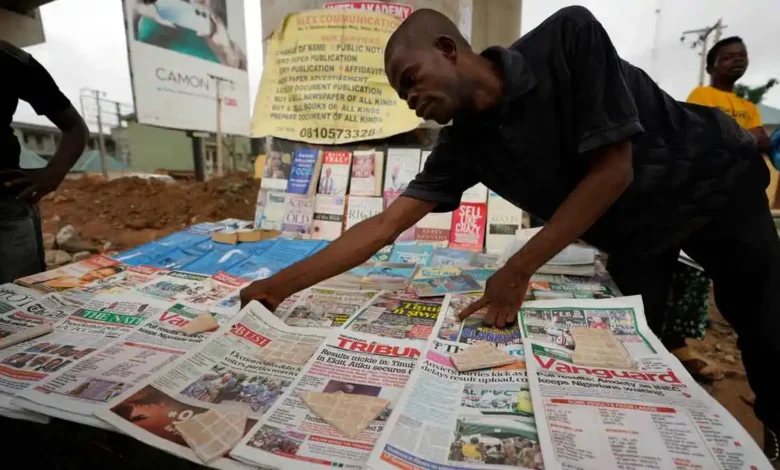


Nigerians will vote for a president in less than seven weeks, and the most contested ground may not be the ballot box at all. It is the phone screen. Every rally clip, every purported result sheet and every late-night voice note now travels faster than any electoral official can respond to it. That reality sits at the heart of the credibility burden the country’s media must carry into the 2027 general elections.
The warning was spelt out in Abuja on November 19, at the 2026 Annual Lecture and Awards of the Association of Corporate Online Editors (ACOE), held at the Army Resource Centre in Asokoro.
Under the theme “Roadmap to 2027: Strengthening Electoral Security through Collaboration between INEC, Media and Political Parties for Credible and Hitch Free Elections,” representatives of the Independent National Electoral Commission (INEC), the National Orientation Agency (NOA) and the National Identity Management Commission (NIMC) told online editors that the integrity of the vote now depends partly on the integrity of what is published about it.
The timetable leaves little room for error. INEC has fixed January 16, 2027 for the Presidential and National Assembly elections, with the Governorship and State Houses of Assembly elections to follow on February 6, 2027. Parties are therefore compressing primaries, alliances, campaign tours and mega rallies into a few intense weeks, and each event produces a flood of speeches, claims and counterclaims.
That intensity is what worries electoral stakeholders. Campaign seasons reward bold statements, and bold statements travel well online. A single inflammatory sentence, stripped of context and posted with a provocative caption, can reach millions before any correction is typed.
INEC Chairman, Prof. Joash Amupitan, SAN, who delivered his keynote through his Chief Press Secretary, Adedayo Oketola, argued that electoral security can no longer be measured only by how many security personnel are deployed on election day.
It also depends on institutional accountability, accurate information and lawful political conduct. When institutions, media organisations and parties work against one another, he said, tensions rise and public confidence falls.
What The Electoral Machinery Says It Has Done
The Commission used the occasion to describe its preparations in detail. Amupitan said INEC had learned from the off-cycle elections in Anambra, Ekiti and Osun states, the Federal Capital Territory Area Council elections and 16 legislative bye elections held since he took office in October 2025.
One result of those lessons is a set of automated validation checks for polling unit results entered on Form EC8A. The checks are meant to catch arithmetic inconsistencies and over voting before results reach the INEC Result Viewing Portal, known as IReV. Collation, he said, will remain a structured administrative process open to accredited party agents, observers and other stakeholders.
The voter register has been trimmed as well. More than 1.6 million invalid, duplicate and deceased records have been removed through Continuous Voter Registration exercises and biometric deduplication.
INEC has bought 57,000 additional Bimodal Voter Accreditation System devices, built climate-controlled storage facilities across the states and lowered the voter to device ratio from 1,250 to 850 per machine. A nationwide mock accreditation and electronic result transmission exercise, scheduled for November 28, 2026, will test the upgraded systems in all 36 states and the Federal Capital Territory.
Security planning runs alongside. INEC is working with the Office of the National Security Adviser, the Nigeria Police Force and other agencies through the Inter Agency Consultative Committee on Election Security, a framework now being extended to state, local government and registration area levels. Its job is to protect more than 1.41 million ad hoc election personnel, sensitive materials and voters, especially in vulnerable locations.
The Parties Under Pressure
Political parties are the other half of the preparation story, and the speakers were blunt about their obligations. Amupitan urged parties and candidates to campaign peacefully and within the law, and warned against violence, hate speech, intimidation, thuggery and attacks on electoral officials, journalists, voters and election facilities.
He said parties must keep their members disciplined, honour peace agreements and make sure their polling agents behave professionally at polling units and collation centres.
The law, he reminded them, has teeth. Sections 96 and 97 of the Electoral Act 2026 prohibit abusive and inflammatory campaign language and certain forms of violent conduct, including the use of thugs and private armed guards at rallies. Section 148 allows INEC to prosecute offenders once security agencies send investigative case files.
The NOA Director General, Mallam Lanre Issa Onilu, pressed the same point from a civic angle. He asked parties and candidates to run issue-based campaigns and to discourage supporters from violence.
“As we look towards 2027, let us remember that the ultimate objective of an election is not simply to produce winners and losers, but to strengthen democratic governance and national development,” he said. “No political ambition is worth the loss of innocent lives, the destruction of property or the destabilisation of our country.”
The ACOE communiqué added that political competition should be driven by policies, ideas and public interest, not by ethnic, religious or regional sentiment, and that parties should take grievances to lawful and constitutional channels.
Threats That Carry No Weapon
Amupitan devoted a significant part of his address to risks that never appear at a polling unit. Misinformation, disinformation, deepfake videos, voice cloning, bot driven narratives and foreign information manipulation, he warned, can undermine an election and provoke public tension.
His examples were concrete. A fabricated notice that a polling unit has moved could keep voters at home. A manipulated video of alleged malpractice could set communities against one another. A premature claim of victory could persuade supporters that an election has been stolen before counting is finished.
INEC has created an Artificial Intelligence Division within its ICT Department to monitor system anomalies and says it is working to close the information gaps that rumours exploit.
The implication for newsrooms is uncomfortable. An editor who publishes a viral clip or a leaked “result sheet” without checking it can become an unwitting carrier of exactly the content electoral officials fear most.
What The Media Is Being Asked To Do
The ACOE communiqué, issued at the close of the event, reads like a working brief for the coming weeks. It asks online media organisations to strengthen verification procedures, authenticate digital materials, establish reliable sourcing and avoid publishing anything unverified that could mislead citizens or raise political temperatures.
It encourages newsrooms to provide context, to correct inaccurate reports promptly and to give priority to verified information from credible and authoritative sources during sensitive periods.
The traffic temptation drew the sharpest language.
Onilu warned editors against amplifying inflammatory narratives for clicks and engagement and cautioned that violent rhetoric and unnecessary religious and ethnic framing of political contests can deepen divisions.
“The media must be a force for enlightenment, not an instrument for polarisation,” he stated.
The communiqué likewise rejected the deliberate amplification of hate speech and sensational content for traffic or commercial gain.
Participants also voiced concern about fabricated stories, misleading headlines and the impersonation of journalists, a reminder that credible outlets compete in an environment where anyone with a phone can pose as a newsroom.
The association therefore committed itself to peer review, editorial accountability, capacity building and ethical guidelines, and to training in election reporting, fact checking and misinformation detection.
Watchdog, Not Lapdog
A call for responsible reporting can easily be heard as a call for silence, and the conference tried to head off that reading. It stressed that self-regulation should strengthen public trust and must not be used to suppress freedom of expression or independent journalism.
It also insisted that the media’s constitutional duty to scrutinise public institutions and hold leaders accountable remains intact.
That distinction matters in a campaign season. Voters need journalists to test promises, examine how public money is spent and report on how election materials are handled. A press that merely repeats official statements fails the public just as surely as one that amplifies rumours.
The task is to pursue hard stories with evidence, context and fairness, and to avoid narratives that could endanger lives or destabilise the process.
The NIMC added a related thought. In a message from Director General Engr. (Dr.) Abisoye Coker Odusote, read by its Head of Corporate Communications, Kayode Adegoke, the commission noted that the line between fact and falsehood is increasingly blurred and that the quality of public discourse depends on the integrity with which information is gathered, verified and shared. She also said the media carries a dual responsibility, to hold institutions to account and to highlight constructive stories that support national development.
Citizens At The Last Checkpoint
No amount of institutional preparation will succeed if voters cannot tell reliable information from manipulation.
The NOA says it is pursuing sustained civic education, sensitisation and advocacy on electoral rights and responsibilities, tolerance of divergent views and the rejection of vote buying.
The conference urged citizens to seek information from credible sources, resist manipulation and refrain from forwarding unverified content that could incite violence.
This is where journalists and citizens meet. Every shared message is a small act of publishing, and every editor who explains a procedure clearly gives voters one less reason to believe a rumour.
From Pledge To Practice
The ACOE communiqué calls for collaboration that goes beyond ceremonial engagements, with joint civic education, verification mechanisms and timely information sharing among INEC, the media, parties, security agencies and civil society.
It also asks electoral institutions to keep communication channels open and transparent on registration, accreditation, polling arrangements and result management. Rumours grow where information is scarce, and a quick, clear answer from INEC is often the best defence against a false one.
The coming weeks will test every promise made in Abuja. When a doctored clip appears on the eve of voting, will editors authenticate it before posting? When a candidate delivers an incendiary speech, will headlines reproduce the worst line or report it with context? When results begin to emerge, will newsrooms wait for official figures before naming winners?
The 2027 elections will be judged by more than the count. They will be judged by whether Nigerians believe the count, and that belief is shaped by what they read, watch and forward long before and long after they vote. The pledges have been made. For the media, the harder work of keeping them starts now.