UNICEF, Media Stakeholders Demand Greater Investment In Nigerian Children
By Alice Etuka, Abuja


Stakeholders in the media, education and child welfare sectors have called for increased investment in Nigerian children, stressing the need to remove barriers to education, strengthen child protection and ensure equal opportunities for every child.

The call was made at a symposium organised through the partnership between the United Nations Children’s Fund (UNICEF), the Nigerian Guild of Editors (NGE) and the Development Media Alliance (DAME) in Lagos on Thursday.
The stakeholders identified the need to address factors preventing children from enrolling in or remaining in school, improve safety and inclusion, strengthen teachers and learning quality, and expand flexible learning opportunities for children in underserved and conflict-affected communities.
Speaking at the event, President of the Nigerian Guild of Editors, Eze Anaba, urged the media to keep children’s rights at the centre of national and editorial conversations rather than limiting attention to commemorative events or the release of statistics.
Anaba said journalists must go beyond reporting figures to investigate their implications for children, assess government commitments and hold relevant stakeholders accountable for their implementation.
“The media must go beyond reporting figures and ask what they mean for real children, what government and other stakeholders have committed to do, and whether those commitments are being fulfilled,” he said.
He added that sustained, ethical and solutions-focused journalism would help keep children’s issues visible, influence public policy and strengthen accountability for lasting progress.
Similarly, DAME Trustee, Lanre Idowu, said the symposium reflected the continuing collaboration between UNICEF, NGE and DAME under their Memorandum of Understanding to advance children’s rights through stronger journalism and public accountability.
Idowu noted that the partnership had improved child-rights reporting through training, access to credible evidence, field visits, editorial engagement and recognition of outstanding journalism, adding that the objective was to translate awareness into policy influence, accountability and concrete action.
In his goodwill message, Director of Corporate Communications and Corporate Social Responsibility at Airtel Nigeria, Adefemi Adeniran, stressed that children’s economic backgrounds and developmental differences should not determine their future opportunities.
According to him, keeping children alive is a fundamental obligation, while ensuring they receive quality education and an enabling environment to thrive remains a collective responsibility.
“The Nigeria we aspire to be tomorrow will be a reflection of the choices we make for our children today,” Adeniran said.
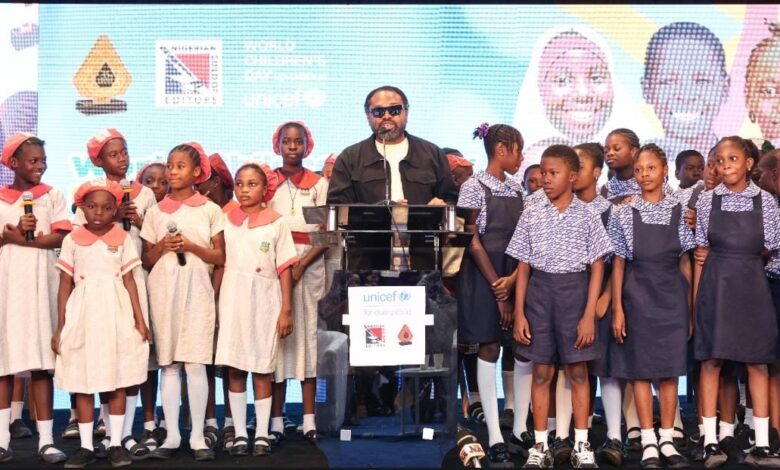
Also speaking, UNICEF Nigeria Goodwill Ambassador and musician, Cobhams Asuquo, highlighted the role of music in communicating important messages about children’s welfare and development.
Asuquo, who produced the song, “The First 1,000 Days of Life,” explained that music could simplify important messages, making them memorable and helping families and communities understand the importance of nutrition, care and support during a child’s early years.
One of the highlights of the symposium was a special performance by Asuquo alongside schoolchildren, titled “I Am a Nigerian Child,” which placed children’s voices at the centre of discussions on their rights and future.