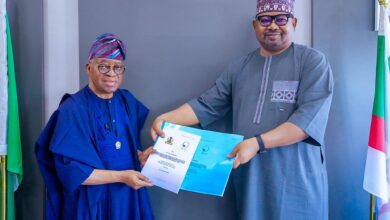


The Federal Government has urged Nigeria’s 36 states and the Federal Capital Territory (FCT) to play a more active role in shaping and owning the Nigeria National Water Compact 2026–2030, stressing that their involvement was essential to securing the country’s water future.

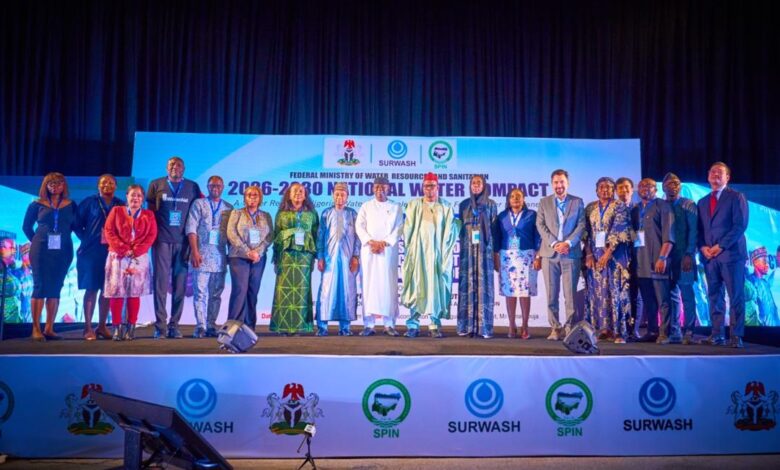
This call came from the Minister of Water Resources and Sanitation, Engr. Prof. Joseph Terlumun Utsev, during a nationwide stakeholders’ consultation workshop on the draft Compact held today in Abuja.
Utsev, in a statement by the Director Information and Public Relations on the Ministry,Funmi Imuetinyan, described water as a foundation of public health, food security, agriculture, industrial growth, environmental sustainability, economic development and national security.
He pointed to a range of pressures facing the sector, including rapid population growth, urbanisation, climate change, environmental degradation, weak infrastructure, fragmented institutions and limited financing.
He explained that the Compact was designed as a practical roadmap to confront these challenges while advancing the Federal Government’s Renewed Hope Agenda.
Developed by a National Technical Working Committee drawing on government institutions, state governments, development partners, academia, civil society and the private sector, the document is organised around three pillars: Water for People, Water for Food Security, and Water for Planet.
Utsev emphasised that the Compact should be seen as a national instrument rather than a document owned solely by the Federal Ministry of Water Resources and Sanitation.
He encouraged states and other stakeholders to review the draft closely and put forward practical recommendations suited to their individual needs and capacities.
He further disclosed that President Bola Ahmed Tinubu had been briefed on the Compact’s progress, and that efforts were underway to secure buy-in from state governors for its implementation.
In a goodwill message, the Minister of State for Health and Social Welfare, Dr Iziaq Adekunle Salako, commended the Ministry of Water Resources and Sanitation for the initiative, describing it as an integrated framework with the potential to deepen collaboration across the water, health, agriculture, environment and climate sectors.
He called for clear governance structures, sustainable financing, equitable access for vulnerable groups, climate-resilient health systems, and strong monitoring with measurable performance indicators, and pledged his ministry’s commitment to helping finalise and implement an inclusive, practical Compact.
The Acting Permanent Secretary in the Federal Ministry of Water Resources and Sanitation, Engr. Ali Ibrahim Dallah, said the consultation process was critical to ensuring the Compact was realistic, inclusive, implementable and sustainable, and urged participants to identify gaps and propose actions reflecting the priorities of individual states.
Representing the World Bank, Acting Country Director Mr Taimur Samad said state governments would play a central role in driving Nigeria’s water agenda, particularly around investment, reform and prioritisation.
He cautioned that public financing alone would not meet the sector’s investment needs, calling instead for sustainable financing models and stronger institutions capable of managing water as an economic asset while ensuring reliable service delivery.
He reaffirmed the World Bank Group’s commitment to supporting the Compact’s implementation alongside the Federal Government and other partners.
Speaking on behalf of the WASH Development Partner Group, Ms Emily Kilongi commended the ministry and the National Technical Working Committee for an inclusive and extensive consultation process, and stressed the importance of sustained political leadership, state ownership, measurable results, mutual accountability and reliable data in turning the Compact into concrete outcomes.
She said the document would help align government priorities, development-partner support, private-sector participation and civil-society contributions around shared national water-sector goals.
The Chairman of the National Working Committee of the National Water Compact and Director of Water Supply at the Federal Ministry of Water Resources and Sanitation, Mr Segun Mukaila Babarinde, gave an overview of the draft document and appealed to participants for contributions that would strengthen its implementation.
The consultation drew representatives from federal and state governments, development partners, civil society organisations, the private sector, academia, professional associations, women’s and youth groups, and other stakeholders in the water resources sector.