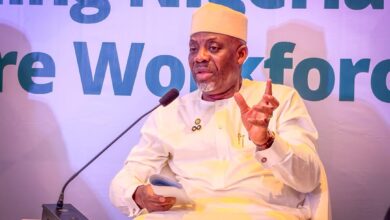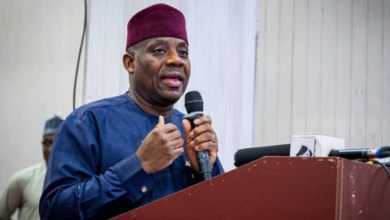
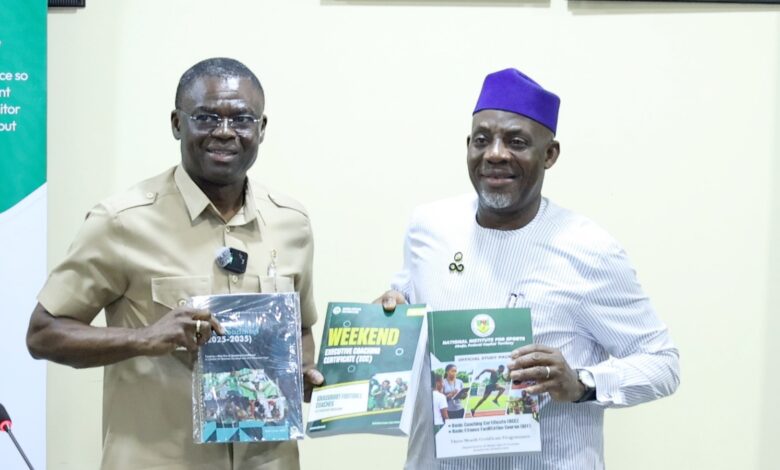


The Minister of Education, Dr. Tunji Alausa is exploring the integration of National Institute for Sports (NIS) training programmes into the Federal Government’s Technical and Vocational Education and Training (TVET).

Special Adviser to the Minister on Media and Communications, Ikharo Attah disclosed this in a statement on Friday.
Attah noted that the initiative was poised to equip young Nigerians with employable skills, expand job opportunities and strengthen Nigeria’s sports sector in line with President Bola Tinubu’s Renewed Hope Agenda.
This formed the basis of discussion during the Minister’s meeting with the Director-General of NIS, Comrade Philip Shaibu, where they discussed ways to strengthen collaboration between education and sports institutions.
He emphasised that sports and education should be mutually reinforcing, noting that structured sports education can nurture talent, create career opportunities and contribute to a sustainable sports economy.
The Minister highlighted a common curricular framework developed in collaboration with the National Universities Commission (NUC), National Board for Technical Education (NBTE), National Commission for Colleges of Education (NCCE), sports experts, the private sector and the National Sports Commission.
The framework covers six areas: Sports and Exercise Science; Coaching and Development Science; Sports Management and Business; Sports Medicine and Rehabilitation; Sports Technology and Data Analytics; and Sports Law. It is designed to support structured sports programmes in universities, polytechnics and colleges of education, broadening opportunities beyond traditional physical education.
Dr Alausa identified basic training, coaching and sports-facility maintenance at the NIS as areas that could be incorporated into the national TVET platform, subject to the necessary approvals and programme requirements.
He said trainees could potentially access training through the Institute’s centres across eight states, while programmes lasting up to six months could be considered where appropriate. He added that further consultations would be required to establish the implementation framework.
The Minister stressed that investment in sports infrastructure must be matched by a skilled workforce capable of maintaining facilities to international standards.
He identified groundskeeping, pitch maintenance and games instruction as potential employment pathways for young Nigerians, noting that developing local expertise could reduce reliance on workers recruited from abroad.
He also cited the national TVET programme’s reported reach of more than 250,000 trainees trained or graduated through approximately 1,200 centres over the preceding 12 to 18 months.
According to him, about 98 per cent of the centres are privately operated, while trainees receive a monthly stipend of ₦30,000.
Furthermore, he maintained that aligning vocational training with the needs of the sports sector could expand employment, strengthen facility management and support a more sustainable sports economy.
Earlier, Comrade Shaibu commended the Minister for the education reforms and renewed emphasis on technical and vocational skills development. Drawing on his experience as Deputy Governor of Edo State, he stressed the importance of integrating sports into the school system and recalled the state’s initiative to allocate five per cent of the 30 per cent continuous assessment score in primary and secondary schools to sports.
He identified the shortage of qualified games masters and certified coaches as a major constraint to grassroots sports development.
The NIS Director-General also highlighted the Institute’s expansion across the six geopolitical zones, its graduation of more than 1,000 coaches within a year and its 2025–2035 strategic plan, which seeks to improve sustainability and reduce dependence on government funding.
He outlined efforts to revive coaching, fitness and executive certificate programmes, strengthen coach certification, train groundsmen and create career pathways for retiring athletes.
He appealed for the integration of the Institute’s basic training programme into the TVET framework, alongside stronger institutional support to expand its training capacity and financial sustainability.