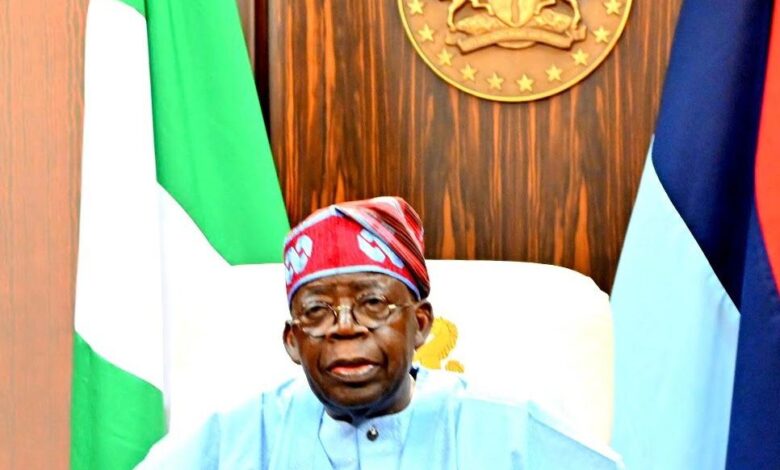


President Bola Tinubu on Thursday said the evidence that Nigeria’s economic outlook has improved is clear, citing growth, falling inflation and rising investment as proof that his administration’s reforms are working.
Delivering his Independence Day address, themed “From Reforms to Prosperity,” the president said: “Three and a half years later, the evidence that Nigeria’s economic outlook has improved is undeniable.”
Tinubu said the economy has grown by over 4 per cent this year, with both oil and non-oil sectors contributing to what he called “the renewed period of stable growth.”
He said oil theft is down, inflation has fallen substantially from its peak, foreign reserves have been rebuilt, and the foreign exchange market has stabilised.
He added that in 2025 the country recorded its highest revenue from non-oil exports in its history, exceeding $6 billion.
“This is real money being made by real Nigerian businesses,” he said.
The president said the improvement was visible beyond government. “International observers, journalists, NGOs and multilateral institutions can see the change,” he said, adding that each had concluded that the reforms “have strengthened Nigeria’s economic stability and resilience.”
He said the private sector “has long since delivered its verdict,” and that foreign direct investment continues to rise each year. The figures were presented in the address and were not independently verified.
Tinubu acknowledged the hardship that accompanied the policy changes. “The reforms that followed were difficult. The side effects were real,” he said. But he insisted that “our reforms did not create the weaknesses in our economy. They confronted them.”
He compared Nigeria’s condition in 2023 to a patient diagnosed with cancer who must choose between painful treatment and morphine. “For too long, Nigeria’s leaders chose morphine while praying for a miracle that never came,” he said.
He also warned against calls to reverse course. “Certain influential but regressive voices would have us abandon the treatment and return ourselves to the abuse of addictive subsidies,” he said. “We must resist their siren song.”
Declaring a turning point, the president said: “The emergency treatment is over. The foundation has been repaired.” He said the overriding purpose of the last three years had been to correct the nation’s course, and that the focus is now “shared and widespread prosperity.”
Bringing down the cost of living, he said, is the first priority, to be achieved “by lowering the cost of producing and moving the things Nigerians consume.”
He outlined plans for mechanised irrigation and dry-season farming, better access to seeds and fertiliser, more storage and transport investment, and the completion of roads, railways and ports.
On jobs, he said the government would use Nigeria’s gas to power new industries, support the revival of factories, expand digital connectivity and invest in skills employers’ demand.
Tinubu acknowledged that many families still struggle. “Some Nigerian families still struggle today for the next meal, the next school fee, the next medical bill,” he said, attributing their situation to “decades of low productivity, inadequate infrastructure, insufficient opportunity.”
He pointed to stronger direct support for the poorest households, an improved National Social Register, the Nigerian Education Loan Fund and the CREDICORP consumer credit scheme. He also said salaries and pensions have been paid on time and in full since 2023.
“These programmes are not substitutes for prosperity,” he said. “They are a bridge.”
Closing the address, he said: “Nigeria has corrected its course. We have passed through our own Red Sea.”