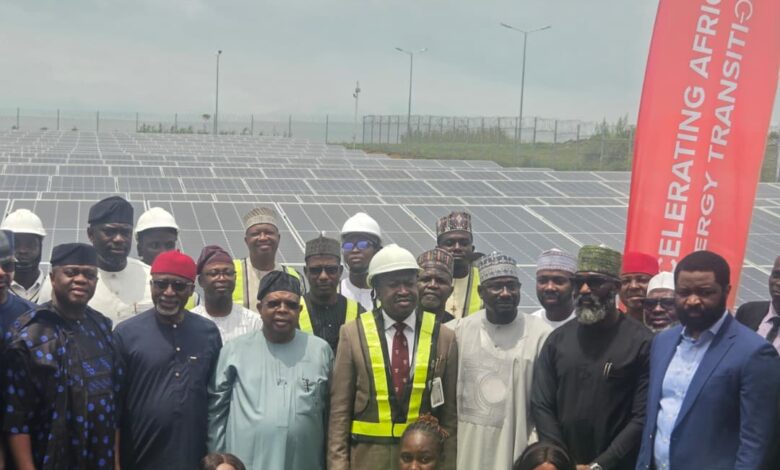


The Federal Government has commissioned a 3-megawatt captive solar hybrid power project at Yakubu Gowon University, Abuja, in a move expected to strengthen electricity supply for nearly 40,000 students and more than 3,500 staff at the institution.
The project, delivered under Phase II of the Energizing Education Programme (EEP), was implemented by the Rural Electrification Agency (REA) through the World Bank-funded Nigeria Electrification Project (NEP).
It is expected to support teaching, research, laboratories, digital services and other critical university operations at the institution, which has almost 40,000 students, including more than 8,000 living on campus, and over 3,500 staff, placing substantial demand on its academic, residential and administrative facilities.
Commissioning the facility on Wednesday, the Minister of Power, Joseph Tegbe, said the project illustrated the practical link between Nigeria’s energy transition and human capital development, describing universities as institutions that bring together everything a modern energy system is expected to support, from learning and research to healthcare, technology and digital infrastructure.
He said the commissioning marked the beginning rather than the conclusion of the investment, stressing that its long-term performance would be the true measure of its success, and tied this focus on sustainability to the newly established Renewable Asset Management Company (RAMCO), created to strengthen the management of renewable energy assets over time.
Managing Director/CEO of REA, Abba Aliyu, said the Energizing Education Programme had evolved beyond simply installing solar infrastructure to creating conditions that allow students to learn, lecturers to teach, researchers to work and laboratories to function with greater certainty.
He said the programme has so far delivered renewable energy infrastructure to 22 federal universities and three affiliated teaching hospitals, deploying more than 100MW of clean energy and impacting over 600,000 students and 50,000 academic and administrative staff nationwide.
Aliyu added that REA’s experience at this scale had underscored the need to plan for an energy asset’s entire life cycle, not just its construction, a consideration that fed into the thinking behind RAMCO.
Head of the Nigeria Electrification Project, Olufemi Akinyelure, said the project’s significance should be judged by the wider development opportunities that reliable electricity unlocks, arguing that powering a university does more than light buildings, it strengthens innovation and the nation’s future.
Vice-Chancellor of Yakubu Gowon University, Professor Hakeem Babatunde Fawehinmi, described the project as central to the university’s academic mission, noting that effective teaching, research and digital services all depend on dependable power, and assured partners that the facility would be properly maintained.
Chairman of the Senate Committee on Power, Senator Enyinnaya Abaribe, said the project showed the connection between energy policy, implementation and tangible improvements in people’s lives, and pledged continued legislative oversight to support power-sector investment and accountability.
He emphasised that sustainability must remain a priority, along with clear arrangements for the facility’s operation and upkeep throughout its useful life.
Beyond the power supply itself, the project includes a Renewable Energy Workshop and Training Centre for practical skills development, as well as a female STEM component offering students hands-on exposure to renewable energy careers.
The initiative was delivered through collaboration between the Federal Government, REA, the Nigeria Electrification Project, the World Bank, the university and EMONE Energy Solutions, with attention now turning to the facility’s long-term performance and its impact on learning, research and innovation at the institution.