

The Federal Government has stepped up efforts to reduce Nigeria’s dependence on imported fish, with the Minister of Marine and Blue Economy, Dr. Adegboyega Oyetola, directing a newly inaugurated technical committee to produce an eight-week action plan for boosting domestic production.
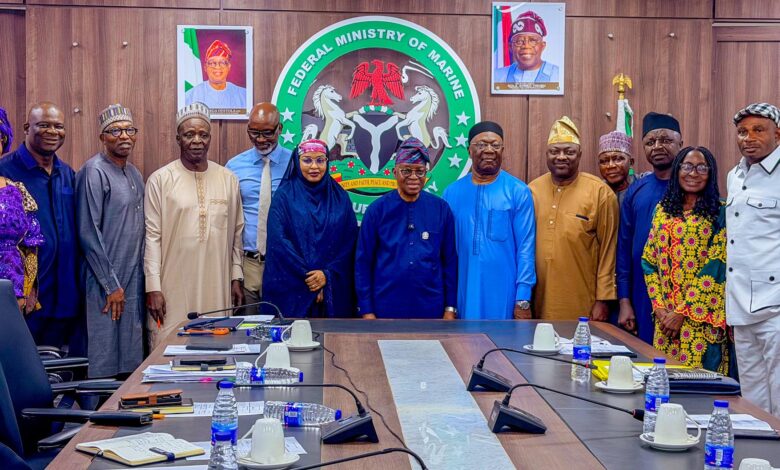
Oyetola gave the charge in Abuja on Thursday while inaugurating the Technical Committee on Accelerating Fish Production in Nigeria
He said the government was determined to move from policy recommendations to practical interventions in the fisheries and aquaculture sector.
The minister said the gap between domestic production and national demand was affecting food security, household incomes and the country’s foreign-exchange resources.
“Domestic production remains substantially below national demand, with consequences for food security, household incomes and foreign-exchange resources,” Oyetola said.
He said addressing the production gap required tackling the high cost of inputs, particularly fish feed, as well as inadequate access to quality fish seed and broodstock.
According to him, weak fish-health and biosecurity systems, post-harvest losses and insufficient cold-chain and storage facilities were also limiting the sector’s capacity to meet national demand.
Oyetola further identified inadequate access to affordable finance, gaps in research and innovation, weak data systems and deficiencies in standards, traceability and market development as challenges requiring urgent attention.
He said the committee was not expected to produce another policy document but to determine how existing recommendations could be implemented effectively.
“Your assignment is not to develop another policy or establish a parallel programme,” the minister told the committee.
He explained that the committee would review recommendations from a strategic roundtable organised by the ministry in collaboration with the National Institute for Policy and Strategic Studies (NIPSS) in October 2025.
Oyetola said the recommendations would be assessed against the National Policy on Marine and Blue Economy, the National Fisheries and Aquaculture Policy, relevant laws and existing government programmes.
He directed the committee to determine which proposals should be adopted, modified, integrated into existing frameworks, subjected to further study or rejected as unviable.
The minister also tasked members with identifying existing initiatives across government, the private sector and development organisations to avoid duplication and ensure that scarce resources were efficiently deployed.
“Your final output should include a clear implementation roadmap and matrix setting out the priority interventions, responsible institutions, timelines, indicative costs, funding options, performance indicators and required approvals,” he said.
Oyetola said the roadmap should also identify opportunities for private-sector investment, public-private partnerships and development finance to support sustainable growth in the sector.
He said the ministry would provide the necessary institutional support, adding that the committee’s work should translate into measurable gains in fish production, job creation and food security.
Earlier, the Permanent Secretary of the ministry and chairman of the committee, Mrs Fatima Sugra Mahmood, said members would approach the assignment with “a strong sense of responsibility.”
Mahmood said the committee would work with government agencies, researchers, industry stakeholders and development partners to identify priority interventions and develop a realistic implementation framework.
She said the objective was to accelerate sustainable fish production, strengthen the fisheries value chain and contribute to Nigeria’s economic development.
A member of the committee, Prof. Akintola Latunji of Lagos State University, who spoke on behalf of other members, thanked the minister for the confidence reposed in them.
Latunji pledged that the committee would engage relevant stakeholders and work towards delivering its mandate within the stipulated timeframe.
The committee comprises representatives of government, academia, research institutions, professional bodies, industry and development organisations.