

The Economic Management Team (EMT), the Federal Government’s principal platform for economic management and coordination, has approved the establishment of an inter-agency committee to harmonise the macroeconomic assumptions underpinning government budgeting and economic planning.

The decision was reached at the Team’s meeting held in Abuja on Monday, where members also reviewed progress across the economy, agriculture, trade and investment, manufacturing, and Nigeria’s preparations to host two major continental trade events.
According to a statement issued by the EMT Secretariat at the Federal Ministry of Finance, the new committee will harmonise assumptions including crude oil price and production volumes, exchange rate, inflation and non-oil revenue projections used by fiscal and monetary authorities across government.
The decision follows a joint budget retreat and a technical validation workshop that traced budget under-performance in part to inconsistent assumptions used by different agencies, as well as occasional divergence between key projections issued by various economic policy authorities.
The committee will also work to resolve inconsistencies in how key indicators are reported within government, to external parties and to the public.
On the state of the economy, the statement said real GDP growth reached 4.43 percent year-on-year in the second quarter of 2026, its strongest quarterly performance since Q3 2024, according to the National Bureau of Statistics (NBS), translating to about 17 percent growth for the first half of 2026 in US dollar terms.
External reserves rose to over US$54 billion in early September 2026, the highest level in nearly 18 years according to Central Bank of Nigeria (CBN) data, comfortably above official 2026 projections.
The naira has also strengthened to its firmest levels in about two years, trading in the N1,300s per US dollar range in early September 2026 alongside the reserve build-up.
The statement noted that FTSE Russell has reclassified Nigeria from “Unclassified” to “Frontier Market” status, effective from market open on Monday, 21 September 2026, marking the country’s return to the index after roughly three years and expected to improve visibility for Nigerian equities among international investors.
The EMT was briefed that public debt remains below 40 percent of GDP, and that Nigeria’s sovereign credit outlook by Moody’s has moved from stable to positive.
The Team also noted that Nigeria’s economy, measured in purchasing-power-parity terms, stands at over US$2.2 trillion, substantially larger than its nominal dollar GDP and indicative of the economy’s growth potential towards the US$1 trillion nominal GDP mark by 2030.
On governance, the Team agreed a revised Terms of Reference expanding its remit to include macroeconomic performance review, stronger fiscal-monetary coordination, monitoring of Renewed Hope Agenda priorities, and periodic review of Federal Government financing needs, alongside a move to a monthly meeting cadence with at least two strategic sector reviews per sitting.
To improve the reliability of official statistics, the Ministry of Finance has been designated as the coordinating custodian for national economic data, with line agencies responsible for their respective datasets as inputs into coordinated public releases.
On agriculture, the EMT reviewed a strategy to grow the sector’s contribution toward Nigeria’s US$1 trillion economy ambition by 2030, including measures to reduce post-harvest losses, expand processing and mechanisation, strengthen export compliance, and improve the timing of capital releases ahead of planting seasons.
The Team also reviewed financing measures for the sector, including a planned recapitalisation of the Bank of Agriculture and a new smallholder credit window, alongside a target to raise agriculture’s share of private-sector credit toward 10 percent by 2030.
On trade events, the EMT reviewed Nigeria’s readiness to host the Creative Africa Nexus (CANEX) in November 2026 and the Intra-African Trade Fair (IATF) in November 2027 in Lagos, both expected to attract large numbers of exhibitors and international buyers, with the IATF also expected to draw African heads of state. Organisers are projecting substantial trade and investment deal flow from both events.
The Ministry of Finance was tasked with coordinating funding and customs facilitation, working with the Ministry of Industry, Trade and Investment on a consolidated action plan with named ministerial owners.
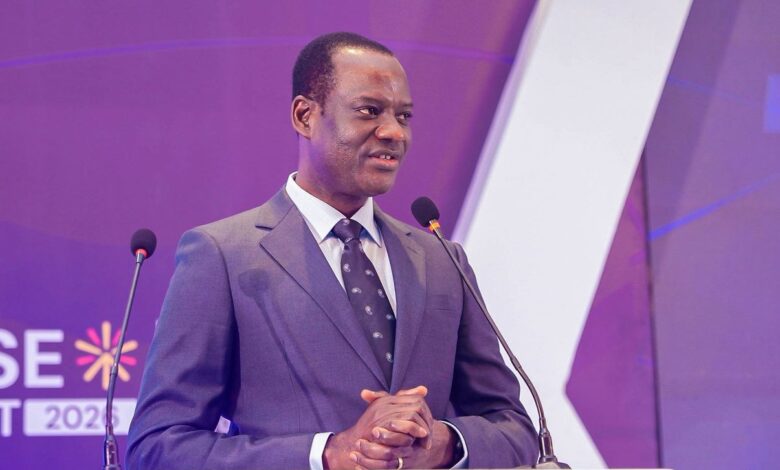
The Minister of Finance and Coordinating Minister of the Economy, Prof. Taiwo Oyedele said: “Today’s decisions tighten the link between the numbers we plan with and the actual outturns. A single, harmonised set of assumptions across the fiscal and monetary authorities means fewer surprises in the budget and more credible planning for investors and all Nigerians.”