


President Bola Tinubu has commended the Economic and Financial Crimes Commission (EFCC) for securing 10,872 convictions and recovering ₦1.233 trillion and millions of dollars in illicit assets in the first 34 months of his administration.

Represented by Vice President, Kashim Shettima, at the opening of the eighth EFCC/National Judicial Institute (NJI) Workshop for Judges and Justices in Abuja on Tuesday, Tinubu said the Commission had filed 14,476 cases and secured 10,872 convictions, representing a 75.1 per cent conviction rate.
The EFCC also recovered $684.48 million, £373,905.78 and €9.34 million.
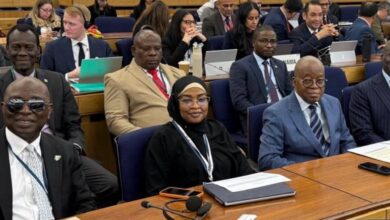
The three-day workshop, themed “Investigation and Prosecution of Economic and Financial Crimes in a Digital Age,” ends on October 15.
Tinubu praised the EFCC’s efforts against cryptocurrency fraud and its recovery of virtual assets, citing the prosecution and deportation of 192 foreign nationals arrested for cyberterrorism and cryptocurrency fraud.
While urging stronger collaboration among anti-corruption agencies and the judiciary, he called for continuous training to tackle technology-driven financial crimes and urged investigators and prosecutors to close procedural loopholes that allow cases to fail on technical grounds.
He also acknowledged the contribution of asset recoveries to social intervention programmes, including the Nigerian Education Loan Fund and the Nigerian Consumer Credit Corporation.
EFCC Chairman Ola Olukoyede said operational reforms had strengthened the Commission’s investigation, prosecution and asset recovery efforts. He identified prolonged trials, frivolous adjournments and frequent changes of counsel as major obstacles to justice, urging judges to ensure rigorous and timely adjudication without compromising due process.
Chief Justice of Nigeria Justice Kudirat Kekere-Ekun stressed the need for judges to understand digital evidence, including cryptocurrency transactions, encrypted communications and electronic records.
She insisted that convictions must rest on credible, admissible evidence, warning that cooperation among institutions must not undermine judicial independence. Senate and House committee chairmen on anti-corruption and financial crimes, Emmanuel Udende and Ginger Onwusibe, respectively, also called for faster trials, stronger forensic capabilities and legislative reforms to address emerging financial crimes.
Attorney-General of the Federation and Minister of Justice Lateef Fagbemi urged investigators, prosecutors and judges to strengthen cooperation in handling digital evidence and recovering criminal proceeds.
He emphasised that prosecutions must uphold the rule of law and the rights of accused persons, adding that sustainable results require effective investigations, international cooperation and stronger coordination across the justice system.