NCAA Warns Funding Cut Could Jeopardise Nigeria’s ICAO Safety Rating
By Stella Enenche, Abuja


The Nigeria Civil Aviation Authority (NCAA) has cautioned that any reduction in its share of the five per cent Ticket Sales Charge (TSC) and Cargo Sales Charge (CSC) could weaken the country’s aviation safety oversight and reverse gains recorded in international safety audits.
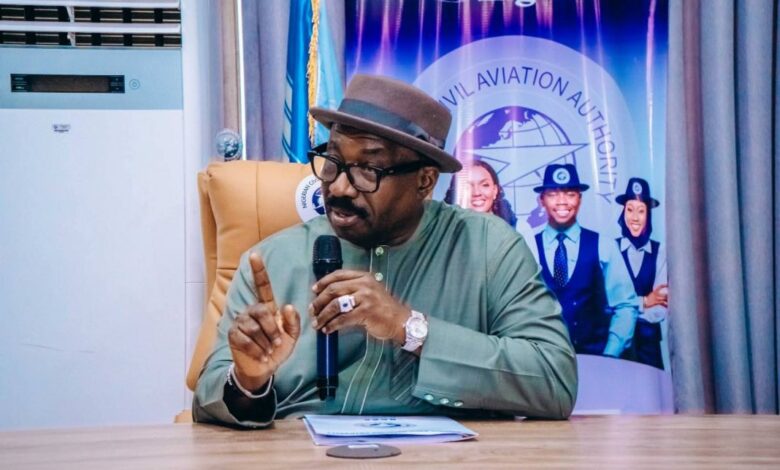
Presenting the Authority’s position at the House of Representatives Committee on Aviation public hearing on the proposed review of the TSC and CSC allocation on Thursday in Abuja, the Director-General of Civil Aviation, Chris Najomo, said restoring the NCAA’s original 65 per cent share of the charges was essential to addressing concerns raised by the International Civil Aviation Organization (ICAO).
Najomo noted that although Nigeria recently attained an Effective Implementation score of 91.3 per cent in ICAO’s Universal Safety Oversight Audit Programme, the country’s weakest performance was in the area of financial resources for safety oversight.
“Nigeria recorded its lowest Effective Implementation score, of only 50 per cent, in the area of financial resources supporting the State Safety Oversight System,” he said.
He warned that reducing the NCAA’s principal source of statutory funding at a time when ICAO had identified inadequate financing as a critical gap would be counterproductive.
“Reducing the Authority’s principal statutory source of funding at this time would amount to legislating against the very deficiency that ICAO has identified for corrective action,” he said.
The NCAA boss explained that the regulator relies on the Ticket Sales Charge for nearly 80 per cent of its revenue, which funds aircraft certification, safety inspections, surveillance, personnel training and Nigeria’s mandatory financial contributions to ICAO, the Banjul Accord Group Aviation Safety and Security Oversight Organisation (BAGASOO), and the African Civil Aviation Commission (AFCAC).
According to him, aviation safety extends beyond legislation and depends on sustained investment in regulatory oversight.
“Aviation safety is not sustained by legislation alone. It depends upon competent inspectors, effective surveillance, continuous certification, recurrent technical training, international cooperation and an independent regulator possessing the financial capacity to discharge its statutory mandate without compromise.”
Najomo argued that the proposed review of the revenue-sharing formula should not be treated simply as a redistribution of funds between aviation agencies but as a matter with direct implications for public safety and Nigeria’s international obligations.
He maintained that if additional funding is required for the Nigerian Airspace Management Agency (NAMA), it should be sourced from its broad commercial income streams and operational reforms rather than by reducing the NCAA’s allocation.
The DG pointed out that NAMA already generates approximately 75 per cent of its revenue from commercial charges, including overflight fees, terminal navigation services, telecommunications, consultancy services, calibration fees and property leases, while the contentious five per cent TSC contributes only about 25 per cent of its income.
“The proposal before this distinguished Committee should therefore be considered not merely as a redistribution of statutory revenue, but in terms of its potential impact on Nigeria’s ability to sustain an effective State Safety Oversight System consistent with the Standards and Recommended Practices of ICAO and to safeguard the travelling public,” Najomo said.
He urged the lawmakers to restore the NCAA’s original 65 per cent share of the Ticket Sales Charge, saying adequate funding of the aviation regulator is critical to preserving Nigeria’s safety record and maintaining global confidence in the country’s aviation sector.