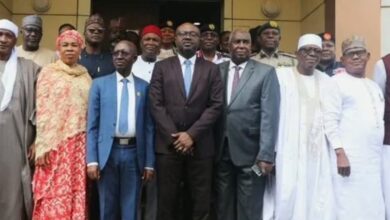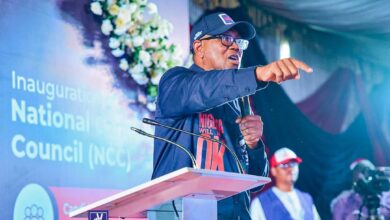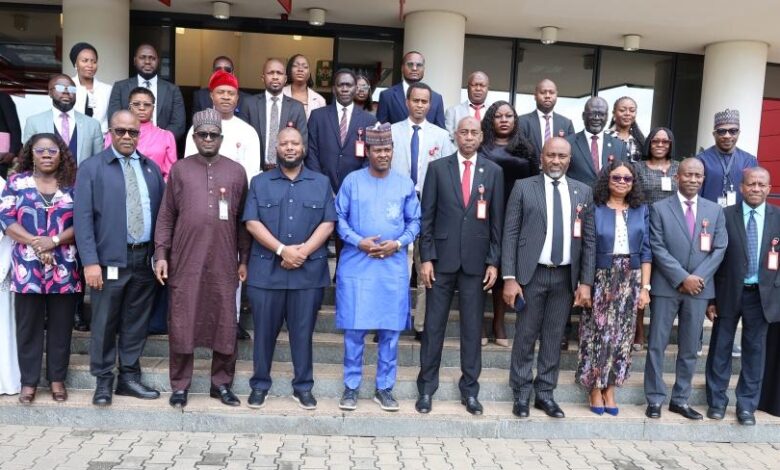


The Economic and Financial Crimes Commission (EFCC) and the Nigerian Financial Intelligence Unit (NFIU) have started a three-day joint review to test how ready Nigeria is for the 2027 Mutual Evaluation by the Financial Action Task Force (FATF) on anti-money laundering and counter-terrorist financing.

According to EFCC’s Head, Media and Publicity, Dele Oyewale, the stocktake began on Tuesday, September 29, 2026, at the EFCC’s corporate headquarters in Abuja and is expected to continue on Wednesday, September 30, and October 2, 2026.
It brings together officials of both agencies and other stakeholders to review progress, identify gaps and strengthen inter-agency cooperation before the evaluation.
EFCC Executive Chairman, Ola Olukoyede, said the exercise demonstrates Nigeria’s commitment to meeting international standards. He was represented by the Secretary to the Commission, Muhammad Hassan Hammajoda.
Nigeria was placed on the FATF Grey List in 2022 for non-compliance with anti-money laundering, counter-terrorist financing and counter proliferation financing rules.
The global watchdog provisionally removed the country on October 24, 2025, after it improved compliance.
Grey listing carries a range of negative consequences for affected countries, and Olukoyede called on all stakeholders to work together to prevent a return.
“It is unimaginable that Nigeria returns to the Grey List,” he said. He listed the issues under consideration as the use of financial intelligence, asset tracing, recovery and management, money laundering, and investigation and prosecution.
He described the stocktake as a chance for Nigeria to show the progress made since exiting the Grey List and to consolidate it at the end of the evaluation.
It would also help the agencies determine what is working and redirect resources accordingly, he said.
According to him, the EFCC has scaled up its anti-money laundering enforcement and recovery of proceeds of crime since the removal, citing the Proceeds of Crime (Recovery and Management) Act 2022.
The NFIU Chief Executive Officer, Mrs Hafsat Abubakar Bakari, was represented by the Chief Operating Officer, Law Enforcement Agencies, Emmanuel Sotande.
She said the exercise was important because of the longstanding relationship between the two institutions and the need to strengthen the country’s collective response to financial crimes.
She stressed that the stocktake was not aimed at addressing a crisis.
“We gathered here not because there is a problem to solve, but because there is a standard to uphold,” she said.
Bakari added that international assessors would go beyond laws and institutional structures to examine how effectively they are implemented.
“They will look at the evidence that we are able to put in place to produce desirable outcomes,” she said.
Assessors, she noted, would look for examples of effective investigation, successful prosecution, asset recovery, inter-agency collaboration and the use of intelligence.
She said the EFCC has played a central role in shaping Nigeria’s progress in these areas over the past year.
In his presentation, Bakari’s Chief of Staff, Mohammed Shahid Ahmed, recalled that Nigeria’s 2019 Mutual Evaluation, whose report was published in 2021, identified deficiencies that led to the Grey List placement.
He said the country then took steps in financial investigations, identification and recovery of proceeds of crime, international cooperation and cross-border currency declaration.
Ahmed regretted that Nigeria had little time to consolidate its gains, as preparations for the next evaluation began barely a year after the removal.
He disclosed that the assessment would focus on effectiveness as well as technical compliance, including whether agencies use financial intelligence, prioritise investigations based on identified risks, and show that enforcement efforts are producing decisive results.