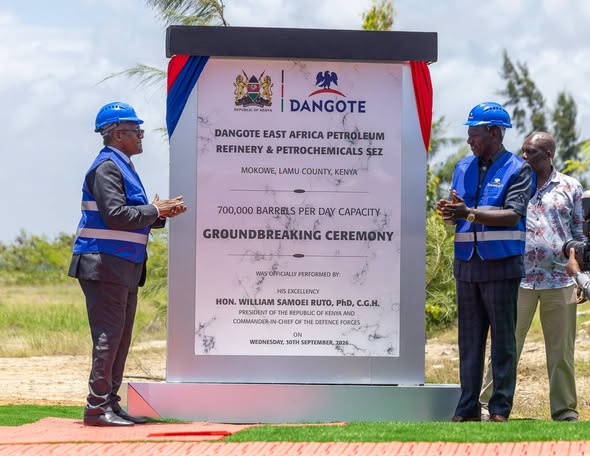


Africa’s drive for industrial self-reliance received a major boost on Wednesday as Kenyan President William Ruto and the President and Chief Executive of Dangote Industries Limited, Aliko Dangote, joined other African leaders to break ground on a $16 billion petroleum refinery and petrochemicals complex in Lamu, Kenya.
The Dangote Group, in a statement on Wednesday, said the facility was designed to process 700,000 barrels of crude oil per day and serve markets across Eastern Africa.
Dangote announced that the Dangote East Africa Petroleum Refinery and Petrochemicals in Lamu would be delivered within 40 months.
He said the company had already begun mobilising equipment and technical resources and would draw extensively on lessons learnt from building the Dangote Petroleum Refinery in Lagos.
According to him, the Kenyan project would be one of the fastest major undertakings by the Group, as the company seeks to show that African businesses can execute complex industrial projects at globally competitive scale and speed.
Dangote said local participation would be at the heart of the project. Qualified graduates from Lamu will be offered opportunities to work on the development, while more than 1,000 young people from host communities will receive technical and vocational training.
The Group will set up a training school to develop the skills needed for construction and subsequent operations.
“We want young Kenyans and East Africans with skills here. We want local businesses to become suppliers. We want entrepreneurs around this project,” he said.
He added that the true measure of the project would be young Kenyans acquiring engineering and technical skills, local entrepreneurs building businesses around the investment and communities enjoying better livelihoods.
“Industrialisation must have a human face. It must create dignity. It must create jobs. It must create opportunities. It must create hope,” he said.
President Ruto put the cost of the development at about KSh2 trillion and described it as a “generational undertaking” meant to serve not only Kenya but the wider region.
The complex will also generate up to 1,000 megawatts of electricity and produce polypropylene and base oil as part of an integrated refining and petrochemicals hub.
Ruto said current projections point to about 60,000 direct and indirect jobs.
He directed technical and vocational institutions and universities to prepare welders, technicians, engineers and managers for the opportunities, insisting that young people from Lamu and neighbouring communities must get a fair chance to compete.
He said the construction phase alone is expected to inject more than KSh2 billion monthly in wages into the economy, circulating through shops, hotels, restaurants, transport and housing.
Dangote disclosed that 30 per cent of the refinery’s equity is being offered to East African countries, allowing governments in the region to share in its ownership and future value.
He said Kenya and Rwanda had already moved quickly to take up the offer. The refinery, he said, is designed as a regional asset serving Kenya, Uganda, Rwanda, Tanzania, Ethiopia, South Sudan, the Democratic Republic of Congo and other markets.
“This refinery is therefore not simply about one country. It is about a region,” he said.
He argued that Africa can no longer afford an economic model in which crude oil, minerals and agricultural commodities are exported while finished products are imported.
“Africa cannot build lasting prosperity by exporting what it has and importing what it needs. We must refine more of what we produce. We must process more of what we produce. We must retain more value here at home in Africa,” he said.
The Governor of Lamu County, Issa Timamy, used the occasion to condemn attempts to stop the project through the courts.
Speaking partly in Swahili, he said those who went to court did not represent the aspirations of Lamu residents, and that the project would go ahead and be completed.
He called on young people and businesses in the county to prepare for the opportunities.
He said Lamu had for too long been rich in history, culture and natural resources but left behind in development, and that the refinery offered a chance to become a major investment and industrial destination.
He also stressed the need to protect Lamu’s mangroves, fishing grounds, coastline and cultural heritage, calling for responsible development in which industrialisation and environmental protection coexist.
Former Nigerian President Olusegun Obasanjo led other African leaders in celebrating Dangote as one of the continent’s leading champions of industrialisation, recalling his journey from trading and importation into large scale manufacturing.
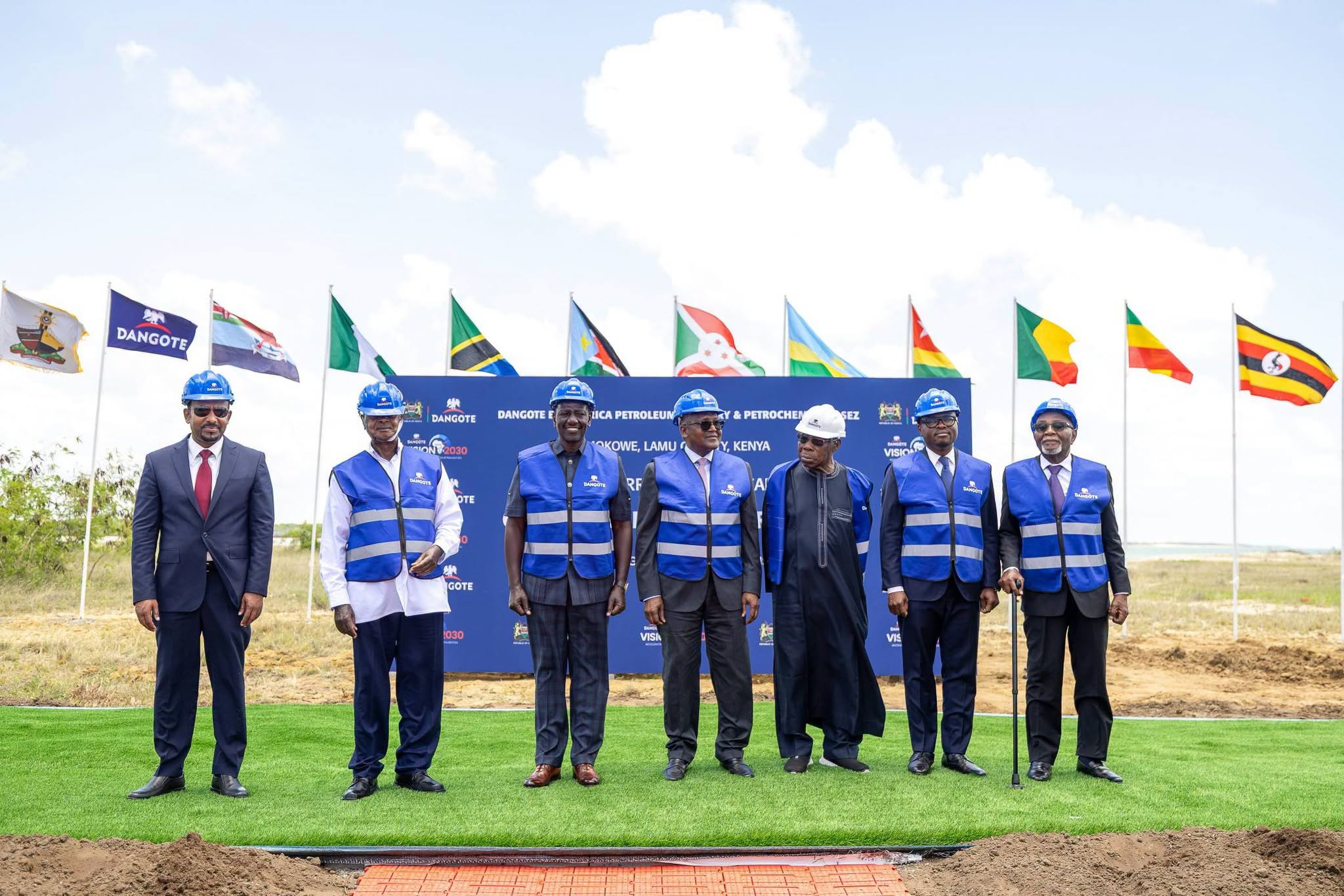
Obasanjo said it showed the importance of governments creating the right environment for indigenous entrepreneurs to invest and compete at scale.
He said he was pleased to witness a project that could deepen economic integration between West and East Africa.
Ugandan President Yoweri Museveni said Africa could not keep exporting raw materials while surrendering the jobs and wealth from processing them elsewhere.
He backed the regional ownership plan as a smart way to make East Africa an owner and not just a market.
Ethiopian Prime Minister Abiy Ahmed said the refinery would strengthen East Africa’s energy security and reduce its exposure to disruptions in global petroleum markets.
He said Dangote’s record in cement, fertiliser and petroleum refining showed that African industrial enterprises can operate at global scale.
“East Africa is not only a market. It is a place to produce, to build and to create value,” he said.