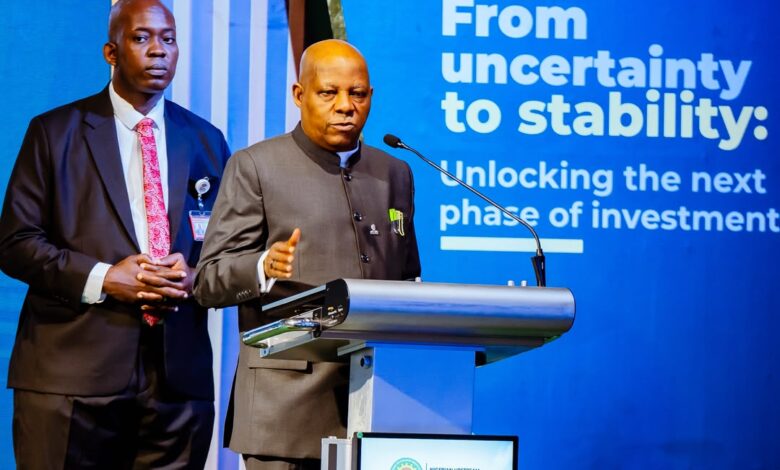


President Bola Tinubu has said Nigeria has significantly reduced its dependence on crude oil revenue and promised to push the diversification drive further while expanding gas supply for power, industry and clean cooking.

Represented by Vice President Kashim Shettima, the President spoke on Tuesday in Abuja at the fifth anniversary of the Nigerian Upstream Petroleum Regulatory Commission (NUPRC), held in Abuja.
He said the Renewed Hope Agenda was building a diversified economy in which agriculture, manufacturing and the digital and creative industries all play their part, moving the country away from reliance on a single sector.
Tinubu, in a statement by the Senior Special Assistant to the Vice President on Media and Communications, Stanley Nkwocha, said joint efforts by security agencies, operators, host communities and the Commission have made oil production steadier and stronger.
He said investors who once left Nigeria in search of better deals are returning, a trend that has ranked the country first among Africa’s leading destinations for upstream investment for two years running.
He stressed that a diversified economy still needs energy, foreign exchange and investment, which the oil and gas sector provides.
According to him, gas can power homes and factories, while petroleum earnings support a stable naira and help fund the Federation.
He added that a well-run upstream industry can create jobs for Nigerian engineers, fabricators and service companies, and that the government intends to use petroleum resources to build the wider economy rather than depend on them.
The President promised an energy transition that is just and suited to Nigeria’s needs, declaring this the decade of Gas.
He said Nigeria, which holds the largest gas reserves in Africa, will reduce flaring and methane emissions and grow renewable energy alongside gas, while meeting its climate responsibilities without sacrificing development and energy access.
Tinubu vowed that his administration will not rest until Nigeria becomes the destination of choice for hydrocarbon investment, adding that the next phase will insist on compliance and accountability.
He said operators who enjoy incentives must deliver on commitments to work programmes, local content, the environment and host communities, while the Commission must also account publicly for its own performance.
He pledged to uphold the rule of law and the sanctity of contracts so that disputes are fewer and quickly resolved.
Calling the Petroleum Industry Act (PIA) a strong foundation, he said a foundation is only the beginning, since laws set the rules while investors decide on commercial terms.
Describing his administration as a listening government, he said investors had pointed to high costs, slow contracting and uncertain fiscal terms for complex projects, and that the government had acted on those concerns.
He described the NUPRC as the bridge between government policy and investment on the ground and charged it to keep its processes clear and timelines reliable, work closely with sister agencies so investors are not caught between overlapping requirements, and remain firm, fair and independent.
He commended the Commission for using its first five years well and urged it to approach the next five with the same commitment, integrity and sense of purpose.
The Minister of State for Petroleum Resources (Oil), Senator Heineken Lokpobiri, said the NUPRC has recorded significant achievements, which he credited to the Tinubu administration’s reform agenda.
He said Nigeria, producing about 1.7 million barrels of crude per day with over 37 billion barrels of reserves, still needs more investment, additional licensing rounds and intensified exploration.
He urged the Commission to adopt decisive regulatory measures and remove bureaucratic bottlenecks that could discourage investment.
The Chairman of the NUPRC Governing Board, Senator Magnus Abe, said the Commission’s creation under the PIA showed Nigeria was making progress in reforming the sector.
He credited its success to the President’s leadership and his decision to shield the regulator from political interference, and praised staff for their commitment to transparency, professionalism and operational efficiency.
The Chairman of the Senate Committee on Gas, Senator Jarigbe Agom Jarigbe, said the PIA reforms have improved transparency, regulatory certainty and investment inflows, and expressed the National Assembly’s satisfaction with the NUPRC’s performance.
Representing the Minister of State for Petroleum Resources (Gas), Ekperikpe Ekpo, the Permanent Secretary, Mrs. Patience Oyekunle, said the separation of policy, commercial and regulatory responsibilities had strengthened regulatory stability, with higher production and greater value for investments expected.
The Minister reiterated the Federal Government’s resolve to maximise Nigeria’s gas resources.
The event also featured the presentation of awards to former Directors of the Department of Petroleum Resources (DPR), which was transformed into the NUPRC, in recognition of their contributions to upstream reforms.
It brought together stakeholders from the petroleum industry, government institutions and the National Assembly.