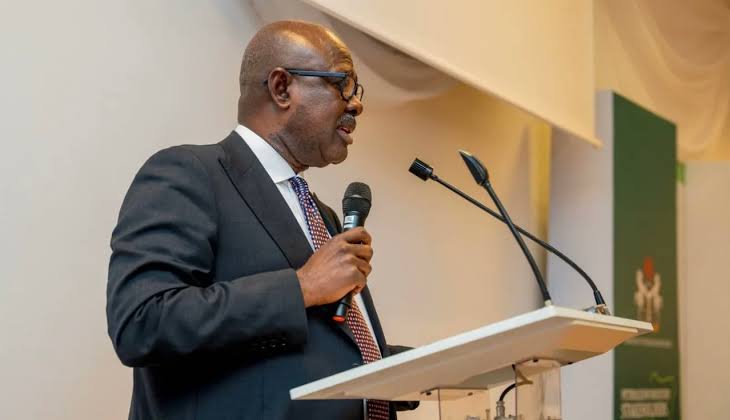


The Minister of State for Petroleum Resources (Oil), Senator Heineken Lokpobiri, has called on the Nigerian Midstream and Downstream Petroleum Regulatory Authority (NMDPRA) to move beyond mere rule enforcement and build the kind of institutional credibility that attract long-term investment, while also putting operators on notice that deregulation cannot become a cover for consumer exploitation.
Speaking at the 2026 edition of the NMDPRA’s General Counsel and Legal Advisers Forum on Monday in Abuja, the minister said compliance with the law is the floor and the ceiling.
“For too long, the dominant question in our regulatory conversations has been: are operators complying?, he said. That question matters. It will always matter. But it is no longer sufficient. The more consequential question today is this: are our regulatory authorities doing their job? Is it clear ,consistent, and predictable enough to give investors the confidence they need to commit capital, not just for one cycle, but for the long term?”
The forum, themed, “Beyond Compliance: Driving Regulatory Certainty and Investment Confidence in Nigeria’s Petroleum Sector”, brought together general counsel and legal advisers from licensed petroleum operators for what the Authority described as a two-day platform for dialogue between the regulator and industry’s legal leadership.
The minister raised concerns about pricing conduct in the downstream market following the recent de-escalation of tensions between the United States and Iran, a development that had been expected to ease global crude prices.
“Following the de-escalation of tensions between Iran and the United States, we expected to see commensurate downward adjustment in the prices of PMS and other petroleum products. However, that has not yet happened,” the minister said, adding that the regulator had a statutory responsibility under the Petroleum Industry Act (PIA) to ensure that deregulation does not become an avenue for profiteering.
He also raised the issue of product measurement, directing the regulator’s attention to ensuring consumers receive the correct volumes of fuel they pay for. “When someone pays for 10 litres of Premium Motor Spirit, they should receive exactly 10 litres, not less,” he said.
The minister told the assembled legal advisers that they occupied a uniquely influencial position in the sector, sitting at the intersection of law and commercial reality, and urged them not allow legitimate legal caution to harden into obstruction.
“Do not become stumbling blocks,” he said. “We will not be judged by the number of regulations we produce. We will be judged by the investiments we attract, the businesses we enable, and the jobs we create.”
The forum also marked the first public appearance of the newly appointed Authorrity Chief Executive of the NMDPRA, Mallam Abdullahi Umar, who used his welcome address to outline the regulatory philosophy he intends to bring to the role.
Describing the forum as a listensing platform rather than one-way communication channel, the new chief executive acknowledged that implementation challenges exist within the curent framework and that areas of ambiguity sometimes arise even in well-designed regulatory ssytems.
“I stand before you all today to make a commitment that the Authority will continue to engage openly with stakeholders, act transparently, regulate fairly and consistently, and remain responsive to the realities of an evolving industry,” he said.
Mallam Umar framed the ultimate ambition of the forum, and of the Authority’s regulatory approach, as building a petroleum sector that is “not only compliant, but competitive; not only regulated, but trusted; not only operational, but investable.”
The forum was scheduled to run over two days, covering six sessions on topics including regulatory certianty and investment confidence, institutional coordination, investment pathways, energy security, midstream development, and host community implementation under the PIA.