

Federal Ministry of Health and Social Welfare is set to establish a Brain Health Desk under the National Mental Health Programme, commence the development of its first National Brain Health Agenda and commemorate the World Brain Day annually.

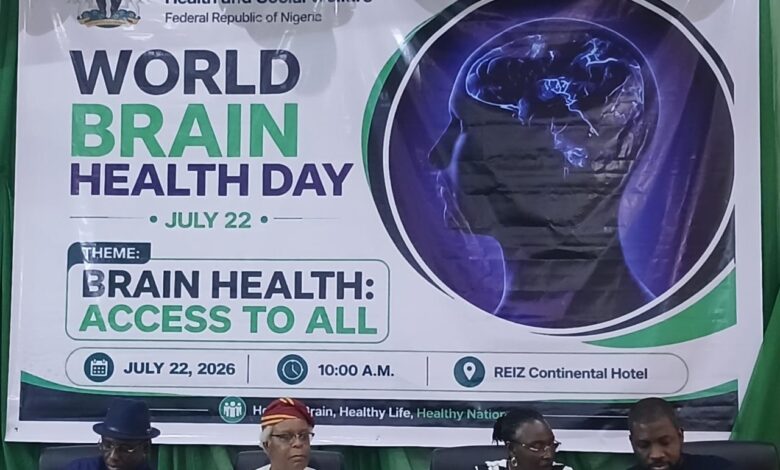
Permanent Secretary of the Ministry, Ms. Daju Kachollom disclosed this at the commemoration of World Brain Day in Abuja on Wednesday.
Kachollom stated that, this year’s theme, “Brain Health: Access for All,” was a reminder that good brain health was not a privilege reserved for a few, but a fundamental component of Universal Health Coverage that must be accessible to everyone, regardless of age, gender, income or geographical location.
She disclosed that the world faces an unprecedented burden of neurological disorders. “More than 3.4 billion people, over 40 percent of the global population, are living with neurological conditions, making them the leading cause of disability worldwide. Yet, despite remarkable advances in neuroscience and medicine, millions continue to experience delayed diagnosis, inadequate treatment and limited access to specialised care,” she added.
The Perm. Sec. lamented that Nigeria was not insulated from this challenge. “Stroke, epilepsy, dementia, Parkinson’s disease, traumatic brain injuries and neurodevelopmental disorders, continue to impose a growing burden on individuals, families and our health system.
“Stroke remains one of the leading causes of death and long-term disability while dementia is a rising concern as our population ages. Thousands of Nigerians living with epilepsy continue to face stigma, discrimination and barriers to quality care. Many neurological conditions are also accompanied by mental health challenges such as depression and anxiety, reinforcing the need for integrated, person-centred care”, she said.
She therefore announced that the Federal Ministry of Health and Social Welfare will establish a Brain Health Desk under the National Mental Health Programme to provide leadership on policy, partnerships, advocacy, research and capacity building, while coordinating efforts to strengthen prevention, early diagnosis, treatment, rehabilitation, surveillance and long-term support for people living with neurological disorders.
Additionally, she informed that Nigeria would commence the development of its first National Brain Health Agenda. “This landmark national framework will guide national priorities for brain health across the life course by strengthening governance, informing investments, promoting research and innovation, expanding workforce capacity, improving access to quality services and fostering multisectoral collaboration.
“It will also align Nigeria with the WHO Intersectoral Global Action Plan on Epilepsy and Other Neurological Disorders (IGAP) 2022-2031, while reflecting our unique national realities and priorities”, Kachollom said.
She also disclosed that the Ministry will henceforth include World Brain Day in its calendar of annual national health commemorations inorder to sustain national awareness and advocacy.
This, she explained was aimed at creating a Nigeria where every person had equitable access to quality brain health services; where neurological disorders were prevented wherever possible, detected early, treated effectively and managed with dignity and compassion.
On his part, The Director of Public Health, Dr. Charles Nzelu urged that brain health should be prioritized as many human functions are dependent on it.
Meanwhile, the Chairman, Mental Health Technical Working Group, Prof. Oye Gureje noted that, “Brain health: Access to all” means creating the opportunity for people with brain health conditions to receive treatment early.
According to Prof. Gureje, “only about 20% of people who have mental health conditions in Nigeria know about their conditions or receive any kind of treatment. The same goes for stroke, the same goes for Parkinson disease. The idea is to try and raise awareness. So creating access means raising an awareness so that people know that they have the condition, but also for government to create the opportunity for early intervention and effective treatment”.